

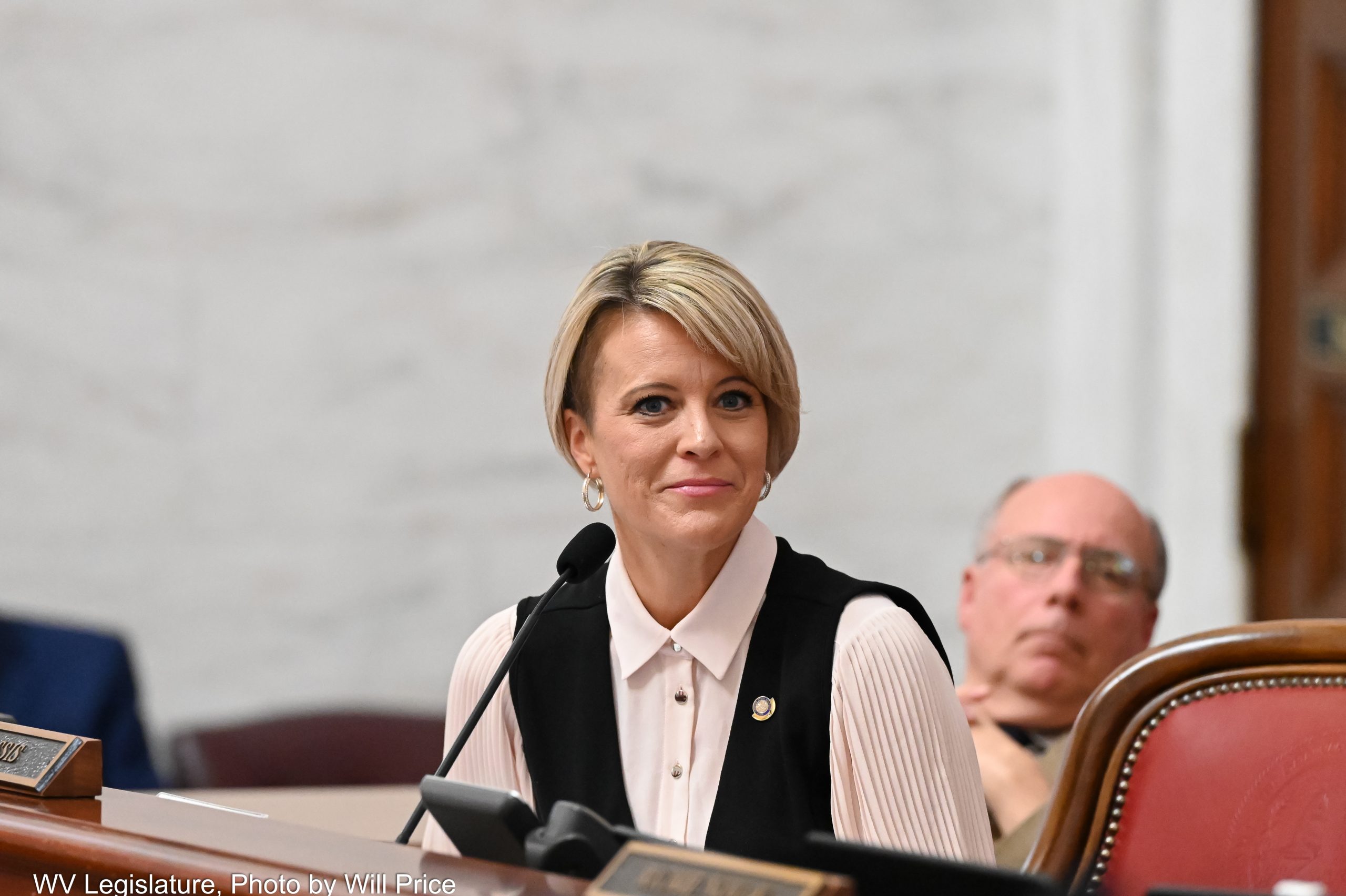
The Joint Standing Committee on Education met this afternoon to hear updates from West Virginia educational organizations.
To start the meeting, Monica Beane, head of educational partnerships for ETS, and Lisa Colon-Durham, director of educational partnerships for ETS, spoke about the nonprofit and provided information on new routes for educators to take the PRAXIS exam. These routes include programs such as Free After Three, Praxis Bridge, and Praxis Steps.
The ETS’ Free After Three program allows candidates to retake the Praxis exam free of charge after their third failed attempt. Colon-Durham said this reflects the program’s commitment to future educators who demonstrate resilience and to alleviating financial barriers for aspiring educators. Praxis Bridge offers candidates who scored within one point of the standard error of measurement an alternative to the exam. Candidates who are eligible for Praxis Bridge can instead opt for a professional module that covers the content, provides study materials, and assesses their understanding.
Praxis Bridge was officially deployed in February of 2025 for elementary education, but West Virginia piloted the program in November of 2024. Following elementary education, Praxis Bridge launched in multiple subjects over the course of 2025.
In addition to these programs, ETS will be introducing Praxis Steps with the new Elementary Education Fundamentals Test in the spring of this year. Praxis Steps allows for educators to have flexibility, targeted retakes, and provides more ways for educators to succeed.
The next presentation was given by the June Harless Center at Marshall University, featuring Tarabeth Heineman, executive director; Maggie Luma, chief of staff; and Kelly D. Bradley, dean of the College of Education and Professional Development.
Luma presented a sample of programs that the June Harless Center provides to the state. The Harless Center received this year $100,000 to support early childhood language. The Harless Center has also taken over the Dolly Parton Imagination Library in West Virginia.
In West Virginia, 56% of eligible children are enrolled in the program. Luma said this equates to 49,000 children in West Virginia.
Since 2019, 3,672,299 books have been delivered to children in the state.
According to Heineman, the Center came not only to present their programs, but also to share the impact of funding cuts from previous years.
In 2008, the state funding for the June Harless Center was established at $300,000. In 2014, the funding amount was cut to $274,889. In 2025, the state funding for the Center was zeroed out.
Heineman said that with this most recent funding cut, the Center’s educator reach has dropped by 62% for their STEAM team.
Following the June Harless Center presentation, the Mountaineer Mathematics Master Teachers organization (M3T) presented its goals and its past and current reach. This information was presented by Joanna Burt-Kinderman.
From 2020 to 2026, the M3T Network had 42 leaders across 29 districts, and teachers participating from 37 districts. The network also included upwards of 300 teachers in local improvement teams and served over 30,000 students.
The M3T is looking towards the future with goals of increasing teacher retention, supporting teachers across district lines, promoting teacher agency, and sustaining investment in WV.
Next, the West Virginia Public Education Commission shared programs like STEAM TAC, Sparking Early Literacy, and Teachers’ Ascend. The WVPEC was represented by Donna Peduto, executive director, and Canyon Lohnas, program specialist.
STEAM TAC is a program that offers classroom visits and professional learning opportunities, enhances STEAM learning through hands-on immersions led by STEAM specialists, and, since the beginning of the program, has reached 63,000 students and 900 teachers in all 55 counties.
Lohnas said with their newest program, Teachers’ Ascend, they aim to alleviate the teacher shortage in West Virginia. During the 2024-2026 Pilot Program, 11 new teachers began working in West Virginia.
Lohnas said outside of alleviating the teacher shortage, the WVPEC is looking forward to exploring sustainable funding models, expanding to high shortage areas, and advocating for systems-level changes.
Sparking Early Literacy funds projects in school readiness; each project in phase 3 demonstrated success and has secured funding for continuation. Over the course of the program, 27 unique projects have impacted 5000 students across 24 counties and have brought a $1.3 million investment to West Virginia.
