

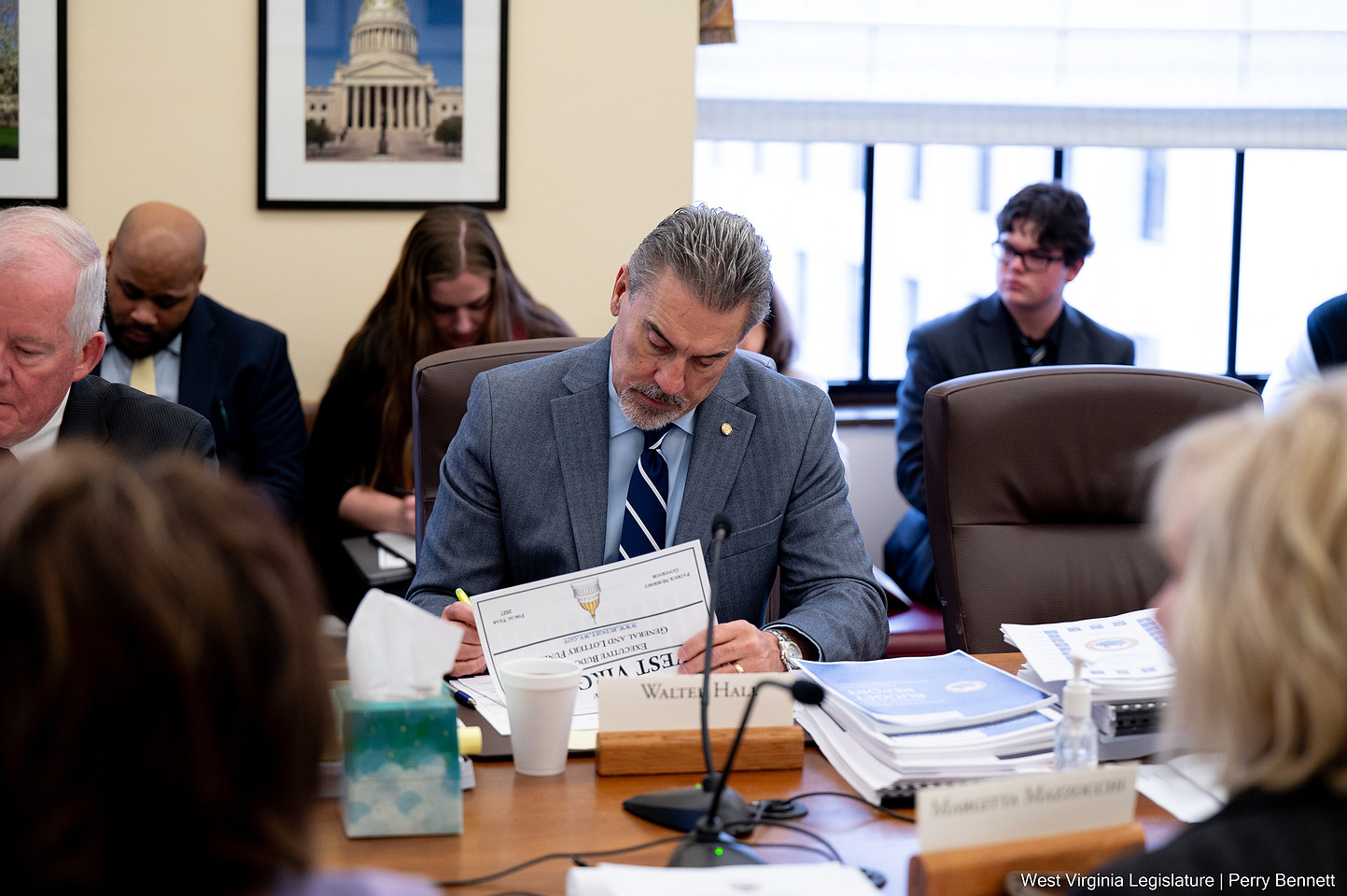
The House Finance Committee met this morning. A committee hearing was held on House Bill 4028, which would provide contractors of school facilities with a tax exemption on construction materials. Currently, sales taxes are imposed on School Board Authority projects. The removal of the 6 percent sales tax will increase the SBA’s purchasing power. There will be a reduction in costs because sales tax revenue can be redirected to other projects. This removal will stretch bond dollars for projects, as construction workers will no longer need to include a tax buffer in their calculations.
The committee also heard a budget presentation from the Higher Education Policy Commission (HEPC) and the Community and Technical College System (CTCS).
Higher education in West Virginia is affordable and attainable. Chancellor Sarah Tucker stated WV’s higher education system is meeting current and future needs of WV, its citizens, and its economy.
The nine community and technical colleges have an annual enrollment of 19,839 students. Of these students, 52 percent are part-time, 94 percent are WV residents, 48 percent receive financial aid, and the average age is 26. The 12 baccalaureate and Medical Institutions have an annual enrollment of 63,690 students. Of these students, 49,864 are undergraduate students, 57 percent receive financial aid, 66 percent are WV students, and the average age is 21.
HEPC is requesting $519,968,668 for FY27, and CTCS is requesting $ 91,396,984 for FY27. For FY26, the HEPC is requesting $290,531 for the Dual Enrollment Program. FY27 improvement request funding totals $12,575,269 for the Dual Enrollment Program, Capital Projects/Deferred Maintenance, and WV Invests Programs.
The Dual Enrollment Program allows students to get a head start in higher education. The additional funding allows students who normally wouldn’t be able to take these courses to take them. The program will be limited to juniors and seniors with a limited number of courses. The WV Invest Grant Program has seen growth over the past two years in degree production and credentials awarded in fields like allied health, education, information technology, hospitality, and tourism. Many Invest students are graduating without student loan debt.
The HEPC will continue to work on increasing college-going rate, attainment rate, and awareness of affordability. There are opportunities to increase accessibility by flattening financial aid and providing medical student loans.
