

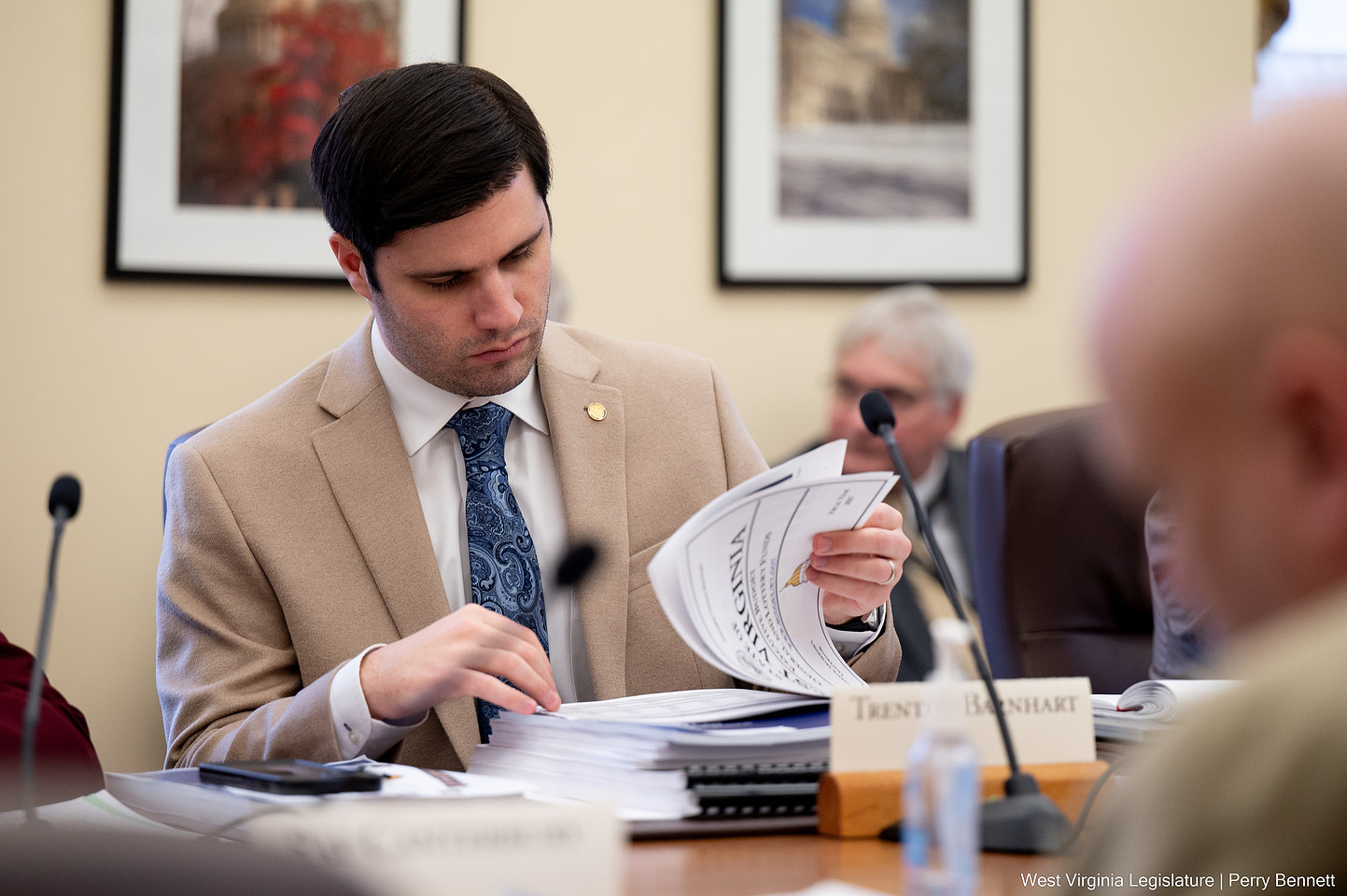
The House Finance Committee met this morning.
Markup & Passage
House Bill 4028 removes the sales tax on construction materials used to build public school facilities. The bill was advanced to the floor.
Then, the committee heard a presentation from the State Auditor Mark Hunt. The agency collected $10 million more than the previous year and saved $153,000 by consolidating leases. The agency did enter a new contract for the WV checkbook. The Fraud Prevention Unit located $190,000 of fraud. This service is an unfunded mandate, as the agency provides it and often receives no payment for it. Restitution is sometimes ordered, but often not provided. The expansion of P-card use has been beneficial to the state, yielding $24 million in rebates. These rebates are then returned to the general revenue. Using the P-card saves the state the cost of checks; the Auditor said it costs about $50 per check.
The County Collection Division has seen an increase in workload and costs, as it is now the primary contact for all tax-delinquent properties in the state. Last year, the division sold 17,000 parcels. The Auditor’s Office stated that the increase in calls and administrative tasks requires a dedicated call center and additional staff to manage the more than 3,000 calls a month, auctions, and the mail-in bidding process. The Auditor’s Office was assigned this role after Senate Bill 552 passed in the 2022 Regular Session. The assignment did not come with an additional funding source. The Auditor referred to this as another “unfunded mandate.” The Office stated that they need greater spending authority to hire more people and address inflation. Raising the fees for the County Collection Division could help offset the costs.
The Auditor mentioned that his office has fewer employees than previous State Auditors and that it is 15 auditors short of the number needed to perform local government audits. He stated that the difficulty in keeping auditors is that they get trained and are poached by the private sector, since in his office, they only make $40,000 a year.
The Office stated that revenues aren’t as high as expenses, which has resulted in a few deficits, and they are working on it. The reappropriated general revenue of $253,107.36 was mostly used for payroll. To save the general revenue, the office tries to do as much as possible through its special revenue. The Auditor’s Office investment balances are about $6 million. The Governor’s budget does provide for an increase in spending authority for personnel services and employee benefits to offset the cost of PEIA cost.
Following the Auditor’s presentation, the State Superintendent of Schools, Michele Blatt provided the Department of Education’s budget.
The Superintendent mentioned that, according to the Harvard/Stanford Education Recovery Scorecard, West Virginia jumped to 11th in increased reading growth and 6th in math growth. It’s one of four states that are consistently gaining in 3rd-grade proficiency.
The Department’s 2026 improvement requests included vocational and institutional education classroom teachers.
In the FY26 budget, the department received one-time funding for school mapping, Mountain State Digital Literacy, and educational program allowances. Ongoing funding for FY26 includes support for computer science education and higher-acuity special needs. The superintendent stated that the number of special education students continues to grow in public schools. Additionally, public schools serve students in all forms of school choice, as special education is not always available at private schools and homeschools.
The HOPE scholarship has received both one-time and ongoing funding. In the FY26 budget, the HOPE scholarship received $96,013,384 from general revenue, lottery revenue, and surplus funding.
The Department is focusing on accountability and school improvement, ensuring counties have the support they need from the state. The Department has reorganized to eliminate redundancy and streamline operations in several offices. The Department’s FY26 budget was cut by around $8.5 million.
The Department of Education’s FY27 requests include $2 million for school safety, $60,000 for the Math Counts Program, and $3 million for digital AI tutoring. For FY27, the department’s improvement requests include pay raises for vocational and institutional education classroom teachers and additional funding for school safety.
The Superintendent offered an update on Hancock County Schools. The State Department of Education has been in the county and is conducting a full audit and investigation into what happened. They’ve only been there since Friday. It was found that there were several contract issues, as the county was over the state aid formula for staffing. Additionally, it’s been found that the county provided bonuses, which is illegal under the State Code. Many failures are attributed to incorrect use of WVEIS, which prevented data from being provided to the state level for issue flagging. WVEIS was rolled out in the early 1990s, and the department does believe an updated system would be beneficial to the state. There is a bid process for a new system; funding will be needed for implementation and annual maintenance. One of the Department’s financial officers stated, “Replacing the system is imperative for transparency.”
The reason these issues were not caught sooner was that in FY24, the County BOE had a surplus of about $5 million and appeared to be doing well financially. However, with more than 140 positions over formula, the county spent about $10 million of its local budget in FY25. The fiscal officer stated that the County had been alerted about being over formula and that the board should find a way to fund or reduce the force. However, the county did not take action, which resulted in a $7 million cost.
The fiscal officer stated that there is currently no forensic audit to determine criminal intent, as the State just took over the county’s BOE and is still in the internal audit process. However, if information is found and a forensic audit is required, it will take place.
