

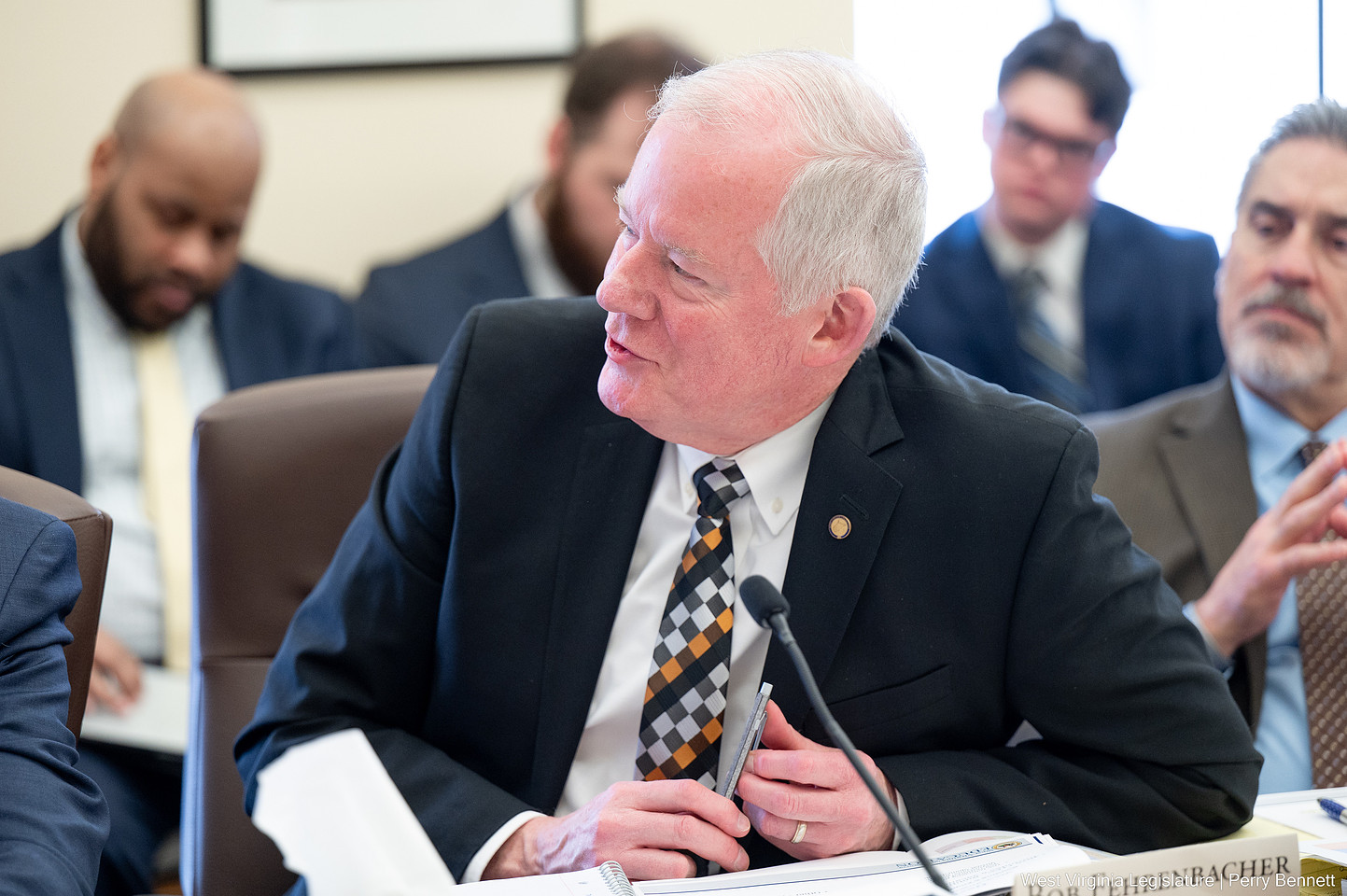
House Finance met this morning for budget hearings and to consider House Bill 4004.
House Bill 4004 establishes the Recharge West Virginia Program, which would reimburse employers for upskilling their workforce. To qualify, the employee must receive a 25 percent wage increase for the upskilling training.
Next, the committee heard budget hearings.
The Department of Health presented first. The core agencies under the Department of Health include the Bureau for Public Health, Office of the Chief Medical Examiner, the Healthcare Authority, Center for Threat Preparedness, the Office of Emergency Medical Services, and the WV Rural Health Transformation Program.
The WV Rural Health Transformation Program provides a foundation for improving health outcomes, expanding access to care, and strengthening families and communities throughout the state. The state secured $199 million. The Office of Emergency Medical Services provides emergency care to citizens in the state. The OEMS protocols have been updated to align with national best practices. The first-time EMS pass rates rose to the 80th percentile. The office has expanded the statewide whole-blood program, allowing teams to provide lifesaving support in the field. Additionally, the office also launched the HOSPITAL Hub, which provides seamless exchanges of patient care records.
The WV Center for Laboratory Sciences is planned for construction in South Charleston. The building will house the Office of the Chief Medical Examiner, the Office of Laboratory Services, the State Police Forensics Laboratory, the Department of Labor’s Weights and Measures Laboratory, Marshall University Laboratory, and West Virginia University Laboratory. Construction bids were due on January 27th, and the opening bid is scheduled for February 19. Completion of the structure is estimated for June 2028.
The Department’s FY27 budget is $572,733,881, with $100,196,582 being funded from state general revenue. The majority of the Department’s budget is federal funding.
The Department of Human Services presented last. The Secretary’s Priorities are set in eight pillars: Pillar 1: Ensure Fiscal Responsibility and Long-Term Sustainability, Pillar 2: Reduce Foster Care Population, Pillar 3: Eliminate Out-of-State Placements, Pillar 4: Strengthen Kinship and Foster Families, Pillar 5: Build a Stable and Qualified Workforce, Pillar 6: Leverage Technology and Al for Better Outcomes, Pillar 7: Increase Private Sector, Community, and Faith-Based Partnerships, and Pillar 8: Increase Foster Family Recruitment and Retention Rate.
The Department’s FY27 budget total is $8,901,799,016, with $1,186,916,906 coming from state general revenue. The majority of the budget is funded through federal money. The department is requesting $40,660,990 in improvements for time studies and CHIP shortfall.
The agencies within the Department of Human Services include the Bureau of Medical Services, Bureau for Family Assistance, Bureau for Social Services, Bureau for Behavioral Health, Office of Drug Control Policy, and the Bureau for Child Support Enforcement.
