

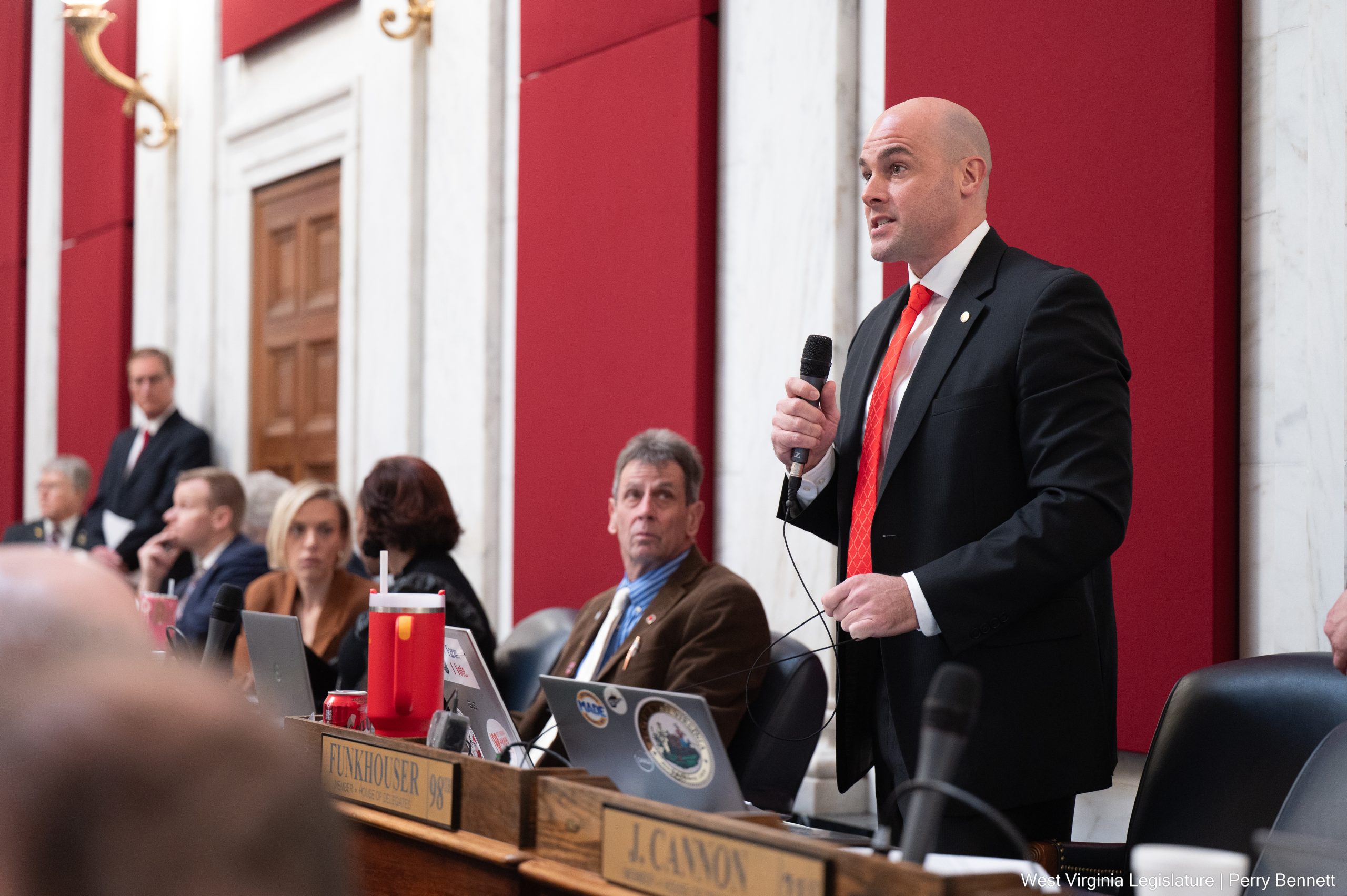
The West Virginia House of Delegates honored former speaker and advanced six bills to the Senate.
The House adopted the House Concurrent Resolution 14 to honor the life and public service of former Speaker of the House Tim Armstead. He served in the West Virginia House of Delegates from 1998 to 2018. He served as minority leader from 2006 until 2014. In 2015, he was elected Speaker of the House and re-elected in 2017. On September 25, 2018, Armstead was appointed to be a Justice on the West Virginia Supreme Court of Appeals. He was elected in a special election in 2018 to retain the seat for the remainder of the term. In 2020, he was elected to a 12-year term, which began in 2021.
House Bill 4865 would create a program allowing juniors and seniors, as well as homeschool students, to serve as poll workers.
The bill’s sponsor, Delegate Joe Funkhouser (R – Jefferson, 98), said the purpose of this bill is to increase civic engagement by allowing 16-to 17-year-olds to work as poll workers for elections.
These high school juniors and seniors would be tasked with checking signatures on ballots and deciding whether a provisional vote is needed, in addition to any other duties a poll worker might be assigned. Young poll workers who join this program would also have to establish a party affiliation.
In discussion, Delegate Evan Hansen (D – Monongalia, 079) shared concerns about the amount of responsibility being placed on 16-to 17-year-olds and the possibility of ill intent. Other delegates shared similar concerns.
Funkhouser said ill intent can happen regardless of age, and penalties are in place for anyone who attempts to tamper with an election. Upon being asked by Delegate Tresa Howell (R – Kanawha, 52) about the penalties a minor might face if they are found guilty of election tampering, Funkhouser said they would face the same penalties as an adult would with election tampering.
Delegate Daniel Linville (R – Cabell, 22) asked Funkhouser whether these poll workers would have adult supervision, and he said they would be under supervision, as current poll workers are.
House Bill 4996 would create mandatory bail conditions for people charged with making terrorist threats against a school. These bail conditions include, but are not limited to, establishing no contact with anyone associated with the school that was threatened, GPS monitoring, and home incarceration within 1000 feet of the school.
In discussion, Delegate Sean Hornbuckle (D – Cabell, 25) said he liked the intent of this bill but believes it needs work and that it isn’t perfect.
In response, Delegate Rick Hillenbrand (R-Hampshire, 88) said that “perfect is the enemy of good enough” and supported this bill.
Delegate Kayla Young (D – Kanawha, 056), following a couple of concerns with language about the bail order, said she was in favor of the bill but hopes it gets work in the Senate.
House Bill 5096 would remove personal care services and intellectual developmental disabilities services from the certificate-of-need requirement.
Delegate Mike Pushkin (D – Kanawha, 54) proposed an amendment to the bill that would remove the moratorium around methadone clinics.
Pushkin said his amendment does not change the bill’s original intent and addresses a moratorium enacted years ago by the legislature.
Delegate Evan Worrell (R – Cabell, 023) said he urged rejection of this amendment, which would allow more methadone clinics to open quickly, and he believed the moratorium should remain in place.
This amendment failed.
In addition to passing bills, the House engaged in a lengthy discussion on data center water usage, with two proposed amendments.
House Bill 4983 would allow the Department of Commerce to adopt a legislative rule for the certification of a microgrid or a high-impact data center.
Two conflicting amendments were proposed.
Delegates Henry C. Dillon (R – Wayne, 29) and Chris Anders (R – Berkeley, 97) proposed an amendment that would include provisions that would regulate the certification process for high-impact data centers. Some of these provisions include a 500ft buffer zone between a data center and a school, home, or church, prohibit the transportation of groundwater in a tanker, require a hydrogeologic study, and many others.
Multiple delegates shared concerns about this amendment, specifically regarding the number of provisions and denials imposed on high-impact data centers. In addition, delegates worried about the number of changes it would make and whether it pertained to the bill. Some delegates also shared concerns about unnecessary burdens being placed on economic development.
Delegate Hansen et al. proposed an amendment that would require data centers, before approval, to report where they obtain their water, the current use of that water, and how these withdrawals will affect communities.
This amendment failed with a vote of 6 to 87.
In discussing this amendment, Delegates said they understood the concerns and intent, but some believed it did not pertain to the rules bill. Delegates also said that, currently, our laws permit water withdrawal and quantity.
This amendment failed with a vote of 23 to 70.
Bills introduced can be found here.
Resolutions introduced can be found here.
Committee Meetings, Today February 16
- Government Organization at 3 p.m. in Room 215E
- Education at 3 p.m. in Room 432M
- Energy and Public Works at 5 p.m. in Room 410M
- Health and Human Resources at 5 p.m. in Room 215E
Committee Meetings, Tuesday February 17
- Finance at 9 a.m. in Room 460M
- Judiciary at 9 a.m. in Room 410M
- Sub. Com on Legal Services at 9:45 a.m. in Room 410M
- Sub. Com on Homeland Security at 10 a.m. in Room 410M
- Sub. Com on Courts at 10:15 a.m. in Room 410M
- Rules at 10:45 in the Speaker’s Conference Room
- Sub. Com on Local Government at 1 p.m. in Room 215E
- Sub. Com on Government Administration at 1:30 p.m. in Room 215E
- Sub. Com on Public Education at 1 p.m. in Room 432M
- Education at 1:30 p.m. in Room 432M
- Health and Human Resources at 3:30 p.m in Room 215E
The House is adjourned until 11:00 a.m. Tuesday, February 17, 2026.
