

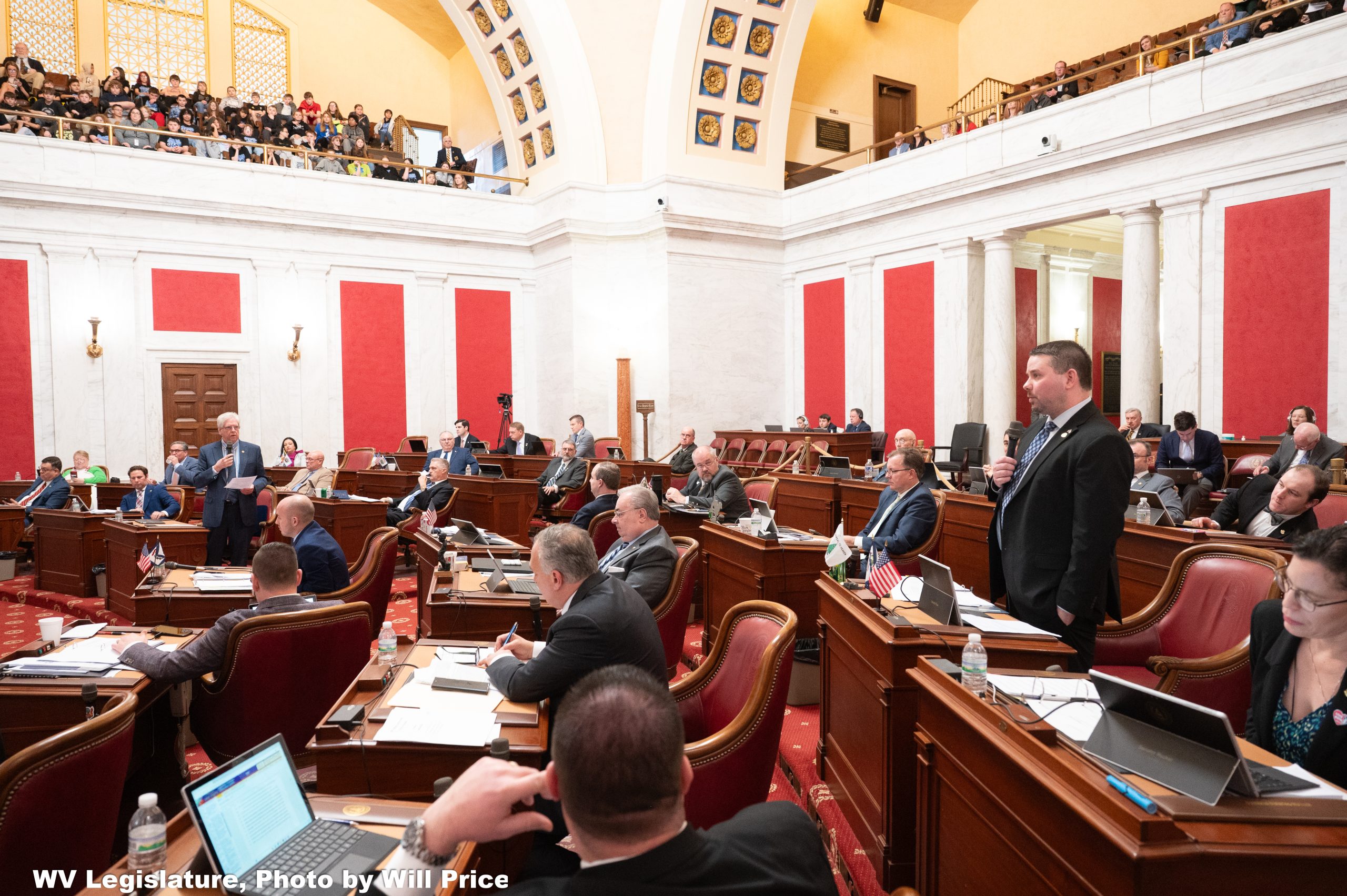
The Senate met on Wednesday morning and advanced 32 bills on Crossover Day.
Senate Bill 420 would establish the West Virginia First Energy Act.
The act would require utilities to do the following:
- Coal Use: Coal plants must hit a 69 percent utilization rate; gas plants back them up.
- Plant Closures: Utilities need PSC and PEA approval before retiring or reducing any coal or gas plant.
- Renewables: Wind and solar projects are limited unless they don’t raise rates or hurt reliability.
- Fuel Security: Utilities must keep a 30-day fuel supply for emergencies.
- Oversight: Utilities submit annual operational plans covering fuel, upgrades, and maintenance for review. `
Senator Tom Takubo (R – Kanawha, 17) questioned whether the bill functions more as a mandate than a policy framework, warning it could lead to unintended consequences.
He stated that tying rate recovery to a required utilization target and restricting cost recovery for certain energy sources could ultimately increase electric bills if utilities are required to run higher-cost coal units rather than relying on market-based generations.
He also expressed concern that the bill narrows future flexibility by limiting when utilities may retire or decommission coal or natural gas plants, potentially “handcuffing” long-term energy planning as markets and technology evolve.
Senator Chris Rose (R – Monongalia, 02) stated that the bill is not a mandate, but a reliability measure intended to protect West Virginia’s energy independence.
He stated that the legislation would push back against what he describe as a continued “war on coal” by ensuring coal-fired plants remain operational and competitive.
He argued that by setting a 69 percent utilization goal and requiring regulatory approval before plant retirements, it would provide stability, preserve jobs, and prevent over-reliance on out-of-state or intermittent energy sources.
Senate Bill 590 would make it a criminal offense to perform an adult cabaret where it could be seen by a minor.
The bill defines “adult cabaret performances” as a performance in a location other than an adult cabaret that features topless dancers, go-go dancers, exotic dancers, strippers, male or female impersonators who provide entertainment that appeals to the prurient interest, or similar entertainers, regardless of consideration.
A first violation would be a misdemeanor, while a second offense would be a felony punishable by up to five years in prison and a $25,000 fine.
Supporters of the bill state it provides clear rules for adult entertainment venues, helping local authorities regulate safety while protecting community standards and public decency.
Senator Joey Garcia (D – Marion, 13) raised concerns that the language of the bill could leave too much for the courts to interpret. He questioned whether the bill might go beyond protecting children and instead regulate public expression, including theater performances like Shakespeare, where male actors play female roles, potentially putting public entertainment at risk.
Senate Bill 641 would update West Virginia’s Aboveground Storage Tank Act.
The bill sets rules for classifying and regulating tanks near public water sources, creating Level 1 and Level 2 tanks based on size, location, and contents. Existing tanks in newly designated zones get nine months’ notice before new rules apply. Most small or industrial tanks are exempt but must still register and post signs.
“This bill weakens standards for clean drinking water,” stated Senator Mike A. Woelfel (D – Cabell, 05), noting that some aboveground storage tanks contain hazardous materials like lead, and argued that lowering protections puts West Virginians at risk. He stated that although he supports natural gas industries, he warned that this approach to water safety is a mistake for the state.
Supporters of the legislation state that it strengthens oversight by regulating tanks based on their risk profile. They note that exempted tanks aren’t considered hazardous, while both Level 1 and Level 2 tanks remain regulated and must have secondary containment. They also state that the bill provides relief from regulations for small “mom and pop” business owners and natural gas operators in West Virginia.
Senate Bill 963 would require a full court hearing before someone can be barred from having guns under a protective order. The hearing must include the respondent, their lawyer, and clear evidence that they pose an immediate danger.
The bill allows the respondent an automatic appeal if their firearms are restricted. All other parts of the protective order, such as banning abuse, harassment, stalking, or threats, would stay in effect.
The gun restrictions may only be applied when the court finds convincing evidence of immediate danger to the petitioner and cannot be used for punitive purposes.
Senator Ryan W. Weld (R – Brooke, 01) raised concerns about domestic violence victims being at risk due to the legislation. Noting that between the filing of an emergency protective order and the full hearing, petitioners face a 5 times higher likelihood of being a victim of domestic violence or killed. “In the name of domestic violence, I rise in opposition to the bill,” he stated.
Supporters of the bill state that the legislation protects respondents’ legal rights while still allowing courts to act in cases of confirmed domestic violence.
Senate Bill 805 would allow the Mothers and Babies Pregnancy Support program to cover the expenses associated with the abortion pill reversal.
The West Virginia Mothers and Babies Pregnancy Support Program is a state program housed within the Bureau for Public Health that provides funding to pregnancy help organizations across the state and will not provide funding to any abortion industry organizations.
The bill defined “abortion pill reversal” as the use of progesterone by a licensed health care provider for the purpose of counteracting the effects of ingested mifepristone as part of a chemical abortion.
The term “chemical abortion” is defined as the use or prescription of an abortion-inducing drug dispensed with the intent to cause an abortion. Further definitions in the bill can be found in code: §16-66-1.
The bill is intended to allow women who decided no longer to follow through with an abortion to reverse the abortion using the medication.
It has not been proven by a major medical organization or by scientific evidence that the medication reverses abortions. Members of the body stated witnessing and hearing successful stories of women using the medication to reverse an abortion.
Senator Joey Garcia (D – Marion, 13) raised concerns that the bill is politicizing healthcare. He noted that the American Congress of Obstetricians and Gynecologists described these procedures as “unproven” and “unethical” and could lead to heavy bleeding or other complications if medication is not taken as intended.
Supporters of the bill state that they have witnessed and heard successful stories of women using the medication to reverse an abortion and have faith in its positive impact.
All bills on third reading passed the full Senate and were sent to the House of Delegates for consideration.
Afternoon Meeting:
Banking and Insurance at 2 p.m. in Room 451M
Judiciary at 3 p.m. in Room 208W
Morning Meetings for March 5:
Education at 9:30 a.m. in Room 451M
Government Organization at 9:30 a.m. in Room 208W
The Senate is adjourned until tomorrow at 11 a.m.
