
Tuesday, June 23, 2026
Home Blog Page 11

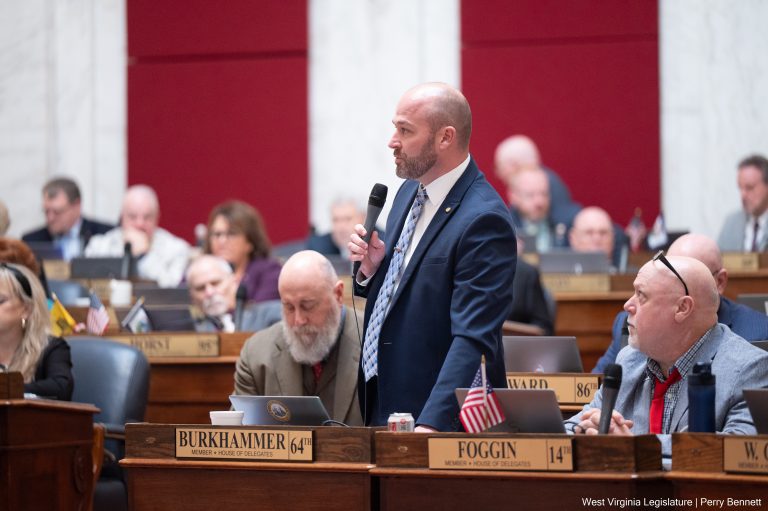
House Advances Three Election Bills

The West Virginia House of Delegates advanced several bills to the Senate, including the following:

Senate Bill 640 would prohibit the release of a political donor’s address and employer in FOIA requests. Under this bill, FOIA requests would still allow for the name of the person and their occupation.

House Bill 5228 would change the definition of electioneering. Under this bill, electioneering is now defined as “visible display or audible dissemination of information that advocates for or against any candidate or ballot question.” This bill was reported to the floor.

In addition to the change of definition, this bill describes prohibited activities, permitting election officials and county employees to enforce election laws, and permitting said people to seek assistance from law enforcement. Prohibited activities include, but are not limited to, displaying a candidate’s likeness, logo, committee name, a ballot question’s number, or paraphernalia in support of a candidate.

This bill passed with a vote of 80 to 13.

House Bill 5273 would require county and municipal campaign finance activities to be published online within 48 hours of the deadline and require municipal candidates file their campaign finance reports with their respective County Clerk.

House Bill 4958 would create the Southern Coalfield Resiliency and Revitalization Program. This program would identify resources that are available to support the Southern counties and the coalfields within them; these counties include Boone, Logan, McDowell, Mingo, and Wyoming.

Delegate Henry C. Dillon (R – Wayne, 29) proposed an amendment that would change the name of the act and add coke-producing facilities to support the steel manufacturing industry. This amendment failed with a vote of 48 to 48.

In addition to the passage of bills, House Bill 4335, House Bill 4982, and Senate Bill 309 have completed legislative action.

Committee Meetings, Today, February 20

Committee Meetings, Monday, February 23

The House is adjourned until 11:00 a.m. Monday, February 23, 2026. 

House Finance Advances Four Bill in Morning Meeting

0

House Finance met this morning and considered four bills on markup and passage.

House Bill 4006 is an economic development bill that targets the aerospace industry to build a stronger aerospace workforce in West Virginia.

House Bill 4126 requires royalties from state-owned oil, gas, and other mineral rights to be deposited into the State Parks and Recreation Endowment Fund.

House Bill 4390 temporarily increases the subsidy payment to kinship parents to an amount equal to foster parent subsidies.

House Bill 4981 establishes that a psychiatric hospital with an average annual inpatient census patient mix of greater than 95 percent of court-ordered forensic and civil involuntary commitments from state custody or from a state-owned hospital qualifies as a “state-designated facility” for purposes of the statute.

House Energy and Public Works Advances Three Bills

0

The House Energy and Public Works Committee met this afternoon.

Markup & Passage

House Bill 4481 enhances the accuracy and transparency of the WV Load Forecasting by the Public Service Commission with oversight for submissions to PJM.

House Bill 4971 requires that certain high-voltage transmission lines be located near industrial parks.

House Bill 5492 establishes guidelines for advanced purchase agreements for electric substation transformers to accelerate economic development projects. The bill was amended and advanced to the Finance Committee.

Committee Hearing

House Bill 5626 establishes rates for and the recovery of costs by public utilities. The bill also allows the elective submission of future test-year data in certain utility reports. The bill requires the commission to rely on certain submitted data in rate cases.

House Bill 5651 creates a statewide microbusiness support and simplification program. It creates non-lapsing funding, provides grants, and establishes revolving microloan support options.

House HHR Tables One Bill, Advances Another

0

The House Committee on Health and Human Resources met this evening.

House Bill 5582 would extend the program for drug screening of applicants for TANF to December 2030. This bill was reported to the floor.

House Bill 4359 would exempt existing West Virginia hospitals from needing a new certificate of need to move their facility up to 10 miles to a new location. After concerns in the hearing phase about possible statewide complications, this bill was tabled.

House Bill 5625 would change the requirements for the license of radon mitigators, testers, contractors, and laboratories. Under this bill, no building contractor may build an radon resistant new construction home without using a licensed radon mitigation specialist or radon mitigation contractor. This bill was advanced to markup and discussion.

House Bill 5476 would require a health care provider that maintains electronic health care records to preserve and maintain each entry in its original form and record an audit trail of any additions, deletions, or revisions to the health care record. This bill would also allow patients to, if they find any information in their chart, request that corrections be made. This bill was advanced to markup and discussion.

House Bill 5569 would reinstate the discount on Public Employees Insurance for retired firefighters hired after 2010. This bill was moved to markup and discussion.

Senate Bill 231 would require the Bureau for Medical Services to establish standard billing codes for all substance-abuse disorders. This would analyze these billing codes to determine trends, costs, and outcomes for substance-abuse disorders.

This bill would also establish value-based treatment programs for substance-abuse disorders. These programs would reward providers for quality and cost-effective care that leads to sobriety for substance-abuse and reduce payments to providers who fail to meet the expectations in the bill. The intent of this is to pay for patient health outcomes rather than the service fees. This bill was advanced to markup and discussion.

House Bill 5260 would allow regulated medical cannabis processors to manufacture medical cannabis as edibles for patients, and requires dispensaries, after dispensing medical cannabis, to report the information into the controlled substance monitoring database. This bill was advanced to markup and discussion.

Senate Judiciary Approves Judicial Deference Reform Bill

0

The Senate Judiciary Committee met Thursday afternoon and advanced four bills regarding the Adopting Uniform Protected Series Act, general powers of PSC, rule-making policies, and criminal penalties for the neglect or abuse of incapacitated adults.

Senate Bill 888 would stop West Virginia courts from deferring to state agencies’ interpretations of laws and regulations.

Judges and hearings officers would instead review rules independently and resolve any unclear language in favor of individual liberty and more limited bureaucratic power.

Senate Bill 669 would clarify utility rate oversight.

This bill would give the Public Service Commission clearer authority over utility rates, while limiting its reach for smaller municipal water, sewer, and natural gas utilities. The bill sets rules for resolving customer complaints within 120 days.

The bill was reported to the full Senate with a recommendation of passage.

Senate Bill 670 would establish the Uniform Protected Series Act.

Each series could hold its own assets, have its own members, and carry its own liabilities to shield one series from the debts of another. The bill also sets rules for management, reporting, and foreign series doing business in the state.

The bill was reported to the full Senate with a recommendation of passage.

Senate Bill 961 would cut redundant rules.

This bill would require West Virginia agencies to eliminate at least two existing regulations for every new rule they issue. This bill intends to reduce unnecessary bureaucracy and ensure rules are up to date with federal standards.

The bill was reported to the full Senate with a recommendation of passage, first being sent to the committee on Finance.

Senate Bill 54 would update West Virginia law to treat abuse or neglect of an incapacitated adult similarly to child abuse.

The bill defines an “Incapacitated adult” as any person 18 years or older who, by reasons of advanced age, physical, mental, or other infirmity, is unable to carry on the daily activities of life necessary to sustaining life and reasonable health.

Any person who neglects an incapacitated adult and risks bodily injury or death would be guilty of a felony and fined $1,000-$3,000 and/or imprisoned 1-5 years.

A caregiver of an incapacitated adult who abuses an incapacitated adult would be fined  $1,000-$3,000 and/or imprisoned for 1-5 years.

The bill was reported to the full Senate with a recommendation of passage.

Abortion Pill Reversal Bill Advances in Senate HHR

0
The Senate Health and Human Resources Committee met Thursday afternoon and advanced three bills regarding abortion pill reversal, protective custody services, and the Addiction Treatment Pilot Program.

Senate Bill 805 would allow the Mothers and Babies Pregnancy Support program to cover the expenses associated with the abortion pill reversal.

The West Virginia Mothers and Babies Pregnancy Support Program is a state program housed within the Bureau for Public Health that provides funding to pregnancy help organizations across the state and will not provide funding to any abortion industry organizations.

The bill defined “abortion pill reversal” as the use of progesterone by a licensed health care provider for the purpose of counteracting the effects of ingested mifepristone as part of a chemical abortion.

The term “chemical abortion” is defined as the use or prescription of an abortion-inducing drug dispensed with the intent to cause an abortion. Further definitions in the bill can be found in code §16-66-1.

The bill is intended to allow women who decided no longer to follow through with an abortion to reverse the abortion using the medication.

It has not been proven by a major medical organization or by scientific evidence that the medication reverses abortions. Members of the body stated witnessing and hearing successful stories of women using the medication to reverse an abortion.

The bill was reported to the full Senate with a recommendation of passage, first being sent to the committee on Finance.

Senate Bill 795 would permit parents, guardians, or custodians to pay for an independent evaluation if their child is in temporary protective custody.

A child could be placed in temporary protective custody for, but not limited to, the following reasons:

  • The child is without supervision or shelter for an unreasonable period, considering the child’s age and ability to care for themselves in those circumstances, presenting an immediate threat of serious harm to the child.
  • The officer determines that the child is in a condition requiring emergency medical treatment by a physician, and the child’s guardian or custodian refuses to provide the child with emergency medical treatment.
  • A child is suffering from a condition that needs emergency medical treatment, and the guardian or custodian refuses to provide the child with emergency treatment.

The bill was reported to the full Senate with a recommendation of passage.

Senate Bill 862 would repeal the Addiction Treatment Pilot Program, which is no longer in operation.

The program, previously overseen by the Department of Military Affairs and Public Safety, provided a framework for pilot efforts in treating drug addiction and required annual reporting on its progress.

The bill was reported to the full Senate with a recommendation of passage.

House Banking and Insurance Advance Five Bills to Markup

0

The House Committee on Banking and Insurance met this afternoon.

House Bill 4869 establishes a clearly defined guaranteed issue right for Medicare Supplement (Medigap) policies regardless of health status.

House Bill 5462 clarifies that if a policyholder has other insurance, the mine subsidence insurance program is only liable for up to the statutory limit of reinsurance for the portion not covered by other sources.

House Bill 5463 reduces mandatory liability minimums from $1.25 million to $1 million and eliminates the $5 million excess coverage requirement for county boards of education.

House Bill 5515 revises outdated code relating to the administration of workers’ compensation claims. It was last updated prior to 2005. The bill also repeals obsolete code.

House Bill 5521 creates application, licensure, and examination requirements for public adjusters. The bill also establishes standards of conduct that govern public adjusters.

House Education Advances Alyssa’s Law to Floor

0

The House Education Committee met this afternoon.

House Bill 4485 would allow education employees to donate sick leave to co-workers for maternity leave. This bill was advanced to the committee on Finance.

House Bill 4798 would allow teachers to choose to wear a “mobile alert button” for emergency situations. This bill would be called “Alyssa’s Law.” This bill was reported to the floor.

House Bill 5110 would adjust tuition and fee waivers to include senior citizens and senior metro area students by changing the eligibility age from 65 years to 60 years of age or older. This bill was reported to the committee on Finance.

House Bill 5412 would establish the Future-Ready Education Act. This would allow boards of education to enter into long-term contracts for textbooks to save money. This bill would also expand the Mountain State Digital Literacy Program. In addition, this bill would require educators to be trained in the science of reading program and expand the program to fourth and fifth-grade classrooms. This bill was reported to the committee on Finance.

House Bill 5438 would allow the Department of Education to retain up to $15 million to implement a uniform budgeting and accounting system to improve instructional programs. This bill was reported to the committee on Finance.

House Bill 4588 would require the State Treasurer to participate in the federal tax credit scholarship program.

House Bill 5478 would establish a pilot program to distribute preloaded early-learning touchpads to eligible preschool children to evaluate impacts on kindergarten readiness.

House Advances Baylea’s Law to Senate

The West Virginia House of Delegates advanced several bills today, including the following:

House Bill 4712 would increase the criminal penalties for DUI causing death to be known as “Baylea’s Law.” This bill would raise the prison sentence to 5 to 30 years and raise several fines in DUI cases.

House Bill 4638 would allow individuals to register as organ donors when registering to vote or updating their voter registration.

House Bill 4765 would increase the salaries for teachers, school personnel, and state police by 3%.

House Bill 4990 would create the crime of gift card fraud.

In addition to the passage of bills, several amendments were adopted during floor session, including the following:

On Senate Bill 640, Delegate JB Akers proposed an amendment to protect a campaign’s treasurer and employer to be protected like donors are in the bill.

On House Bill 4355, two amendments were proposed. Delegate Eric Brooks’ (R – Raleigh, 45) amendment would make the upland game bird stamps only required if you hunt in wildlife management areas.

Delegate Gary G. Howell’s (R – Mineral, 87) amendment would make it so people who have already bought the lifetime hunting license wouldn’t have to buy this new upland game bird stamp.

House Bill 4819 was amended by the committee on Government Organization to require the results of an arrest or charge be included in a criminal background check that is reviewed.

Resolutions introduced can be found here.

Committee Meetings, Today, February 19

Committee Meetings, Tomorrow, February 20

The House is adjourned until 11:00 a.m. Friday, February 20, 2026. 

Senate Completes Action on 2 Bills

The Senate met on Thursday morning and introduced Senate Bills 993-1014, passing several bills, including ones concerning the West Virginia Department of Environmental Protection and the Department of Health.

House Bill 4696 authorizes the West Virginia Department of Environmental Protection (DEP) to deposit certain federal abandoned mine land funds into the state’s Abandoned Land Reclamation Fund.

This bill updates state code to allow new federal funds, including those from the Infrastructure Investment and Jobs Act and the Safeguarding Treatment for the Restoration of Ecosystems from Abandoned Mines Act, to be deposited into the state’s reclamation fund.

Spending would continue to follow priorities under the Surface Mining Control and Reclamation Act of 1977, which allowed a portion to be set aside for long-term environmental treatment.

House Bill 4740 exempts the Department of Health from standard state purchasing requirements when implementing the federal Rural Health Transformation Program.

The program aims to enhance rural healthcare, modernize delivery systems, strengthen workforce pathways, and expand healthcare technology throughout the state.

Both bills completed legislative action and now head to the Governor’s desk for consideration.

Afternoon Meetings:

Health and Human Resources at 1 p.m. in Room 451M

Finance at 3 p.m. in Room 451M

Judiciary at 3 p.m. in Room 208W

Morning Meeting for Feb. 19:

Military at 9:30 a.m. in Room 208W

The Senate is adjourned until Friday, Feb. 19, at 11 a.m.