Tuesday, June 23, 2026
Home Blog Page 14

Public Education Focus of Committee Hearings

0

The House Education Committee met this afternoon. Six bills were reported from subcommittees, then the committee continued with the agenda.

Markup & Passage

House Bill 4817 changes the name of the Charters School Stimulus Fund to the Charter Schools Startup Fund. The bill requires submitting an application to the West Virginia Professional Charter School Board to receive funds from the Charter Schools Startup Fund. The bill requires specific information to be submitted with the application, expands the uses of the funds, and requires the distribution of funds to qualifying applicants. The bill allows the West Virginia Professional Charter School Board to establish a competitive process when the number of applicants exceeds funding.

House Bill 5212 updates the financial aid system for higher education to streamline the requirements for grants, scholarships, loans, and financial aid for postsecondary education programs, workforce development initiatives, and workforce grants.

Committee Hearing

House Bill 5012 allows in-year movement of school personnel to meet school needs.

House Bill 5089 allows for verifying content mastery through testing when a student enrolls or re-enrolls in a public school.

House Bill 5453 establishes a revised method of school aid funding. The bill clarifies that there is a base fund per student, a local share, and a school aid formula. The bill also establishes supplemental funding for students with special needs. Additional funding can be requested for transportation, vocational and technical education centers, alternative learning centers, and pilot programs.

House Honors Former Speaker Tim Armstead, Advances Poll Worker Bill

The West Virginia House of Delegates honored former speaker and advanced six bills to the Senate.

The House adopted the House Concurrent Resolution 14 to honor the life and public service of former Speaker of the House Tim Armstead. He served in the West Virginia House of Delegates from 1998 to 2018. He served as minority leader from 2006 until 2014. In 2015, he was elected Speaker of the House and re-elected in 2017. On September 25, 2018, Armstead was appointed to be a Justice on the West Virginia Supreme Court of Appeals. He was elected in a special election in 2018 to retain the seat for the remainder of the term. In 2020, he was elected to a 12-year term, which began in 2021.

House Bill 4865 would create a program allowing juniors and seniors, as well as homeschool students, to serve as poll workers.

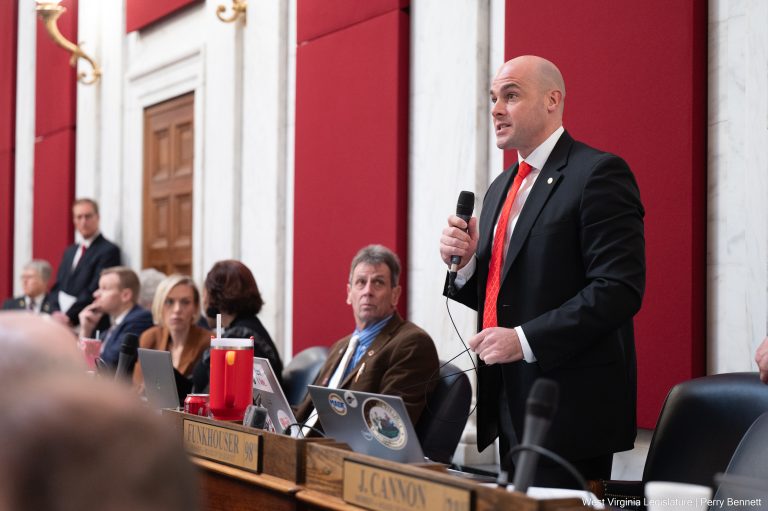
The bill’s sponsor, Delegate Joe Funkhouser (R – Jefferson, 98), said the purpose of this bill is to increase civic engagement by allowing 16-to 17-year-olds to work as poll workers for elections.

These high school juniors and seniors would be tasked with checking signatures on ballots and deciding whether a provisional vote is needed, in addition to any other duties a poll worker might be assigned. Young poll workers who join this program would also have to establish a party affiliation.

In discussion, Delegate Evan Hansen (D – Monongalia, 079) shared concerns about the amount of responsibility being placed on 16-to 17-year-olds and the possibility of ill intent. Other delegates shared similar concerns.

Funkhouser said ill intent can happen regardless of age, and penalties are in place for anyone who attempts to tamper with an election. Upon being asked by Delegate Tresa Howell (R – Kanawha, 52) about the penalties a minor might face if they are found guilty of election tampering, Funkhouser said they would face the same penalties as an adult would with election tampering.

Delegate Daniel Linville (R – Cabell, 22) asked Funkhouser whether these poll workers would have adult supervision, and he said they would be under supervision, as current poll workers are.

House Bill 4996 would create mandatory bail conditions for people charged with making terrorist threats against a school. These bail conditions include, but are not limited to, establishing no contact with anyone associated with the school that was threatened, GPS monitoring, and home incarceration within 1000 feet of the school.

In discussion, Delegate Sean Hornbuckle (D – Cabell, 25) said he liked the intent of this bill but believes it needs work and that it isn’t perfect.

In response, Delegate Rick Hillenbrand (R-Hampshire, 88) said that “perfect is the enemy of good enough” and supported this bill.

Delegate Kayla Young (D – Kanawha, 056), following a couple of concerns with language about the bail order, said she was in favor of the bill but hopes it gets work in the Senate.

House Bill 5096 would remove personal care services and intellectual developmental disabilities services from the certificate-of-need requirement.

Delegate Mike Pushkin (D – Kanawha, 54) proposed an amendment to the bill that would remove the moratorium around methadone clinics.

Pushkin said his amendment does not change the bill’s original intent and addresses a moratorium enacted years ago by the legislature.

Delegate Evan Worrell (R – Cabell, 023) said he urged rejection of this amendment, which would allow more methadone clinics to open quickly, and he believed the moratorium should remain in place.

This amendment failed.

In addition to passing bills, the House engaged in a lengthy discussion on data center water usage, with two proposed amendments.

House Bill 4983 would allow the Department of Commerce to adopt a legislative rule for the certification of a microgrid or a high-impact data center.

Two conflicting amendments were proposed.

Delegates Henry C. Dillon (R – Wayne, 29) and Chris Anders (R – Berkeley, 97) proposed an amendment that would include provisions that would regulate the certification process for high-impact data centers. Some of these provisions include a 500ft buffer zone between a data center and a school, home, or church, prohibit the transportation of groundwater in a tanker, require a hydrogeologic study, and many others.

Multiple delegates shared concerns about this amendment, specifically regarding the number of provisions and denials imposed on high-impact data centers. In addition, delegates worried about the number of changes it would make and whether it pertained to the bill. Some delegates also shared concerns about unnecessary burdens being placed on economic development.

Delegate Hansen et al. proposed an amendment that would require data centers, before approval, to report where they obtain their water, the current use of that water, and how these withdrawals will affect communities.

This amendment failed with a vote of 6 to 87.

In discussing this amendment, Delegates said they understood the concerns and intent, but some believed it did not pertain to the rules bill. Delegates also said that, currently, our laws permit water withdrawal and quantity.

This amendment failed with a vote of 23 to 70.

Bills introduced can be found here.
Resolutions introduced can be found here.

Committee Meetings, Today February 16

Committee Meetings, Tuesday February 17

The House is adjourned until 11:00 a.m. Tuesday, February 17, 2026. 

WV Small Business Growth Act Clears Senate, Becomes Session’s First Completed Bill

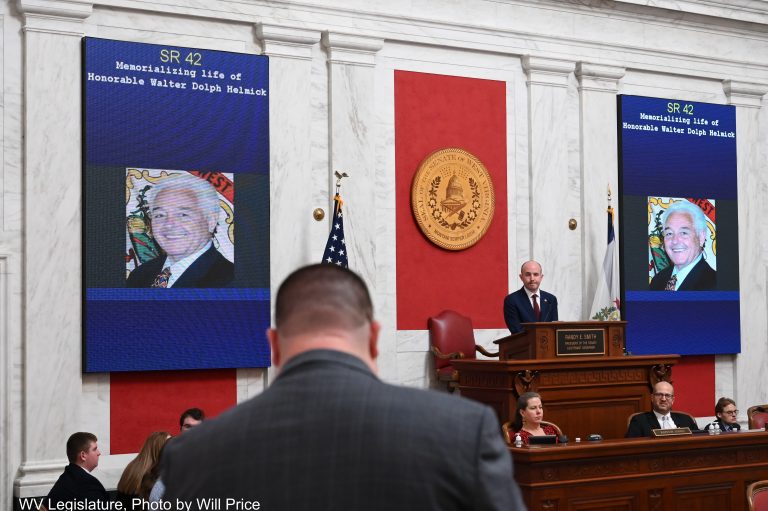
The Senate met on Monday morning and passed several bills, introduced Senate Bills 944-959, and passed Senate Resolutions, including Senate Resolution 42, which memorializes the life of the Honorable Walter Dolph Helmick.

Senate Bill 1 is the first bill from the 2026 West Virginia Legislature Session that has completed legislative action. The Legislation now heads to the Governor’s desk.

This bill would establish the Small Business Growth Act, which would be administered by the Department of Commerce.

The Small Business Growth Act is a program that would provide private investments into small businesses across West Virginia. Growth Funds would apply to the state for approval to qualify and must complete the following:

  • Have major prior investment experience of at least $100 million in rural or small company investments.
  • Submit a 10-year economic impact study.
  • Pay a $5,000 application fee.

Funds must invest 100 percent of their money into eligible West Virginia businesses within three years and maintain those investments for six years. The program would track job creation, salaries, and economic impact, with the state able to recapture credits if the rules aren’t followed. The bill would take effect January 1, 2027.

Senator Eric J. Tarr (R – Putman, 04) proposed an amendment that would change the title of the bill to “WV First Small Business Growth Act” and allow small business owners to receive tax credits for investing directly into their own companies, not just through growth funds. It also updates definitions, uses the 2020 census for eligibility, and delays when credits can first be claimed until 2029.

Following a discussion, the amendment was rejected.

The bill was passed by the Senate and has now completed legislative action.

The Senate also honored Walter Dolph Helmick who was elected to the West Virginia House of Delegates in 1988; and was appointed to the West Virginia Senate on September 13, 1989, to fill the vacancy created by the resignation of Larry A. Tucker; and whereas, following his appointment to the Senate, the Honorable Walter Dolph Helmick was elected to six terms: 1990, 1994, 1998, 2002, 2006, and 2010.

Senate Resolution 42: Memorializing the life of the Honorable Walter Dolph Helmick states, “The Senate hereby memorializes the life of the Honorable Walter Dolph Helmick, coal miner, welder, teacher, businessman, Mason, former West Virginia Commissioner of Agriculture, former member of the West Virginia House of Delegates, former member of the West Virginia Senate, statesman, and dedicated public servant. The Senate extends its sympathies to the family of the Honorable Walter Dolph Helmick on his passing”.

Afternoon Meetings:

Transportation and Infrastructure at 2 p.m. in Room 451M

Workforce at 2 p.m. in Room 208W

Pensions at 2:45 p.m. in Room 451M

Energy, Industry, and Mining at 2:45 p.m. in Room 208W

Finance at 3:15 p.m. in Room 451M

Judiciary at 3:15 p.m. in Room 208W

Morning Meetings for Feb. 17:

Education at 9:30 a.m. in Room 451M

Government Organization at 9:30 a.m. in Room 208W

The Senate is adjourned until tomorrow, Feb. 17, at 11 a.m.

House Judiciary Advances Baylea’s Law Bill

0

The Standing Committee on the Judiciary met this morning.

House Bill 4638 would include an option to become an organ donor when registering to vote or when updating voter registration. This bill was reported to the floor.

House Bill 4990 would create the crime of gift card fraud. This bill provides definitions and penalties for the crime. This bill was reported to the floor.

House Bill 4546 would require biennial reports for limited liability and foreign limited liability companies. This bill was advanced to markup and discussion.

House Bill 4712 would increase the criminal penalties for DUI causing death and DUI offenses for minors. The increase of these penalties will be called “Baylea’s Law.”

House Bill 5197 would make any action brought against the state and its agencies to set aside a sale or deed may be instituted within one year following the date of the sale. This shortened period applies only to claims against state and local governments.

House Bill 5214 would require parents with child abuse and/or child neglect claims against them to be drug tested before their children can be placed back into their care.

House Bill 5219 would provide residence definitions for voting registration and for Election Day. Under this bill, “a place shall be considered the residence of a person in which that person’s habitation is fixed, and to which, whenever that person is absent, that person has the intention of returning,” with exceptions defined in the bill.

House Bill 5228 would change the definition of electioneering. Under this bill, electioneering is now defined as “visible display or audible dissemination of information that advocates for or against any candidate or ballot question.”

In addition to the change of definition, this bill describes prohibited activities, permitting election officials and county employees to enforce election laws, and permitting said people to seek assistance from law enforcement. Prohibited activities include, but are not limited to, displaying a candidate’s likeness, logo, committee name, a ballot question’s number, or paraphernalia in support of a candidate.

House Bill 5273 would require county and municipal campaign finance activities to be published online within 48 hours of the deadline and require municipal candidates file their campaign finance reports with their respective County Clerk.

Abortion Pill Ban Clears Senate

The Senate met on Friday morning and passed several bills, including bills prohibiting abortion pills and establishing the First Amendment Preservation Act.

The Senate also introduced Senate Bills 938-943 and adopted Senate Resolutions 35, 36, and 37 regarding National Organ Donor Day, WV Silver Jackets Flood Resiliency Day, and Pretrial, Probation and Parole Supervision Week.

Senate Bill 173 would prohibit the trafficking and dispensing of chemical abortion pills in West Virginia.

The legislation would amend the West Virginia Unborn Child Protection Act by adding provisions that specifically target “abortifacients”. The bill defines an abortifacient as “any chemical or drug prescribed or dispensed with the intent of causing an abortion.”

According to the bill’s language, a person or entity would be guilty of performing or attempting to perform an abortion with an abortifacient if they are knowingly and willfully:

  • Send an abortifacient to a person in West Virginia by courier, delivery, or mail service.
  • Place an abortifacient into the stream of commerce, knowing it will be used in or sent to West Virginia.
  • Prescribe an abortifacient to a person in West Virginia, regardless of whether the prescriber is in the state.
  • Disseminate an abortifacient in West Virginia without a lawfully valid prescription.

The bill establishes different penalties based on who commits the offense:

Non-medical professionals convicted of violating the law may be charged with a felony and face imprisonment in a state correctional facility for 3 to 10 years.

Licensed medical professionals who are found to have knowingly and willfully violated the law would face disciplinary action by their licensing board, including mandatory revocation of their medical license.

The legislation specifically states that “a woman who unlawfully receives an abortifacient” cannot be charged with or convicted of a criminal offense related to her own unborn child.

The bill would also create a civil cause of action, allowing a pregnant woman or her family members, spouse or baby’s father to sue anyone who knowingly and willfully violates the prohibition. If a claimant prevails, they may receive:

  • Injunctive relief preventing future violations
  • Damages of $10,000 for each abortion that was knowingly and willfully performed or attempted

Notably, an indictment or conviction is not required to establish liability in a civil action.

Sen. Eric Tarr, (R-Putnam, 04) successfully amended the bill to require claimants who sue under the law to notify the state attorney general. It also adds language that the attorney general may pursue civil action under the law and recover expenses to the maximum amount allowed by law. An indictment or conviction would not be necessary to establish liability.

The bill provides limited exceptions:

  • Pharmacies fulfilling lawfully valid prescriptions issued by licensed medical professionals in West Virginia.
  • Physicians providing medical procedures or services for legitimate medical reasons to a pregnant woman that result in accidental or unintentional physical injury to or death of the unborn child.

The bill passed the full Senate and was reported to the House of Delegates for consideration.

Senate Bill 531 would establish the First Amendment Preservation Act.

This bill would prevent the state of West Virginia and its agencies from contracting with media monitoring or fact-checking organizations. Hiring advertising or marketing companies that use certain media monitors would be prohibited.

State agencies are prohibited from the following:

  • Entering into a contract with any media monitoring organization
  • An advertising or marketing agency that utilizes the services of a media monitoring organization for the agency’s contract or agreement
  • Provide support of any form, other than nondiscretionary actions required by law, to a media monitoring organization.
  • The bill aims to maintain viewpoint neutrality in state spending and prevent government involvement in determining which news sources are credible or acceptable.

The bill passed the full Senate and was reported to the House of Delegates for consideration.

Senate Majority Leader Patrick Martin (R-Lewis, 12) presided over today’s floor session. President Randy Smith (R-Preston, 14) was absent due to the death of his sister.

The Senate is adjourned until Monday, Feb. 16, at 11:15 a.m.

House Advances Small Business Growth Act

The West Virginia House of Delegates advanced several bills, including the following:

Senate Bill 1 would create the Small Business Growth Act. This act would establish a tax credit for employers that have fewer than 200 employees and 60% of their workforce are West Virginia employees. This bill would allow West Virginia’s small businesses to be able to receive more capital than they could previously access. 

House Bill 4098 would restore a person’s right to sit on a jury upon the expungement of one’s record. This bill was advanced to the Senate. 

House Bill 4462 would prohibit the sale of cell-cultured products in West Virginia, specifically targeting cell-cultured meat, fish, poultry, or eggs.

In the discussion of the bill, the opposition shared concerns about constitutional issues with this bill regarding the commerce clause. Opposition also shared that there have been no concerns so far with these products and did not believe we should ban these products for West Virginians.

Those in favor of the bill shared that they were concerned about possible health and safety issues that could arise in the future for West Virginians.

This bill passed with a vote of 64 to 25.

Bills introduced can be found here.
Resolutions introduced can be found here.

Committee Meetings, Today February 13

Committee Meetings, Monday February 16

The House is adjourned until 11:00 a.m. Monday, February 16, 2026. 

House Health Focuses on Childcare and Foster Care

0

The Committee on Health and Human Resources met this afternoon.

Markup & Passage

House Bill 4599 updates the WV CARES process by requiring renewal before background checks lapse.

House Bill 4907 was pulled from the agenda.

House Bill 5086 formalizes peer support teams and services for correctional officers, emergency services professionals, emergency telecommunicators, and law enforcement officers. It allows for private testimonial communication between peer support members.

House Bill 5379 requires insurers to pay out-of-network emergency medical services agencies directly and to promptly pay clean claims.

Committee Hearing

House Bill 5345 requires child-care subsidies to be based on monthly enrollment rather than daily attendance. This will provide consistency for childcare providers, helping them stay open.

House Bill 4067 provides a childcare subsidy for any childcare employee who works 20 or more hours per week.

House Bill 4517 maximizes the utility and accessibility of West Virginia’s childcare tax credit for employers by extending this credit to employer-sponsored daycare facilities accessible to the work site in addition to on-site, fully employer-provided day cares.

House Bill 4782 creates the Sustainable Child-Serving Workforce & Foster Care Modernization Act, which requires the Bureau for Social Services to rebase all foster care rates using current cost data and implement an automatic annual adjustment based on a recognized index.

House Bill 4730 establishes a continuum of services and supports for youth preparing to exit foster care or who have aged out of it.

House Bill 5430 would require an annual study of pharmacy dispensing fees, limit the amounts charged by pharmacy benefit managers, and prohibit certain pharmacy benefit manager contracts with West Virginia Medicaid and the West Virginia Public Employees Insurance Agency. It would also require implementing a pharmacy cost-containment tool.

Senate Judiciary Advanced Strategic and Critical Resources Act Bill

0

The Senate Judiciary Committee met on Thursday afternoon and advanced two bills on the Strategic and Critical Resources Act and the appointment of chief deputies.

Senate Bill 648 would establish the Strategic and Critical Resources Act.

This bill would establish a statewide framework to encourage the development of critical resources such as minerals essential for energy, technology, and national security. Regulations would be put in place by the state and federal government, not local governments.

The bill was reported to the full Senate with a recommendation of passage.

Senate Bill 185 would change state law to allow county sheriffs to appoint more than one chief deputy with the consent of the county commission.

This bill is intended to provide flexibility to have multiple top deputies to help manage larger departments or workloads.

“Some agencies require more supervision than others, and that’s where this bill will come into place,” Executive Director of the West Virginia Sheriffs’ Association, Rodney Miller, stated.

The bill was reported to the full Senate with a recommendation of passage.

Senate HHR Advances Make West Virginia Healthy Act of 2026 Bill

0

Senate Health and Human Resources met Thursday afternoon and advanced eight bills regarding the Food is Medicine Program, involuntary hospitalization, family caregivers and more.

House Bill 4982 would establish the Make West Virginia Healthy Act of 2026.

This bill would authorize the use of nutrition-based interventions, such as the Food is Medicine Program.

The Food is Medicine Program incorporates basic nutrition and culinary skills education, patient-provider relationships, health metric collection, and locally grown produce to improve patients’ overall well-being.

The Bureau for Medical Services would also design programs to improve health outcomes for Medicaid members with nutrition-related chronic diseases through nutrition supports and reduce the need for higher-cost medical care.

The bill was reported to the full Senate with a recommendation of passage.

Senate Bill 742 would authorize physicians to determine the involuntary hospitalization of a patient or individual at a hospital emergency department in need of treatment.

This bill would strike language stating that a mental hygiene commissioner, magistrate, or circuit judge would have to determine if an involuntary hospitalization of a patient is necessary, and give full authority to the staff physicians present at the hospital.

The bill was reported to the full Senate with a recommendation of passage, first being sent to the committee on Judiciary.

Senate Bill 741 would expand the pilot program to implement the involuntary commitment process.

West Virginia’s pilot program for involuntary commitment is a trial project intended to make the process safer and more effective. Selected counties test new procedures such as trained alternative transport to hospitals, quick mental health evaluations, and audits to ensure commitments are justified.

This bill would expand the pilot program by adding the counties of Hampshire, Morgan, Ohio, and Wood to implement an involuntary commitment process.

The bill was reported to the full Senate with a recommendation of passage, first being sent to the committee on Finance.

Senate Bill 650 would establish a psychiatric hospital that treats exclusively civil and forensic patients committed from the state or from state hospitals.

The hospital would require an average annual inpatient census patient mix greater than 95 percent of court-ordered forensic and civil involuntary commitments from state custody.

The bill was reported to the full Senate with a recommendation of passage, first being sent to the committee on Finance.

Senate Bill 766 would establish the Creating Caregiver Tax Credit Act.

The West Virginia State Department of Revenue would publish that a tax credit shall be reduced on the first day of the effective year, and the total amount of credits used to offset the tax does not exceed $5 million annually per year.

This bill is intended to support family caregivers financially, such as helping finance durable medical equipment that is necessary to assist an eligible family member in carrying out one or more activities of daily living.

The bill was reported to the full Senate with a recommendation of passage, first being sent to the committee on Finance.

Senate Bill 114 would establish the Paid Parental Leave Pilot Program.

This bill would allow an employee to receive 12 weeks of paid leave during any 12-month period to care for and bond with his or her child during the first 12 months after the child’s birth.

This program is intended to promote working families’ physical and mental health, increase employee retention, and improve employee productivity and morale following the birth or adoption of a child.

Following a discussion, the bill was reported to a newly formed subcommittee where Senator Joey Gracia (D – Marion, 13) would be the chair, and the bill would be taken for further consideration.

Senate Bill 130 would establish a state-wide directory of e-cigarette products and e-cigarette liquids and strengthen regulations on their distribution and sale.

Manufacturers would be required to receive market authorization from the U.S. Food and Drug Administration before their products can be listed and sold.

The bill was reported to the full Senate with a recommendation of passage, first being sent to the committee on Finance.

Senate Bill 398 would remove the existing requirement that certain state public health officials be employed on a full-time basis.

This bill is intended to provide more flexibility in hiring and retaining qualified individuals in key public health leadership roles.

The bill was reported to the full Senate with a recommendation of passage.

House Judiciary Advances Animal Abuse Database Bill

0

House Judiciary and its subcommittees met this morning.

Judiciary

House Bill 5176 would create the animal abuse database within the West Virginia State Police. This database would include the names of individuals who have been convicted of, or who have entered a plea of guilt, or are in violation of animal cruelty codes. These codes include §19-20-24§61-8-19§61-8-19a§61-8-19b, or §61-8-19c.

House Bill 5101 would create the Joanna Phillips Domestic Violence Prevention Act. This act would create and increase penalties for certain acts of domestic violence, in addition to changing bail requirements for domestic violence cases.

House Bill 4568 would prohibit service of process in Family Court and civil actions on county property.

House Bill 4709 would recognize the West Virginia Legislature’s legal standing in court actions in the event of unauthorized changes to election laws and rules.

House Bill 4710 would increase the amount of time a candidate could switch parties before filing to run for office from 60 days to 180 days before an election.

House Bill 5025 would allow the burning of certain farm structures, provided the Department of Environmental Protection approves the burning.

House Bill 5166 would require a notice to be given to any political committee violating the filing requirements before assessing any civil fines. This bill would also give the Secretary of State authority to grant additional time for compliance, but not exceed an additional 14 days.

House Bill 5182 would allow the State Treasurer’s security personnel to carry concealed weapons while performing their official duties, upon approval from the State Treasurer.

House Bill 4638 would include an option to become an organ donor when registering to vote or when someone is modifying their voter registration.

House Bill 4990 would create the crime of gift card fraud. This bill provides definitions and penalties for the crime.

Senate Bill 4 would require bystanders to stand 30 feet back from first responders engaged in their duties if they are trying to threaten or harass first responders. If bystanders violate this bill, they are guilty of a misdemeanor and, upon conviction thereof, shall be fined at least $50 but no more than $500 or confined in jail for not more than one year. Upon a judge’s discretion, a person could be both fined and confined.

Legal Services

House Bill 5219 would provide residence definitions for voting registration and for Election Day. Under this bill, “a place shall be considered the residence of a person in which that person’s habitation is fixed, and to which, whenever that person is absent, that person has the intention of returning,” with exceptions defined in the bill.

House Bill 5228 would change the definition of electioneering. Under this bill, electioneering is now defined as “visible display or audible dissemination of information that advocates for or against any candidate or ballot question.”

In addition to the change of definition, this bill describes prohibited activities, permitting election officials and county employees to enforce election laws, and permitting said people to seek assistance from law enforcement. Prohibited activities include, but are not limited to, displaying a candidate’s likeness, logo, committee name, a ballot question’s number, or paraphernalia in support of a candidate.

House Bill 5273 would require county and municipal campaign finance activities to be published online within 48 hours of the deadline and require municipal candidates file their campaign finance reports with their respective County Clerk.

House Bill 5066 would prohibit the release of addresses and names of people who make contributions to a political election. If someone were to release said information, misdemeanor penalties are spelled out in the bill.

Courts

House Bill 5197 would make any action brought against the state and its agencies to set aside a sale or deed may be instituted within one year following the date of the sale. This shortened period applies only to claims against state and local governments.

House Bill 5214 would require parents with child abuse and/or child neglect claims against them to be drug tested before their children can be placed back into their care.

House Bill 5105 would prohibit the financial exploitation of people recovering from addiction.

House Bill 5198 would increase the penalty for crimes against people who have a mental disability.

Homeland Security

House Bill 5234 would prevent the absentee voters’ personal information from being displayed on the outside of an absentee ballot envelope sent through the mail. The information that was previously put on the outside of the envelope will now be kept inside the envelope.

In the discussion, legal counsel shared concerns about the bill conflicting with House Bill 4600, which has been advanced to the Senate. House Bill 5234 and House Bill 4600 both amend the same section of code, §3-3-5. Counsel said if these bills both pass as they are, then the last bill passed would take advantage over the first bill. In this instance, if H.B. 5234 were to pass without any changes following H.B. 4600, it would repeal H.B. 4600.

This bill was reported to the Judiciary.

House Bill 5203 would forbid any municipality from issuing any kind of municipal ID for the purposes of voting in a municipal election.