

Monday, August 3, 2026
Home Blog Page 172

Education Omnibus Bill Advances

0

House Passes Amended Senate Education Bill

After days of deliberation, and close to 11 hours of debate on the amendment stage, the West Virginia House of Delegates passed a Senate education bill with several changes.

The House passed Senate Bill 451 in a 71-29 vote. The bill as amended by the House included a 5 percent pay raise for teachers and service personnel, a $250 tax credit for teachers and service workers purchasing supplies, a salary increase for math teachers, a provision including seniority to be considered in a reduction in force decision unless the last personnel evaluation is unsatisfactory, a $1,000 year-end bonus for teachers and service personnel who miss fewer than four days, and a provision providing a law enforcement officer in every school.

The bill also capped charter schools to two in West Virginia. These two charters would have to be low-performing Title I elementary schools and a majority of parents and teachers would have to vote in favor of conversion. The bill also was changed to eliminate Education Savings Accounts, or ESAs.

House Finance Chair Eric Householder, R-Berkeley, estimated the total cost of the bill to be about $202 million.
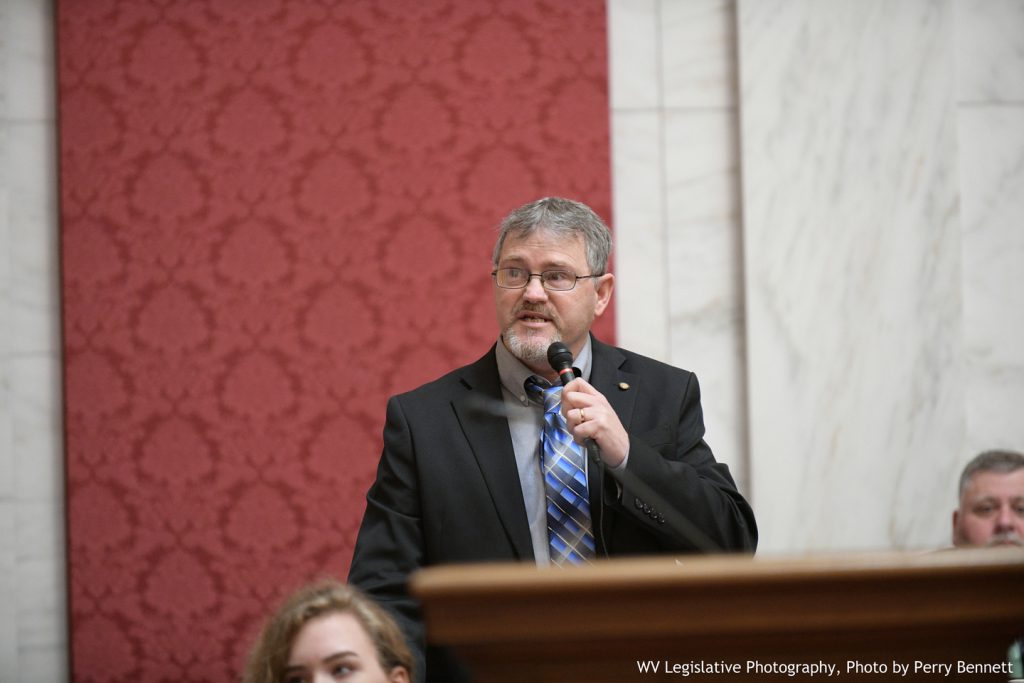
Delegate Daryl Cowles, R-Morgan, supported the bill, commended members of the House for sorting through provisions of the bill and compared the process to cooking chili.

“We sorted through the ingredients. Some things went in and some things did not go in,” Cowles said, mentioning several provisions he supported including the pay raise, the two charter schools, expanded Innovation Zones, and bonuses for math teachers. “These were the good things that went into this pot of chili.”

Others, including Delegate Mick Bates, D-Raleigh, weren’t optimistic.
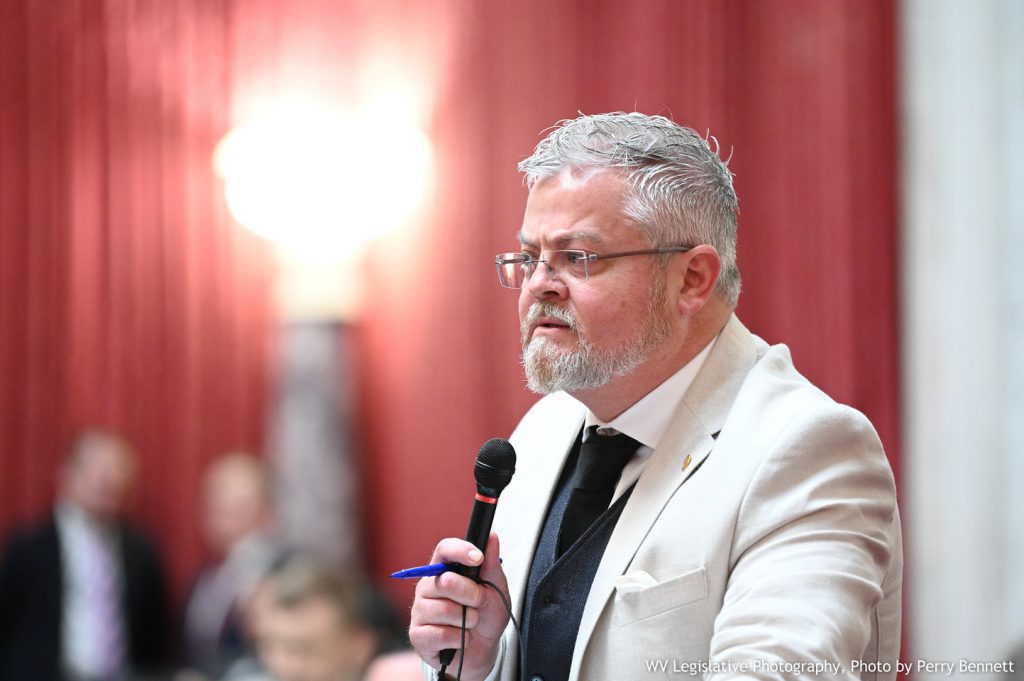
“It has improved substantially from what was sent over from the Senate,” Bates said. “Overall, we’ve done excellent work. There were many things in the bill I am in favor of and would support. My concern is what we will be voting on will not be what we sent over to the Senate.”

Bates’ biggest concern was the charter school provision.

“If charters would have come out, I would have been comfortable with the bill we had,” Bates said. “However, there is no way this is going to be the final product. So the question is what does the Senate do? If they take the position that we need to expand charters, I don’t think the House will accept that and it puts at risk all the good things in the bill.”

Bates also was concerned about was the local share of state aid.

“We did things to help counties with low population or those losing population and did things to help counties with growing populations. The problem is that over time, this will cause bigger differences between the amount of state aid that goes into these counties. The problem is in the near future we’re going to see legal challenges as well as fighting over state dollars for education.”

Senate Bill 451 was an originating bill out of the Senate Education Committee. The committee advanced the bill Jan. 28 and the Senate made a rare move to commit the bill to the Committee on the Whole—which comprises all members in the Senate.

Senators called and questioned several witnesses and advanced the bill to the floor, passing the measure in an 18-16 vote.

As it passed the Senate, the bill included unlimited public charter schools, 2,500 ESAs for households making under $150,000, a bonus for math teachers, a tax credit for school supplies for teachers only, a year-end bonus if teachers aren’t absent more than four days, $24 million for student support personnel and a provision making it where reduction in force decisions would not be based on seniority alone.

The Senate’s version included a provision that had no pay during work stoppages unless days are made up, and a provision requiring unions to get written permission from members before spending membership dues on political causes.

The Senate’s version also included a non-severability clause.

A proposed strike-and-insert offered in the House Education Committee made several substantial changes to the version that passed out of the Senate. The biggest changes included making charter schools a pilot program and capping them at two for the state. The Education Committee’s version also eliminated ESAs.

The Education Committee’s version also expanded the year-end bonus to include service personnel, added that teachers would get paid during work stoppages and could have extracurricular activities, said reductions in force decisions would be on seniority plus evaluations, and eliminated the provision requiring unions to get written permission from members before spending membership dues on political causes.

The House Education Committee advanced its strike-and-insert last Friday following three days of discussion. The bill then headed to House Finance.
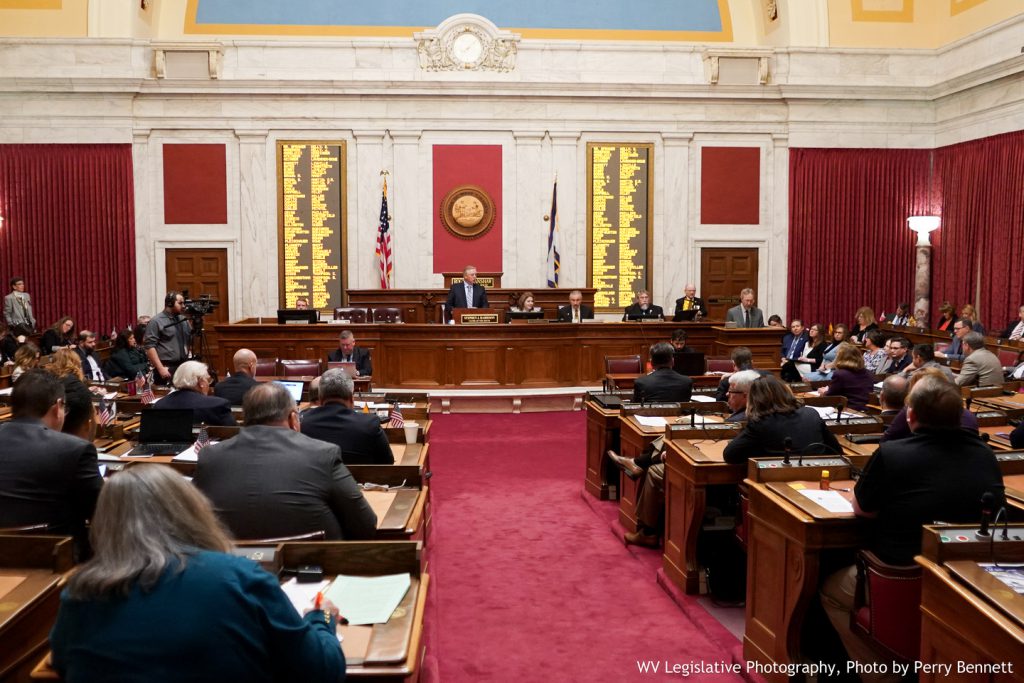
Monday started off with a public hearing at 8 a.m. where many voiced their opinions on the bill. As per a motion adopted on the House floor on Feb. 8, the House Finance Committee hosted a second public hearing at 5:30 p.m. The committee met in between and after the two public hearings to discuss the bill, hear from speakers, and go over their own proposed strike-and-insert amendment.

About 60 people spoke in the two hour-long Monday evening public hearing to a packed House chamber. Some senators stood at the back of the chamber to listen to the speakers.

A majority of those who spoke Monday evening voiced strong opposition to the measure. They expressed concerns that certain provisions in the bill would create wider gaps between higher- and lower-income families, and expressed fears that certain provisions could result in losses of funding for public schools.

Heather Blankenship, a teacher and mother of four, told the committee that although she felt there are problems with public schools, she didn’t think these problems would be solved by adding charter schools or ESAs.

“We need highly qualified teachers, seniority, competitive pay, and support from the Legislature,” Blankenship said.

Those who supported the bill disputed that there would be a loss of funding for public schools, said the bill would give parents more choices of where to send their kids, and mentioned the 5 percent pay raise.

Supporters also mentioned other states with charter schools and ESAs. There are 44 states and the District of Columbia that have charter schools. Five states currently have ESAs. Nevada’s ESA program currently is not operating.

Dan Brokke, a pastor and administrator at Grace Christian School in Huntington, spoke in favor of the bill.

“Please vote in favor of this bill and include ESAs. This would not only be a help to students in private schools but public school parents could use it toward extra-curricular activities or college courses,” Brokke said. “Think about the children and their parents.”

Debate and testimony extended into Monday night. The committee later took up its proposed strike-and-insert, which proposed changes to the House Education version.

The Finance Committee’s proposed strike-and-insert made a few changes to the Education Committee’s strike-and-insert. However, the committee ultimately ended up rejecting the proposed strike-and-insert in a narrow 13-12 vote near midnight.

The committee met early the following morning and voted 17-8 to advance the House Education proposed strike-and-insert. The House then received the bill and took it up for immediate consideration, advancing it to second reading.

“We went line-by-line, point-by-point through this bill to work with all parties in order to build consensus and support for the House’s changes to this bill,” said House Education Committee Chairman Danny Hamrick, R-Harrison. “In the end, we drafted a product that was able to pass this House on a wide 71-29 margin.”

Senate Bill 451 now heads back to the Senate for further consideration.

“There’s a long way to go,” Bates said. “It’s a long way from over. The ball is down in the Senate’s court. They will receive it. I don’t expect they will accept it. I expect they will reject it. They will ask us to recede and we will not. We will trade messages for next couple of days, put a conference committee together and see where it goes from there.”

Judiciary Committee Approves Regulations on Third-Party Litigation Financing

0

The Senate Committee on the Judiciary met yesterday afternoon to discuss and debate in great detail over litigation financing.

A litigation financing transaction is a non-recourse transaction in which financing by a third-party, who is unrelated to the case, is provided to a consumer in return for a consumer assigning to the litigation financier a contingent right to receive an amount of the potential proceeds of the consumer’s judgment, award, settlement, or verdict obtained with respect to the consumer’s legal claim.

Senate Bill 360 would add regulations to this type of business in West Virginia. The proposed regulations with this legislation would include:

  • All litigation financiers to register with the secretary of state.
  • Litigation financiers must:
    • Provide the consumer with a completed, written agreement.
    • Contract must contain a right of rescission within five days of receiving funds.
  •  Prohibits litigation financiers from:
    • Paying, offering to pay, or accepting any commissions or referral fees to or from any attorney, law firm, medical provider, chiropractor, or physical therapist.
    • May not use false or misleading advertisements.
    • May not charge a consumer an annual fee of more than 18 percent of the original amount of money provided to the consumer.

Committee members heard testimonies from insurance agencies, the West Virginia Association for Justice, and local attorneys who were all in favor of passage of the bill. Senators expressed most concerns over the 18 percent rate, and if that requirement was too low or too high. After hearing the testimonies, the members agreed that the original 19 percent was a fair rate for both the litigation financiers and the consumers.

The Committee also discussed Senate Bill 601 which would authorize the Division of Corrections to release inmates 180 days prior to his or her discharge date if they have not been released on parole.  Inmates may be placed on electronic monitoring during the period of supervision. This bill was proposed in result over overcrowded prisons throughout the state.

The Committee approved both bills unanimously, and will be reported to the full Senate to be voted upon.

RA

Senate Finance Receives Land-Grant Bill from Education

0

Legislation relating to federal funds for land-grant institutions came before the Senate Finance Committee following Tuesday’s review from the Education Committee.  

Senate Bill 553, which intends to donate funding to two of the state’s universities, was brought before finance committee members to be considered. The proposed legislation would donate $1.4 million to West Virginia State University to match funding supplied by federal land-grants. 

President of the university, Anthony Jenkins, came before the education committee on Tuesday to urge passage of the bill to ultimately spread the universities positivities impacts on the state.  

Following consideration, the bill was reported to the full Senate with the recommendation to pass.   

Members also reviewed supplemental appropriation to the Department of Veteran’s AssistanceAccording to the Cabinet Secretary of the department, Dennis Davis, House Bill 2666 would address $5 million of unpaid bills accumulated by the VA.  

Davis explained that the department has implemented a corrective action plan intended to address the debt and prevent further loss of funding.  

Committee members motioned to report the bill, in addition to House Bill 2668 and Senate Bills 310519 and 587, to the full Senate as well. 

Legislation Passes Health Committee

0

Three pieces of legislation were reported to the full Senate by the Health and Human Resources Committee, 1 p.m. Thursday.  

Of the proposed bills, two were from the Senate and two were from the House of Delegates. 

Review of Senate Bill 86, a bill which would require county boards to provide free feminine hygiene products to female students, opened discussion between committee members. Council led members in reviewing a committee substitute of the proposed legislation which calls for county boards to supply feminine hygiene products to girls in grades 6 through 12. The introduced bill called for counties to provide free products to all girls in the selected grades range but was altered to only supply products to students with financial need 

According to council, the legislation was created following representatives in Monongalia county noticing that an inability to purchase feminine hygiene products directly effected the attendance of female students in grades 6 through 12.  

Sen. Patricia Rucker, R-Jefferson, expressed concern over the bill’s potential impact on county school boards following implementation. Currently, the bill has no fiscal note because it would require county school boards to cover the total cost of the program.  

Rucker stated that although she supported the bill, she didn’t like that it’s an unfunded mandate for a program which some schools may already have in place.  

Committee chair, Sen. Michael Maroney, R-Marshall, addressed Rucker and explained that although the bill has a unfunded mandate, the Senate Finance chair and multiple country boards were contacted during the drafting of the legislation and said they were okay with county school boards covering the costs.  

Members voted to agree to the committee substitute and report the bill to the full Senate with the recommendation that it shall pass.  

Senate Bill 300, relating to adoption records, also came before the committee and sparked debate. According to council, the proposed legislation would require multiple health records to be completed and uploaded online prior to the adoption of a child.  

Gary Thompson, director of the Health Statistics Center at the Department of Heath and Human Resources, came before members to discuss the objectives of the legislation, and stated that although the service would be voluntary, he expected that 2,000 cases would be reported online within the first year.  

Thompson also explained that two jobs would be added to the DHHR in order to keep up with the projected high volume of cases within the first few years.  

Following discussion, Sen. Eric Tarr, R-Putnam, moved to add a conceptional amendment which would require the DHHR to report the total volume of cases to the state every three years. The Senator attributed the amendment to a fear that too many positions would be present in the DHHR following passage of the bill.  

Overall, members moved to incorporate the amendment into a committee substitute which has been reported to the full Senate.  

House Bill 2607 was also reported while House Bill 2490 was laid over. 

Small Business, Entrepreneurship, and Economic Development Passes Bill for Low Income

0

The committee on small business, entrepreneurship, and economic development passed House Bill 2887 which establishes a West Virginia growth in low income communities tax credit.

This bill provides a $36 million insurance premium tax credit for investment into impoverished zones. Qualified areas include areas with a poverty rate over 20 percent or median family income below 80 percent of e metropolitan median family income. The bill will be reported to the House, but will be referred the Finance committee.

House Bill 2943 relates to deliveries by wine specialty shops. This bill allows wine specialty shops to deliver within their county (or within 50 miles of the shop’s location, if the delivery is out of county without a shippers license.) The bill requires conspicuous packaging and proof that the purchase was made by an individual 21 years of age or older. Finally, the purchase must be made at the shop and delivered by an employee of the shop.

The bill will be reported to the House, but will be referred to the Judiciary committee.

Senate Bill 106 alleviates double taxation on foreign income at state level. Under current law, a West Virginia resident is permitted a tax credit on their personal income in the amount of any income tax imposed by another state. However, taxes paid to a foreign country are not provided a similar tax credit. This bill provides one. The bill will be reported to the House, but will be referred to the Finance committee.

House Bill 2724 relates to Small Business Tax Credit. This bill provides a tax credit to small businesses headquartered in West Virginia with fewer than 25 employees. The amount of the tax credit is 50 percent the costs of branding, marketing and advertising of agricultural or manufactured products produced or manufactured in West Virginia. The credit is capped at $10,000.00 per year and is available for 5 years. The bill will be reported to the House, but will be referred to the Finance committee.

TH

House of Delegates Passes Renewed Version of Senate Bill 451

0

The House of Delegates convened at 11a.m on the 37th day of the regular session of the 84th West Virginia Legislature to consider a number of bills on third reading, including the highly debated Senate Bill 451, a bill to reform public education in West Virginia.

The House of Delegates passed the strike-and-insert amendment to Senate Bill 451, which includes several comprehensive provisions to amend public education policy within the state. The amendment would set uniform levy rates for county boards in the state, offer an open enrollment policy for student transfer eligibility, and cap the amount of charter schools allowed in the state at 2. The strike-and-insert amendment would also replenish funding for WV innovation zones by $5 million, include social workers and psychologists within public K-12 schools, eliminate educational savings accounts completely, and provide for one law enforcement officer per WV school. There would also be financial incentive for math and science teachers in the state, and a 5 percent pay raise for teachers.

Delegate Eric Householder, R-Berkley, provided the House of Delegates with a fiscal note of $202,570,438 for the gross cost of all of the provisions included within the accepted version of Senate Bill 451.

Discussion ensued over whether or not the updated version of Senate Bill 451 was worth passing.

Delegate Shawn Fluharty, D-Ohio, argued that the input of teachers wasn’t valued enough in the creation of Senate Bill 451, and that the Senate would make significant changes to whatever the House passed.

“I’m not taking the bait here,” Fluharty said. “Senate is going to reject this if it goes through, we are going to go into conference committee, and we’re going to get stuck with a pile of garbage. I’ve seen it before.”

Other delegates were concerned about the constitutionality of the bill as it pertains to the Single Object Rule in the state constitution. This rule provides that there should be one idea per piece of legislation to prevent political log-rolling.

Delegate Pat McGeehan, R-Hancock, was one of these delegates.

“The means don’t always justify the ends,” McGeehan said. “If you take your oath of office seriously and measure the morality of the situation, this isn’t right.”

While major concerns regarding the passage of Senate Bill 451 were vocalized, a lot of support for the bill was as well.

Delegate Matt Rohrbach, R- Cabell, was impressed with the House of Delegates’ ability to compromise and create a bipartisan bill after the 11 hour House floor session yesterday.

“We listened to our constituents, we listened to the stakeholders, and most importantly, we compromised.” Rohrbach said.

Delegate Isaac Sponaugle, D-Pendleton, spoke on the confidence that he had in voting “yes” on Senate Bill 451, even if the bill does to conference committee.

“I trust the Speaker to hold the House’s position in confidence,” Sponaugle said.

In the end, the House strike-and-insert amendment proposed to Senate Bill 451 prevailed in a 71-29 vote.

All other bills on third reading, with the exception of House Bill 2173 and House Bill 2992 which were tabled for one day, passed the House as well on this day.

House Bill 2338, a bill that would exempt antique military vehicles from using certain registration insignia that covers the original markings of the vehicle, was passed unanimously by the House.

Another House Bill that was passed unanimously was House Bill 2359, a bill that would exempt commercial motor vehicle operators employed with a farm related service industry from the commercial driver’s license requirements. West Virginia citizens employed in the fields of agrichemical business, harvesting, livestock feeding, and other applicable careers would be exempt from getting a commercial driver’s license for a limited time.

House Bill 2673 was passed after little debate. This bill would create the Oil and Gas Abandoned Well Plugging Fund, which would create a tax exemption from certain gas wells in the state and provide funds for the WV Environmental Protection Agency to plug more orphaned wells.

To bills regarding hunting in the state of West Virginia were passed on this day: House Bill 2709 is a bill that mandates that information given to the Department of Natural Resources for hunting licenses are not subject to discovery with a Freedom of Information Act (FOIA) request. House Bill 2715 would create a specialized Class Q hunting permit for disabled persons.

House Bill 2739 was passed on this day. This bill was passed by both chambers in the previous year, but did not complete legislative action in time. This bill would make it a criminal offense for any participating public employer of any retirement system administered by the Consolidated Public Retirement Board to fail to make required contributions.

House Bill 2743 made technical updates to code regarding pension funds. This bill would delete a reference to municipal policemen’s pension or municipal firefighter’s pension as restrictions on pensions funds are contained in another section. This bill was passed unanimously by the House.

House Bill 2761 would modernize the self-storage lien law. The bill clarifies what rights owners have, what dates would be made effective after July 1, 2019, among other technical code changes. This bill unanimously passed through the House.

House Bill 2793 would expand the applicability of educational facilities that are eligible for consideration under the West Virginia Prepaid Tuition and Savings Program. Currently in code, only institutions of higher education are included. This bill would also include certain private K-12 state institutions to be included in the program.

House Bill 2821 would make a financial adjustment within the institution of the national guard. This bill would clarify the recipient of command and clerical pay and to allow for an appropriate annual adjustment.

House Bill 2848 relates to the WV ABLE Act. This bill would raise the age requirement for eligibility from 21 to 26, thus matching the federal ABLE act. It also clarifies that family members and attorneys are permitted to manage a beneficiary’s ABLE account.

Bills on second reading that were advanced without amendment included House Bill 2538, House Bill 2579, House Bill 2618, and House Bill 2846.

Consideration of amendments for Senate Bill 377 was postponed for one day.

House Bill 2472 and House Bill 2716 both underwent technical amendments.

All bills on first reading were advanced.

The House is adjourned until 11 a.m. tomorrow, Friday, February 15.


Committees Meeting After Floor Session Today:

  • The House Committee on Seniors, Children, and Family Issues will convene 15 minutes after the House floor session in 215-E.
  • The House Committee on Health and Human Resources will meet at 3:15 p.m. in 215-E.
  • The House Committee on Energy will meet at 3:15 p.m. in 418-M.
  • The House Committee on Prevention and Treatment of Substance Abuse will meet at 4 p.m. in 215-E.
  • The House Committee on Political Subdivisions will meet at 4 p.m. in 432-M.
  • The House Committee on Veterans Affairs and Homeland Security will meet at 5:30 p.m. in 432-M. 


Committees Meeting Before Floor Session Tomorrow:

  • The House Committee on Education will meet at 9 a.m. tomorrow in 432-M.
  • The House Committee on Finance will meet at 9 a.m. tomorrow in 460-M.
  • The House Committee on Government Organization will meet at 9 a.m. tomorrow in 215-E.
  • The House Committee on the Judiciary will meet at 9 a.m. tomorrow in 418-M.


Gov. Org. Committee Passes Reorganization of State Agencies Bill

0

The Senate Committee on Government Organization met Thursday afternoon to discuss thre bills on the agenda.

Most of the discussion revolved around Senate Bill 326 which would reorganize state agencies involved with emergency and disaster planning. The legislation includes many moving parts,one piece of which would create a state wide effort to demolish old and dilapidated buildings deemed unusable. There is an estimated 50,000 + buildings (commercial and private) that would be demolished if this bill becomes a statute. The Committee approved the bill unanimously, and made a motion to have the double committee reference to Finance waved.

Senate Bill 580 is closely related to the Municipal Home Rule Program and would allow counties to implement a one percent consumer sales tax in certain circumstances. Blair Couch, Commissioner of Wood County, provided testimony about the positive impacts of the 1 percent tax within his three municipalities. In Parkersburg, the annual revue jumped from $26 million to $34 million from the one percent tax. The Committee passed the bill, and referred it to the Committee on Finance.

House Bill 2324 would authorize the West Virginia Acupuncture Board to issue certification for performing auricular acudetox therapy, which would treat substance abuse, alcoholism, chemical dependency, detoxification, behavioral therapy or trauma recovery. The proposed legislation was approved by the Committee and will be reported to the full Senate.

RA

Senate Passes Pepper Spray Bill, Sends One Other Bill to House

0

The Senate convened Thursday morning to discuss two bills that were on third reading.

Senate Bill 339 would allow people 16 years of age or older to possess pepper spray on the Capitol Complex for self-defense purposes. The bill would also allow the Director of Protective Services to temporarily prohibit the possession of pepper spray during designated special events on campus.

Senate Bill 74 would exempt people who volunteer their time or services, without wages, for a ski area operator or for a ski area sponsored program from workers’ compensation coverage, notwithstanding that the people may receive noncash remunerations.

Senate bills 605 to 616 were also introduced.

The Senate also adopted three Resolutions.

Senate Resolution 43 designated Feb. 14, 2019 as Tiny Hearts Day. Senate Resolution 44 also designated Feb. 14, 2019 as West Virginia Arts Day at the Legislature.

The Senate also adopted Senate Resolution 45 which recognized the Cabell Midland High School Marching Knight Band for being reigning state marching band champions for the past seven years.

The Senate is adjourned until tomorrow, Feb. 14 at 11 a.m.

The following committees will meet today:

Health at 1 p.m. in 451M

Energy at 1 p.m. in 208W

Education at 2 p.m. in 451M

Gov. Org. at 2 p.m. in 208W

Finance at 3 p.m. in 451M

Judiciary at 3 p.m. in 208W

The following committee will meet tomorrow:

Transportation at 10 a.m. in 451M

RA

House of Delegates Adopts Strike and Insert Amendment

0

The House of Delegates adopted a strike and insert amendment that became the new education reform act bill. After nearly 12 hours of debate the House moved to adopt the strike and insert amendment as amended which became the official bill, Senate Bill 451. The bill has been moved to third reading and will be voted on the floor February 14.

House Committees Meeting:

Small Business, Entrepenuership, and Economic Developement 9 a.m.

Banking and Insurance 10 a.m.

Rules 10:45 a.m.

Other committee meetings scheduled for the evening may be subject to change.

TH

House Continues Consideration of Senate Bill 451 Amendments

0

As of 8:30 p.m. on Wednesday, February 13, the House of Delegates continues their work on the second reading of Senate Bill 451.

The House of Delegates has considered and passed a number of secondary amendments to the strike-and-insert amendment to Senate Bill 451, which was passed out of the House Education Committee last week.

One of these amendments was an amendment proposed by Delegate Paul Espinosa, R-Jefferson; Tom Bibby, R-Berkley; Delegate Daryl Cowles, R- Morgan; and Delegate S. Marshall Wilson, R-Berkley, notated as HFA Espinosa et al 2-13 #2.

This amendment, which was overwhelmingly passed by the House, would allow school personnel to be suspended or dismissed if they are found by the Department of Health and Human Services to be abusive to students within public schools.

Delegate Mick Bates, D-Raleigh and a large number of Democratic delegates also drafted an amendment for consideration that would strike all of Senate Bill 451’s references to charter schools. HFA Bates et al 2-13 was tabled indefinitely until all other amendments addressing charter schools were considered.

Five amendments proposed by Delegate S. Marshall Wilson, R-Berkley, called for increasing the number of charter schools permitted in the state by significant amounts.

The strike-and-insert primary amendment passed out of the House Education Committee currently allows for 2 charter schools.

Wilson proposed multiple highly-contested amendments to increase the number of charter schools allowed to unlimited, one per county, 25 maximum charter schools allowed in the state, and 20 maximum charter schools allowed in the state.

Delegate Terry Waxman, R-Harrison, addressed the Delegates in voting for the Wilson secondary amendments.

“The allowance of charter schools in the state is permissive,” Waxman said. “It gives our parents the right to choose. This is for freedom. Think long and hard before pressing that red button, because you’re voting against freedom.”

All five of the proposed amendments to increase the number of charter schools permitted failed overwhelmingly.

Delegate Doug Skaff, D- Kanawha, defended the body’s opposition to charter schools.

“This body continues to speak loudly against charter schools,” Skaff said. “We have to put faith in our current system and fund it.”

Upon HFA Bates et al 2-13 being reconsidered after the consideration of other charter school amendments, the vote came incredibly close.

As a result of the roll call vote, charter school references remain in the bill indefinitely, in a close 49-45 vote.

The House of Delegates continues to have consideration of the proposed amendments to Senate Bill 451 as of 9:54 p.m., Wednesday, February 13. More updates to this bill are pending as the floor session continues.