Sunday, August 2, 2026
Home Blog Page 188

Senate Welcomes Hardesty

0

The Senate welcomed Sen. Paul Hardesty to the 7th District West Virginia Senate seat, in Friday morning’s floor session.

Hardesty was appointed to the seat following Sen. Richard Ojeda’s resignation on Jan. 10.

The Senate also discussed Senate Concurrent Resolution 11 which seeks to address the crumbling infrastructure around the state.

The resolution was unanimously adopted following the passage of Senate Bill 272 which updates code relating to the Commission on Special Investigations.

During the floor session, the Senate also passed Senate Bill272, relating to updating the code relating to the Commission on Special Investigations.

The Senate also introduced Senate Bills 343-353.  Senate Bill 343 relates to the review and approval of state property leases.  Senate Bill 350 would define terms to assure correctional officers are considered law-enforcement offices.

The Senate is adjourned until 11 a.m. Monday, Jan. 21.

The following committees will meet today:

·         The Senate Committee on Agriculture and Rural Development will meet at 12:30 p.m. in 208W

·         The Senate Committee on the Judiciary will meet immediately following the Agriculture and Rural Development committee.

The following committees will meet Monday:

·         The Senate Committee on Banking and Insurance will meet 2 p.m. in 451M.


New Session, New Leaders Emerge

“We Have Arrived”

House Majority Leader Amy Summers, didn’t initially picture herself as a delegate or even getting into politics.

Summers, a Republican from Taylor County, works as an ER nurse and lives on an Angus cattle farm. Her father was involved in politics, serving as the Grafton mayor and chairman of the Republican party.

“My dad actually ran for the House of Delegates and lost. He passed away before I got into office. Many people who knew him said he would have been so proud. But no, I didn’t see myself as a delegate. I always had an interest in it and I wasn’t happy with the way things were. I thought I had to do something.”

She was first elected to the House in 2014 and this year, became the first Republican woman to serve as majority leader. When he selected Summers as majority leader, House Speaker Roger Hanshaw, R-Clay, said of her, “Having worked with Amy the past four years on the Judiciary Committee, I’ve seen firsthand the reasoning and tenacity that will help her excel as majority leader.”

“I want to work closely with the speaker,” Summers said. “We are united as a caucus to pass legislation that makes people’s lives better in West Virginia. That’s what we’re focusing on. We are focusing on broadband, foster care, education. We are going to try new things because what we’re doing is not good enough.”

With her background in health, Summers’ passion has been in health care legislation. This is one of the reasons why although the majority leader traditionally serves on the Finance Committee, Summers wanted to continue her role in Health and Human Resources. “That’s where my knowledge base is,” she said. “I want to be somewhere where I will make the most impact.”

Summers has been involved in American Cancer Society initiatives and was part of the “ban the tan” legislation to prohibit teens from using tanning beds.

“We’ve expanded a lot of health care in West Virginia since I’ve been here,” she said. “We have worked with telemedicine so people can call if they can’t get out to a doctor. It makes it difficult when you don’t have wireless but we are working on broadband too.”

Summers also mentioned Sen. Patricia Rucker, R-Jefferson, who was selected to lead the Senate Education Committee. Rucker is the first Republican woman to lead this committee.

“We have arrived,” Summers said. “We are being considered as equals to lead this team.”

“My experience in my four years is that women are respected in our caucus,” Summers added. “In my experience, women are treated equally and are well respected. That is a reflection on this institution and the people elected.”

Summers praised Rucker’s selection for the committee.

“We’ve been told we don’t have the workforce and what are we going to do to educate people in this state,” Summers said. “I’m proud of her and she’s going to do an excellent job.”
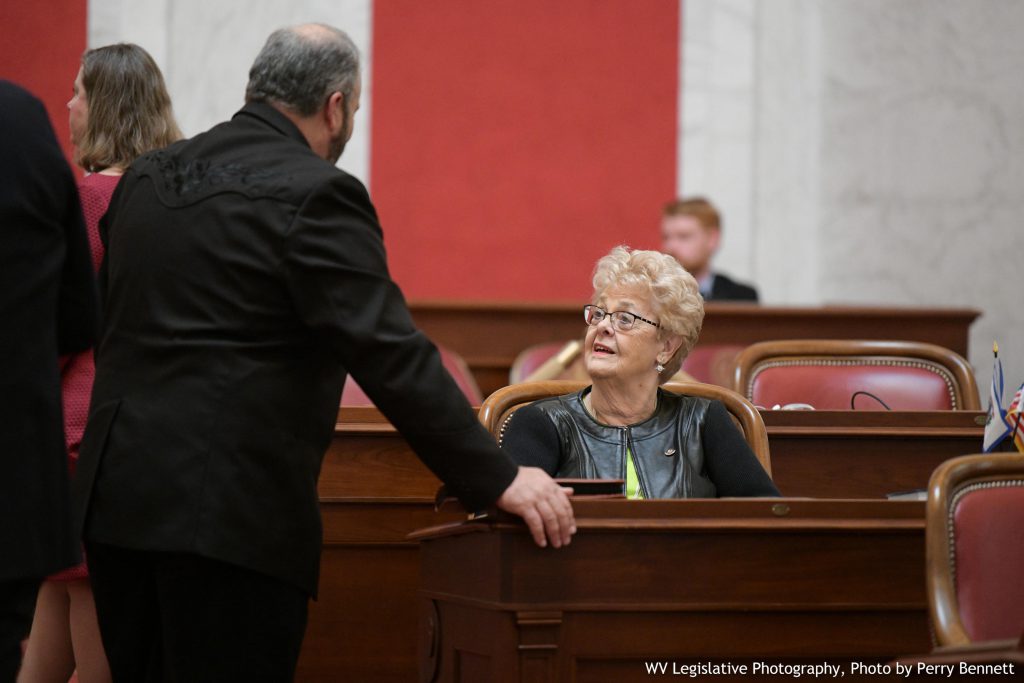
Boley will be the longest continuous serving senator come May and at one time was the Senate Minority Leader for three straight Legislature’s. PHOTO: Will Price

Sen. Donna Boley, R-Pleasants, also said she was excited to see Rucker selected to chair the Education Committee.

“Patricia will do a great job as education chair,” Boley said. “It’s great to have her here.”

Boley has seen much change since she was first appointed to the West Virginia Senate in 1985.

Boley is the president pro tempore. She previously was the minority leader in the 70th, 71st, and 72nd Legislatures and at one point in time was the sole Republican in the Senate.

“When I came in, there were about four or five Republicans—all guys,” Boley said. “The Democrats had some—maybe seven or eight women in the Legislature. … It later went down to where I was the only Republican woman.”

Boley, like Summers, didn’t picture herself in the Legislature. She previously was chairwoman of the Republican Party in Pleasants County. After the governor appointed a state senator to fill a circuit judge vacancy judge in Pleasants County, Boley found herself on a short list of possible replacements to fill the Senate seat. And the rest is history.

“As of May 14, I will have been here 34 years,” she said, noting by that time, she will be the longest continuous serving senator.

Boley served on the judiciary until she became minority leader in 1991. She likes serving on the Finance Committee but says sometimes she misses Judiciary.

“Judiciary is a hard committee but you learn a lot from it,” she said, later adding. “I like Finance, though. You see where the money goes.”

Boley, who is the chairwoman of the Confirmations Committee, said a goal is for the committee to meet more often.

“Sometimes, we would go six months without a meeting or approving someone,” she said. “Then, the minute you go back in session, you have to approve them. … We need to have more meetings so if we have problems, we can let the governor know in case he needs to withdraw one.”

For Boley, her favorite part about being a senator isn’t necessarily introducing or passing legislation. Her favorite part is helping constituents. She recalled various phone calls she’s received about issues affecting people back home, including issues with water lines or roads.

“These are the things I like to do,” she said. “I like helping constituents. Sometimes, they don’t know where to go so I like to help them.”

Summers feels the same way, whether she’s working in the ER or in the Capitol.

“I get my most joy when I go to work in the ER,” she added. “I get to make a difference in someone’s life that day, help them cope with a crisis and make them feel better. That brings me joy—changing people’s lives here and in the ER.”


House Finance Committee Hears WV Supreme Court Budget Presentation

0

The House Committee on Finance heard a budget presentation from the West Virginia Supreme Court of Appeals for the first time Friday morning.

This is the first budget hearing from the state Supreme Court since the passage of Constitutional Amendment 2, which allows for legislative oversight over how the state Supreme Court spends its money.

Chief Justice Beth Walker presented the court’s budget for the 2020 fiscal year, which was held constant with Gov. Jim Justice’s budget recommendations.

Walker first gave the committee an outline of how the court system in West Virginia operates with a detailed list of employee numbers across the state courts for the fiscal year of 2018. Personal services make up 80 percent of the court’s budget. The appropriations for the fiscal year of 2019 equaled about $139.9 million.

Walker proposed her budget for the fiscal year of 2020, which requests $131,150,000 in total general revenue. Most of this will be used to pay employees within the Court, and help establish guardian ad litems, guardians, and mental hygiene commissioners throughout the state. A chunk of this will also be used to help provide the computer equipment needed to counties implementing the new CourtPLUS e-filing software, which is due to be fully implemented within the state by 2021.

Walker also unveiled the new financial policies that the West Virginia Supreme Court will be utilizing this year to increase transparency for the agency. These new policies include more oversight over travel and use of state vehicles, the acceptable use of court information systems, and purchasing cards to track fixed court assets.

“We see this presentation as the beginning of the partnership between the judiciary and the legislative body of this state,” Walker said. “We want the public to be confident that we’re being transparent and straight-forward.”

A lot of the delegates’ questions focused on the possibility of an intermediate court in West Virginia. The current budget doesn’t account for the existence of one. Senate Bill 2, a major piece of legislation for this session, would create an Intermediate Appellate Court for the state. This would help to alleviate the case load on the existing state courts.

Although West Virginia Supreme Court has not taken an official position on the proposed bill, Walker briefly addressed the subject in the budget hearing.

“The state constitution has vested the power within this body of government to decide if this is what’s best for the state,” Walker said. “We do want to be a part of the conversation if it does pass.”

A major concern for the West Virginia Supreme Court is the alarming increase of abuse and neglect cases that their court sees. Walker stated that out of the 937 cases filed in the past year, the vast majority of those were domestic abuse and neglect case. She said that these cases have increased 54 percent in the state of West Virginia in the past year. Walker said the Supreme Court was assisting the state courts who hear these cases by providing continuing education for their employees and administrative support for difficult cases that they may face.

Walker concluded the presentation and maintained that the justices, which were all present during the committee meeting, are committed to transparency and cooperation with the legislature.

Delegate Isaac Sponaugle, D-Pendleton, proceeded to address “the elephant in the room.”

“The elephant in the room is that we impeached essentially an entire branch of government last year,” Sponaugle said. “That being said, I greatly appreciate the transparency efforts that you all have made by presenting this. It’s great that you’re going to be working with us.”

Walker addressed this by pointing to an allegorical storm.

“After a storm, you have to figure out how to repair. We’ve assessed the damage, and now we are committed to those repairs,” Walker said.

Senate Finance Discusses Senate Bill 1

0

The Senate Finance Committee agreed to add a committee substitute for the committee substitute for Senate Bill 13 p.m. Thursday, Jan 17.  

During the committee, the bill was reviewed and highly discussed between Senators. One in particular, Sen. Roman Prezioso, D-Marion, showed concern over Senate Bill 1, which would increase access to career education and workforce training through Associate’s Degrees at community and technical colleges.  

“We’ve got a relatively fragile higher education system in West Virginia,” Prezioso said. “We have so many students that have the opportunity to choose education from several different sources of higher education. As we pit one group against the other we’re not exactly enhancing students. It seems as though we’re taking students that intend to go one and we’re dividing them.” 

Sarah Armstrong Tucker, chancellor of Community Technical College Systems, assured the committee that the bill isn’t intended to divide students but help create easier pathways for students.  

This is an attempt to make pathways for more open for students so they could potentially start at a community college,” Tucker said.  

Prezioso addressed the Chancellor and asked if the committee could potentially amend the bill to apply it to Associate’s Degrees at four year colleges in addition to two year college and technical programs.  

Tucker said she and her peers would be more than happy if the committee amended the current bill, but was concerned that including regional schools would put too much strain on the bill. Tucker explained that the bill was also introduced last year with the inclusion of four year regional programs and said that was one of the reasons why the bill didn’t pass.  

The current fiscal note on the bill stands at $7,677,294.  

Tucker also explained that a similar proposal was recently put into place in Tennessee where higher education system saw a four percent increase in community college enrollment. She said that although many people believe this bill would mainly affect students who are currently enrolled in a fouryear program, she said the bill could also encourage more people to start a two-year program.  

“We need to acknowledge that 55 percent of the state’s recent high school graduates are said to not be going anywhere,” Tucker told the committee. “I think this bill could help us target people who had no other plan. It’s vital that we don’t leave those people out of the conversation.” 


11 of 55 West Virginia School Districts Have Low Enrollment

0

Amy Willard, executive director of the Office of School Finance at the West Virginia Department of Education, updated the Senate Education Committee on the current school funding formula, 2 p.m. Thursday, Jan. 17.  

Willard addressed the committee and explained that 11 of the state’s 55 school districts currently have less than a 14,000 net enrollment rate for the 2018-2019 school year which classifies the counties as having low enrollment.” 

According to Willard, a large portion of the education funding is based on enrollment and full-time equivalence, also known as FTE, and calculated through a 10 step system. These seven steps review professional educators, service personal, fixed charges, transportation, student support personnel and other current expenses, and recieves the majority of the funding.

The committee learned that the fiscal year 2020 budget was calculated from the Department of Education’s spending in 2018. Willard explained that the budget is calculated though a year lag system where the budget is derived from spending made the previous year.   

In total, Willard said that the department’s budget request is set at $1,124,000 for fiscal year 2020.  

“Despite an increase in in enrollment pay, a drop in student enrollment in the state did account for a drop in the proposed budget for the upcoming year,” Willard said. 


Three Bills Considered in House Health and Human Resources

0

The House Committee on Health and Human Resources convened at 2 p.m. on Thursday, Jan. 17 in 215-E to consider three pieces of legislation.

House Bill 2405 was the first bill on the agenda, which passed the House of Delegates unanimously last year. This bill would impose a tax on health management organizations in order to maximize Medicaid dollars within the state.

House Bill 2405 was approved unanimously within the committee, and advanced to the House Floor with the recommendation that it pass but first go to the House Finance Committee for second reference.

The committee then revisited a bill that had been previously laid over, House Bill 2347. This bill would require the Secretary of the West Virginia Department of Health and Human Resources (DHHR) to modernize or rebuild two West Virginia state hospitals, Jackie Withrow and Hopemont hospitals. These hospitals, which are primarily used to long term care for elderly and substance abuse patients, are both nearly a century old.

Amendments were discussed at length amongst the committee.

Delegate Andrew Robinson (D-Kanawha), proposed an amendment to the bill that would require the Secretary of the West Virginia DHHR to modernize or rebuild the two state hospitals, and then if the state were to choose to contract those facilities out, an institution of higher education within the state (likely Marshall or West Virginia University) would have the right of first refusal. Robinson argued that this amendment was to ensure that innovative treatment for substance abuse victims and long term patients would still be progressed even if the secretary chose to sell the facilities.

Delegate Amy Summers (R-Taylor) stood in opposition to the amendment, arguing that giving institutions of higher education the right of first refusal added unnecessary bureaucracy to the process.

Robinson’s amendment to the bill failed.

Delegate Barbara Fleischauer (D-Monongalia) also proposed an amendment to House Bill 2347, for the sake of clarity.

The amendment would maintain the amount of beds currently present at Jackie Withrow and Hopemont hospitals (198 and 89 beds respectively) instead of adding to that count. It also clarifies that these beds are to be used for long term care patients.

Fleischauer’s amendment passed through the committee unanimously. As amended, the bill advanced to the House Floor with the recommendation that it should pass, but first go to the House Finance Committee for second reference.

Finally, House Bill 2324 was considered by the committee. This bill, if passed, would allow for the state acupuncture board to issue certificates to those who wish to become certified in the practice of acudetox therapy. This form of acupuncture, which releases toxins from the ear, would be available for health professionals other than those who practice acupuncture to become certified. It is argued to be beneficial to individuals who are experiencing the physical effects of drug withdrawal, as well as patients seeking therapeutic relief.

House Bill 2324 was advanced to the House Floor with the recommendation that it do pass, but it first gets a second reference from the House Committee on Government Organization.

Senate Judiciary Committee Amends Gun Legislation on Capitol Grounds

0

The Senate Judiciary Committee met Thursday afternoon to discuss crimes at the state Capitol Complex.

Senate Bill 18 proposes an amendment to the current West Virginia code having a concealed carry on Capitol grounds. The bill would allow people to keep a handgun in their motor vehicle that is parked on Capitol property without requiring them have a valid concealed handgun license. 

The Committee voted unanimously to approve the bill, and was reported to the Senate to be voted upon.

RA

Committee on Seniors, Children, and Family Issues Passes Bill to Update Foster Care

0

The Committee for Seniors, Children, and Family advanced a bill that seeks to update foster care regulations. This bill addresses multiple issues currently affecting the foster care crisis in the state such as getting appropriate help for children’s mental health and how proceedings should be dealt with children moving from different states.  This bill would also affect the amount of safety checks done for foster homes.

In Thursday’s meeting, the committee took up House Bill 2010. The committee discussed the bill in depth and advanced the bill. House Bill 2010 also is referenced to the Health and Human Resources and the Judiciary committees.

The committee also heard from Jennifer Taylor, staff attorney for West Virginia Legal Aid. Taylor spoke to lawmakers about senior issues.

One major issue Legal Aid has seen is an increase in cases relating to undue influence. This is an influence where a person is induced to act otherwise than by their own free will or without adequate attention to the consequences. This can be done to a senior who is completely capacitated and of sound mind.  West Virginia Legal Aid would like to work with lawmakers further to help this problem and how it is addressed in court cases.

TH

Health Committee Works on Updating West Virginia Code

0

The Senate Committee on Health and Human Resources met Thursday afternoon to discuss four bills.

Senate Bill 63 relates to partial filling of prescription drugs. The bill would update West Virginia code to be complacent with the federal code. The bill would allow a pharmacist to partially fill a prescription, and provides new regulations on how to refill the rest of the remaining prescription.

Senate Bill 136 would add electronic cigarettes (E-Cigs) to the same list as other tobacco products that are prohibited on public school property. The bill would also increase the penalty for anyone who would violate carrying tobacco products on public school property.

Senate Bill 169 relates to minor rule changing to assisted living residencies.

Senate Bill 310 relates to health insurance companies and dentists. The bill would prohibit insurers from requiring dentists to provide discount on non-covered services, and prohibit dentists from charging more for covered persons on non-covered services.

All four bills were passed by the Committee. Senate Bill 63, 136, and 169 were referred to the Committee on Judiciary. Senate Bill 310 was referred to the Committee on Finance.

RA

DUI Bill Passes House of Delegates

0

HouseBill 2183The House of Delegates convened at 11 a.m. on Thursday, Jan. 17 in the House Chamber to consider legislation.

Several bills were introduced in the House and referred to the appropriate committee on this day. Of these bills includes House Bill 2010, which works to reform foster care regulation in the state. This strike and insert legislation would change a lot of the jurisdiction over the state foster care system to be under the Division of Corrections and Rehabilitation rather than the Division of Juvenile Services. This bill was referred to the House Committee on Senior, Children, and Family Issues.

Several bills reached third reading in the House.

House Bill 2028, which would require state engineers to observe the laying of road lines periodically instead of throughout the duration of the project, passed through the House unanimously.

The committee substitute for House Bill 2038 generated a lot of conversation on its third reading. This bill, if passed, would not require the regulation of an occupation if it isn’t regulated in 25 or more states.

Delegate Andrew Robinson (D-Kanawha), stood in opposition against the bill, arguing that the process for licensure is meant to protect the public and any legislation working to reduce oversight could be harmful.

Delegate Gary Howell (R-Mineral), one of the lead sponsors of the bill, argued that the legislation would not directly remove any occupational licensing requirements until they go through additional legislative preclearance.

“There’s no removal of licenses,” Howell said. “It just provides another step for review.”

House Bill 2038 passed through the House after lengthy discussion.

House Bill 2128, which would allow state employees to take paid leave to attend parent-teacher conferences, passed through the House unanimously.

Another House Bill that raised controversy was HouseBill 2183, which would allow for intoxicated individuals to operate a motor vehicle on their personal property without being subject to a DUI.

Delegate John Shott (R-Mercer), an advocate for this legislation, clarified that West Virginia citizens should have the right to do what they want on their personal property, as long as it causes no injury or death. He clarifies that if somebody is operating a motor vehicle on their property and it does cause injury or death, they would then be subject to a DUI charge.

The bill generated lengthy discussion regarding the definition of “private property” and if private roads and large clearings are included under that operational definition. Because of the function of this definition, several delegates were “uncomfortable” with voting through the House Bill.

Despite this, House Bill 2183 passed almost unanimously.

Bills on second reading included a piece of strike and insert legislation regarding animals in motor vehicles, House Bill 2185. This bill would allow agents acting at their official capacity to break into an enclosed motor vehicle to rescue animals that they believe are in danger.

The House Committee on Judiciary proposed to add language to the bill that would further protect the professionals who are permitted to enter these vehicles. This amendment passed.

House Bill 2307, which would create provisional licenses for cosmetologists and barbers throughout the state, also advanced without any proposed amendments.

Bills on first reading were all referred to their appropriate committees.

The House of Delegates will reconvene at 11 a.m. tomorrow, Friday Jan. 18, in the House Chamber.

Committees Meeting Today After 11am:

  • The House Committee on Senior, Children, and Family Issues will meet at 1 p.m. today, Thursday, Jan 17, in 215-E.

  • The House Committee on Health and Human Resources will meet at 2 p.m. today, Thursday, Jan 17, in 215-E.

  • The House Committee on Energy will meet at 2 p.m today, Thursday Jan. 17, in 410M.

  • The House Committee on Prevention and Treatment of Substance Abuse will meet at 3:30 p.m. today, Thursday, Jan. 17, in 215-E.

  • Committees Meeting Tomorrow Before 11am:

  • The House Committee on Education will meet at 9 a.m. tomorrow, Jan. 18, in 434-M.

  • The House Committee on Finance will meet at 9 a.m. tomorrow, Jan. 18, in 460M for a presentation on the West Virginia Supreme Court’s budget.

  • The House Committee on Government Organization will meet at 9 a.m. tomorrow, Jan. 18, in 215-E.

  • The House Committee on the Judiciary will meet at 9 a.m. tomorrow, Jan. 18,  in 410-M.