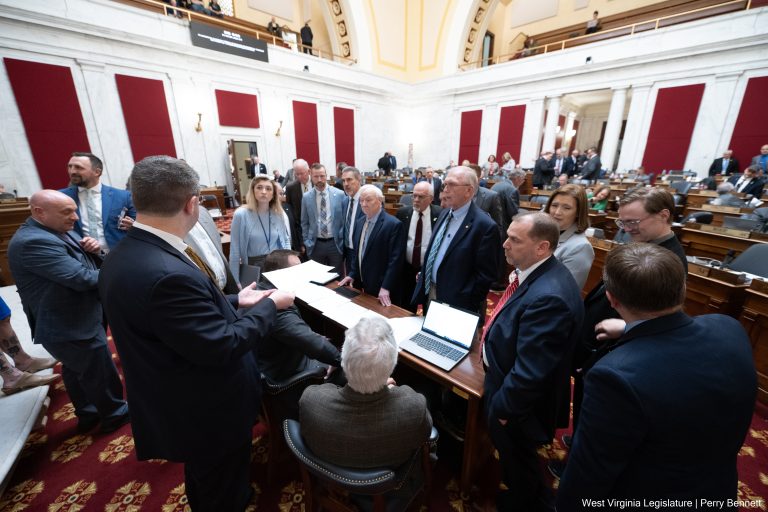


306 Bills completed legislative action (153 House Bills, 153 Senate Bills)
2777 Bills were introduced (1693 House Bills, 1084 Senate Bills)
Senate Bill 1, The West Virginia First Small Business Growth Act establishes a program administered by the West Virginia Department of Commerce to encourage capital investment in eligible West Virginia businesses.
The program allows “growth funds” (entities that invest in businesses) to apply for certification of their capital investments, which are defined as equity investments made in exchange for cash that are then used to invest in West Virginia businesses with fewer than 250 employees and their principal business operations in the state.
If approved, these growth funds can receive “capital investment authority,” which is then used to issue capital investments to “growth investors” (entities making the initial investment in the growth fund). In return for making these capital investments, growth investors are eligible for a tax credit against their state tax liability, with the credit amount determined by an “applicable percentage” of their investment over several years.
The legislation outlines procedures for application, certification, and the use of these tax credits, including provisions for recapturing credits if the growth fund fails to meet its investment obligations or violates certain prohibitions, such as eligible businesses investing back into growth funds.
The Department of Commerce is responsible for certifying capital investment authority, ensuring that no more than $15 million in credits are claimed annually, and growth funds must submit annual reports detailing their investments and their impact on job creation and wages.
Senate Bill 4 establishes a new law in West Virginia that creates a 30-foot barrier around “first responders,” which are defined to include law-enforcement officers, probation officers, firefighters, and emergency responders, when they are lawfully performing their duties.
The legislation makes it a misdemeanor offense, punishable by a fine of up to $500 or jail time of up to one year, for any person to knowingly and willfully approach or remain within 30 feet of a first responder after receiving a verbal warning to stay back, if their actions impede the first responder’s duty, threaten physical harm, or “harass” them, meaning to intentionally cause substantial emotional distress without a legitimate purpose.
Senate Bill 28 allows members of the State Police retirement system to use their accrued leave, meaning unused annual or sick leave days, to gain additional credited service towards their retirement.
Specifically, for those who joined the retirement system after July 1, 2015, each day of accrued leave will count as one day of credited service, with 20 days making up a month of retirement credit, and any remaining days of 10 or more also counting as a full month.
Senate Bill 29 institutes pay increases for various members of the judiciary in West Virginia, including magistrates, justices of the Supreme Court of Appeals, circuit court judges, family court judges, and judges of the Intermediate Court of Appeals, with specific salary adjustments scheduled to take effect on different dates between July 1, 2021, and July 1, 2028.
Additionally, the bill mandates that employees contribute a certain percentage to the judicial retirement system, while suspending the employer’s contribution until a specific condition related to the fund’s financial health is met.
Senate Bill 44 establishes new regulations for the sale of homemade food items in West Virginia, aiming to support small-scale food production and the local food industry. It defines “cottage foods” as food items produced and sold directly to consumers from a producer’s residence, excluding meat, poultry, seafood, and Grade A dairy products.
While vendors selling “nonpotentially hazardous cottage foods” (foods that don’t require refrigeration) are exempt from most state regulations, those selling “potentially hazardous cottage foods” (foods that do require time or temperature control for safety, such as acidified foods) must obtain a permit from the Department of Agriculture.
The Department will set the conditions for these permits, which may include inspections, and will also have jurisdiction over these potentially hazardous homemade foods. Local health departments can halt production if an imminent health hazard is identified but must consult with the Department of Agriculture.
The legislation also mandates that the Department of Agriculture create rules to implement these provisions and clarifies that farmers market vendors selling potentially hazardous products will not have to pay a fee for their permits, aligning them with home-based vendors.
Senate Bill 54 establishes criminal penalties for the abuse or neglect of incapacitated adults, who are individuals 18 or older unable to carry out daily activities necessary for life and health due to age, physical, mental, or other infirmities.
The legislation introduces a definition for “gross neglect” as reckless or intentional caregiver conduct that disregards an incapacitated adult’s health, safety, or welfare.
The bill removes the requirement of “malice” (intent to harm) for felony charges related to caregiver actions that result in bodily injury, serious bodily injury, or death to an incapacitated adult, making it easier to prosecute such cases. It legislation also clarifies that offenses under these provisions are separate from other existing criminal offenses.
Senate Bill 59 clarifies and strengthens voter eligibility and residency requirements in West Virginia, specifying that individuals must be legal residents of the state, county, or municipality where they intend to vote.
It defines “legal resident” as someone domiciled in a location with both physical presence and the intent to remain indefinitely, and outlines various factors for determining residency, such as where a person spends their time, their place of employment, and the addresses on their government-issued documents.
The bill also establishes procedures for challenging a person’s residency during voter registration, including notice requirements and the opportunity for the individual to provide evidence of their residency, and clarifies rules for determining residence, especially in cases of divided living situations or non-traditional housing.
Senate Bill 63, titled the Creating Sustaining Opportunities for Academics in Rural Schools Act, aims to support rural communities by ensuring continued access to local schools and preventing unnecessary consolidation.
The legislation introduces a new section to the code that establishes “rural in-person public charter schools” designed to serve “eligible students,” defined as those living in rural areas where the commute to the nearest non-charter public school exceeds 45 minutes by bus.
These rural charter schools will operate under the sponsorship of existing public charter schools, which will provide administrative, operational, legal, financial, and curricular support. The bill also outlines funding mechanisms, including per-pupil funding and a supplemental amount for sponsoring schools, and details the governance structure for these rural schools, which will have their own distinct governing boards.
Additionally, the bill amends existing provisions related to public charter school applications to allow for abbreviated applications for currently authorized charter schools seeking to establish a second location or campus, a process that rural charter schools will also be able to utilize.
Senate Bill 84 establishes new rules for law enforcement’s use of surveillance cameras on private property in West Virginia. Generally, law enforcement officers are prohibited from installing surveillance cameras on private land to gather information or evidence about the property owner or occupant unless they have obtained either the owner’s consent or a valid search warrant. However, this prohibition does not apply to cameras placed in areas where an officer has a legal right to be and that face a location on private land visible to the public, nor does it apply in certain emergency situations where there isn’t enough time to get a warrant. The bill defines “private land” as posted, cultivated, or fenced land not owned by the government, and “surveillance camera” as a device on private land that records visual images of that land or activities on it, specifically excluding vehicle dash cameras and body cameras.
Senate Bill 104 provides a $5,000 salary increase to state mine inspectors, including those who specialize in electrical, underground, and surface mining, as well as any other inspector classification, effective July 1, 2026.
Senate Bill 137 modifies parole eligibility for individuals convicted of second-degree murder and voluntary manslaughter, and for those sentenced to life imprisonment. Specifically, it increases the minimum and maximum prison terms for second-degree murder to 15 to 60 years, requiring at least 15 years to be served before parole eligibility.
For voluntary manslaughter, the prison term is increased from 5 to 25 years, with a minimum of 5 years required before parole. The bill also raises the minimum imprisonment period before parole eligibility for individuals sentenced to life imprisonment, including those convicted of first-degree murder or repeat offenders, with specific increases for offenses committed on or after July 1, 2026.
Additionally, the legislation clarifies definitions related to felony offenses involving minor children and outlines conditions under which the Parole Board may waive certain required reports and allows for appearances at parole hearings via electronic teleconference.
Senate Bill 155 establishes a new pathway for individuals to teach in West Virginia by creating an “adjunct teaching permit,” which is a one-year permit that can be renewed based on performance.
To qualify for this permit, an individual must have at least four years of experience in the subject area they wish to teach or a college degree in that area, pass a criminal history check, and have no felony convictions or convictions related to sexual misconduct with a minor.
An adjunct teacher can fill a vacant teaching position, offer a new class, or supplement an existing program, but only if no certified teacher is available and willing to take the position.
These teachers can be hired full-time or part-time, with compensation and benefits determined by mutual agreement between the county board of education and the teacher.
They will be assigned a mentor, must complete specific training, and are prohibited from teaching special education. County school boards employing adjunct teachers are required to report detailed information about them to the West Virginia Department of Education, and vacant adjunct positions must be posted publicly and announced at board meetings.
Senate Bill 167 clarifies when local levying bodies can hold meetings and file reports later than usual, and it revises how reduced levy rates are calculated. The bill addresses situations where property appraisals lead to an increase in projected tax revenues, requiring a proportional reduction in levy rates to ensure revenues don’t exceed 101% of the previous year’s projected revenue, unless a public hearing is held and specific conditions are met.
It also allows for extensions of meeting deadlines for local levying bodies, particularly when a levy is on the ballot for a primary election and establishes a process for the State Auditor to grant permission for late meetings and report filings if good cause is shown.
Senate Bill 194 updates the definition of a “disabled veteran taxpayer” in West Virginia law to include individuals who have received an honorable discharge from the U.S. armed services and have been rated as having a 90 percent or greater service-connected disability by the U.S. Department of Veterans Affairs (VA), or who are eligible for individual unemployability according to the VA’s disability ratings. This clarification is important for determining eligibility for certain tax benefits available to disabled veterans in the state.
Senate Bill 197 increases criminal penalties and fines for various offenses involving children, specifically targeting sexual abuse and neglect. It raises the penalties for sexual assault in the third degree, which involves sexual intercourse or intrusion with a mentally incapacitated person or a person under 16 who is at least four years younger than the defendant, and for sexual abuse in the third degree, which is sexual contact with someone under 16 without their consent.
The bill also increases penalties for child neglect that results in death, where a parent, guardian, custodian, or person in a position of trust fails to care for a child, leading to their death. Furthermore, the legislation establishes and increases penalties for offenses where a parent, guardian, custodian, or person in a position of trust engages in or attempts to engage in sexual exploitation, intercourse, intrusion, or contact with a child under their care, regardless of the child’s consent or apparent injury.
The legislation includes new provisions for situations where such individuals knowingly procure, authorize, or induce another person to commit these acts against a child, with different penalties depending on whether the child is under 16, disabled, or 16 or older. Finally, the bill increases penalties for parents, guardians, custodians, or those in a position of trust who knowingly send, distribute, possess, display, or transport material depicting a child under their care engaged in sexually explicit conduct.
Senate Bill 200 increases criminal penalties and fines for assaulting certain public service workers, law-enforcement officers, and police animals in West Virginia.
It amends existing laws to establish new penalties for causing injury or death to “public safety animals,” which are defined as animals trained to assist public safety officers like law enforcement or fire investigators.
The bill also revises penalties for assaults on “government representatives” (any state or local government employee or contractor), “health care workers,” “utility workers,” “correctional employees,” and “emergency service personnel” (including firefighters and paramedics).
The new provisions include higher fines and longer prison sentences for various levels of assault, from simple battery to causing serious injury or death to a public safety animal, with specific penalties for repeat offenses. The legislation clarifies that the right to self-defense can be exercised by someone charged under these new provisions, and it includes an exception for euthanizing an injured or infirm public safety animal as part of official duties, while also requiring restitution when such an animal is killed or injured.
Senate Bill 207 clarifies that the county commission will decide if a sheriff has met the requirement to receive a $15,000 annual commission. This commission is an additional payment to the sheriff’s regular salary and is only allowed after the sheriff has successfully collected 85 percent of all taxes assessed on real and personal property.
Senate Bill 208 creates a new section of code that exempts certain classified and sensitive military records from public disclosure. Specifically, this exemption applies to information classified to protect national or state security, vulnerability assessments and response plans for terrorist acts, communication codes, deployment plans of the Department of Defense, armed forces, National Guard, or Department of Homeland Security, and specific intelligence or investigative records related to terrorist threats shared between various law enforcement and military agencies.
It also covers sensitive military information that, if released, could threaten public safety, endanger military personnel, or give an advantage to an adversary, including details about deployment, operational plans, tactics, rules of engagement, critical infrastructure security, and personnel and equipment information for the National Guard, armed forces, or Department of Defense.
Senate Bill 210 modifies oversight provisions for the Legislative Oversight Commission on Health and Human Resources Accountability (Commission) by requiring state departments involved in health and human resources to develop and submit detailed performance plans and reports.
These plans will outline specific, measurable goals for each program activity, along with indicators to track progress and outcomes, and the resources needed to achieve them. The departments will then submit annual program performance reports to the Commission, detailing their achievements against these goals, explaining any shortfalls, and outlining plans for improvement. The Commission, in turn, will provide an annual report to the Joint Committee on Government and Finance summarizing its activities, policy decisions, and recommendations for improving the efficiency and effectiveness of health and social services programs in the state.
Senate Bill 228 establishes two pilot programs within the West Virginia Department of Human Services to improve child abuse and neglect investigations and caseworker support.
The first program, a caseworker services pilot program, will contract with private entities to provide administrative support to caseworkers in the Bureau for Social Services, aiming to free up their time for direct interaction with children and families. This program will be implemented in up to three counties facing high caseloads, staff vacancies, or a significant number of children placed out-of-state, and will run for 15 months, with a report on its effectiveness to be submitted to the legislature.
The second program, a technology pilot project, will require the use of mobile devices, such as computers or tablets, to access the department’s case management system in two selected counties, starting October 1, 2027. This initiative aims to enhance and expedite real-time fact-gathering and data management during child abuse and neglect investigations by allowing Child Protective Services workers to create digital records that upload securely to the department’s servers. This technology pilot will run for five years, and annual reports on its progress will be submitted to the Legislative Oversight Commission on Health and Human Resources Accountability.
Senate Bill 231 attempts to reform West Virginia’s addiction care system by shifting from paying for the volume of services provided to paying for the quality of patient outcomes, a model known as value-based payment. Recognizing the state’s struggles with substance use disorder and overdose deaths, the legislation establishes a coordinated “continuum of care” encompassing prevention, treatment, and recovery support services. Key provisions include defining terms like “baseline year” (a period for collecting performance data to set benchmarks) and “value-based payment,” requiring the Bureau for Medical Services to establish standard billing codes for addiction services by early 2027, and mandating the collection and analysis of data to measure provider performance.
Specific outcome measures will focus on housing stability, sobriety, reduced involvement with the criminal justice and child welfare systems, self-sufficiency, and provider transition plans. The bill sets timelines for developing these measures, collecting baseline data starting in mid-2027, and implementing value-based payments by mid-2028.
Senate Bill 233 clarifies the qualifications for individuals seeking to become licensed as a psychophysiological detection of deception examiner, commonly known as a polygraph examiner, in West Virginia. It specifies that applicants must be at least 21 years old, a U.S. citizen, and have no felony convictions.
The bill also requires applicants to have an honorable discharge from the armed services, pass an examination demonstrating competency, complete a six-month internship, and meet other education or training standards set by the Commissioner of Labor, which must be at least as strict as those recommended by the American Polygraph Association. Importantly, it explicitly states that a Class I license (for general polygraph use) does not require a baccalaureate degree, and a Class II license (for law enforcement use on employees) does not require an associate degree.
The bill also outlines the Commissioner of Labor’s authority to administer tests, establish fees, and create legislative rules governing the administration of these examinations, including training, testing, equipment accuracy, and ethical standards.
Senate Bill 243, titled the West Virginia Disaster Repair and Recovery Tax Credit Act, establishes a new tax credit for businesses that are subject to West Virginia’s severance tax and business privilege tax, and that incur qualified expenses for disaster repair and recovery efforts.
A “disaster” is defined in the bill as a natural catastrophe like a hurricane, tornado, flood, or fire. “Eligible taxpayers” are those who make these qualified expenditures and are subject to the severance tax. “Expenditures for repair and recovery efforts” include costs for labor, materials, services, and equipment used to remove debris, repair damaged public property and infrastructure, and prepare sites for construction following a disaster, provided these costs do not exceed fair market value.
The credit allows an eligible taxpayer to claim up to $500,000 in credit per disaster, which can be applied against up to 20 percent of their annual severance tax liability (excluding certain specific taxes). Unused credit can be carried forward for up to 10 years, after which it is forfeited. To claim the credit, taxpayers must apply for certification of their repair and recovery project with the Secretary of the Department of Environmental Protection within 72 hours of starting the project, and the total amount of expenditures certified for the credit statewide is capped at $5 million annually.
The credit can be transferred to a successor business if the original business maintains a controlling interest or if the business is sold and continues to operate in the state. Taxpayers must maintain records to support their claimed expenditures, and both the Department of Environmental Protection and the Tax Commissioner are authorized to create emergency rules to implement this act, which becomes effective for tax years beginning on or after January 1, 2026.
Senate Bill 250, the Budget Bill, appropriates between $5.46 and $5.5 billion dollars of public money from the Treasury for the fiscal year 2027, which runs from July 1, 2026, to June 30, 2027. It outlines the general policy of economical and efficient discharge of state duties and defines key terms like “Governor,” “Code,” “spending unit,” and various types of funds such as “general revenue fund” and “special revenue funds.”
The bill classifies appropriations into categories like “personal services” (salaries and wages), “employee benefits,” “current expenses” (operating costs), “equipment,” “repairs and alterations,” and “buildings.” It also details rules for transferring funds between appropriations, with specific limitations and approvals required, and allows for the transfer of funds to match federal grants.
The bill then lists specific appropriations from various funds, including general revenue, the state road fund, other funds, lottery net profits, and federal funds, detailing amounts allocated to different state agencies and institutions for their operations and programs. Finally, it addresses appropriations for claims against the state, surplus funds, and specific funds and collection accounts, emphasizing that expenditures are conditional upon compliance with state financial laws.
Senate Bill 251 authorizes various agencies within West Virginia’s Department of Administration to create and implement legislative rules. Specifically, it allows the Department of Administration to establish a rule for its “One-Stop Shop Permitting Program,” designed to streamline the process for obtaining permits. The Office of Technology is authorized to create a rule for “cyber reporting,” likely concerning the reporting of cybersecurity incidents. Additionally, the Board of Risk and Insurance Management is empowered to promulgate three distinct legislative rules: one for “mine subsidence insurance,” another for the “public entities insurance program” which covers insurance for government bodies, and a third for the “Preferred Medical Liability and High-Risk Medical Liability Program,” which addresses insurance for medical professionals facing significant liability risks. These authorizations follow a process where proposed rules are filed, reviewed by the Legislative Rule-Making Review Committee, and potentially modified before being officially authorized by the Legislature.
Senate Bill 256 authorizes the West Virginia Department of Environmental Protection (DEP) to enact specific legislative rules. These authorized rules include those related to alternative emission limitations during startup and shutdown operations, ambient air quality standards, performance standards for new stationary sources, control of air pollution from burning solid waste, control of air pollution from hazardous waste treatment, storage, and disposal facilities, emission standards for hazardous air pollutants, and a cross-state air pollution rule to manage nitrogen oxides and sulfur dioxide emissions.
Additionally, the bill authorizes rules for the hazardous waste management system, requirements for water quality standards, and a fee schedule for carbon dioxide sequestration, with specific amendments made to the water quality standards and carbon dioxide sequestration rules after review by the Legislative Rule-Making Review Committee.
Senate Bill 281 authorizes various agencies within the Department of Homeland Security to create and implement legislative rules. Specifically, it allows the Governor’s Committee on Crime, Delinquency, and Correction to establish rules for law-enforcement training and certification standards. The Fire Commission is authorized to create rules for the fire code, and the State Emergency Response Commission can establish rules for emergency planning and community right-to-know, which informs the public about hazardous substances in their communities.
Additionally, the West Virginia State Police are empowered to create legislative rules concerning their career progression system, the provision of contracted police or security services, and the procedures for member grievances. These rules, after being reviewed and potentially modified by the Legislative Rule-Making Review Committee and the Legislature, will become official state regulations.
Senate Bill 309 authorizes the West Virginia Division of Motor Vehicles (DMV) to officially adopt and implement three specific legislative rules. These rules cover motor vehicle equipment, compulsory motor vehicle liability insurance (meaning mandatory insurance coverage for vehicles), and special purpose vehicles. The bill confirms that these rules, as filed with the State Register on specific dates and in one instance modified to address concerns from the Legislative Rule-Making Review Committee, are now authorized by the Legislature.
Senate Bill 374 authorizes various agencies within the West Virginia Department of Commerce to create and implement legislative rules. Specifically, it allows the Division of Economic Development to establish rules for tourism development districts, the Division of Forestry to certify managed timberland, and the Division of Labor to regulate child labor.
The Office of Miners’ Health, Safety, and Training is authorized to create rules for mine safety programs, and the Division of Natural Resources can now issue rules concerning small arms hunting, wildlife rehabilitation, special boating regulations, defining hunting and trapping terms, hunting and trapping prohibitions, deer hunting, and special migratory game bird hunting.
Finally, the Division of Rehabilitation Services is authorized to create rules for the Ron Yost Personal Assistance Services Act Board.
Senate Bill 392 enacts significant changes to West Virginia’s personal income tax structure, by reducing tax rates. Starting January 1, 2026, the bill introduces new, lower graduated income tax rates for individuals, married couples filing jointly, heads of households, and estates and trusts, as well as for married individuals filing separately.
It also reduces the tax rate on certain composite returns and on withholding tax for nonresidents, including income from the sale of real estate and lottery winnings, from 6.5 percent to 4.58 percent. Furthermore, the bill establishes a mechanism for future, contingent personal income tax rate reductions, which will be triggered if the state’s general revenue fund collections exceed inflation-adjusted base year revenues, with these reductions beginning in taxable years after August 15th of the determination year and capped at a 10 percent overall reduction.
Senate Bill 393 updates West Virginia’s corporate net income tax laws to align with federal tax definitions, ensuring that terms not explicitly defined in state law are interpreted the same way they are for federal income tax purposes.
Specifically, it mandates that any changes to federal tax laws made between December 31, 2024, and January 1, 2026, will be applied to West Virginia corporate income taxes, regardless of whether those federal changes are retroactive or prospective, but it will not incorporate any federal tax law amendments made on or after January 1, 2026.
Senate Bill 400 updates West Virginia’s personal income tax laws by aligning the definition of federal adjusted gross income with federal tax law changes made between December 31, 2024, and January 1, 2026, ensuring that state taxes reflect these federal adjustments.
It also preserves a specific state provision allowing taxpayers to deduct gaming and gambling losses, even if federal law changes how these losses are treated. Additionally, it provides specific definitions for terms like “surtax” related to medical savings accounts and clarifies how certain federal tax concepts, like personal exemptions and the definition of “low income” for senior citizen property tax credits, are to be interpreted for state tax purposes, particularly for taxable years beginning on or after January 1, 2018, and January 1, 2026.
Senate Bill 402 establishes the West Virginia Micro-Credential Program under the authority of the West Virginia Higher Education Policy Commission to create a standardized and credible system for recognizing specific skills and knowledge gained by individuals, whether through traditional education or other experiences.
The program aims to help students and employees better demonstrate their mastery of skills, such as critical thinking or communication, which are valuable for employment but not always captured by traditional grades or assessments. This initiative is particularly beneficial for those in manual labor and skilled trades, offering a cost-effective alternative to traditional higher education for workforce development, and will also allow state higher education institutions to integrate these micro-credentials into degree programs to enhance students’ practical skills and employability.
The West Virginia Higher Education Policy Commission will be responsible for developing standards for identifying skills, designing and validating micro-credentials, creating a platform for managing and sharing them, and ensuring their security and the individual’s control over their educational records, while also verifying that these credentials lead to measurable workforce improvements and assisting higher education institutions in implementing high-quality micro-credential offerings aligned with workforce needs.
Senate Bill 427 modifies West Virginia law concerning loan documentation for licensed residential mortgage lenders, brokers, or servicers, specifically regarding loan fees or points. It clarifies that while licensees must document and maintain records of benefits to the borrower when refinancing a loan within 24 months, they are not required to refund appraisal fees paid to unrelated third parties if the loan is not made, unless federal law mandates it.
The bill also addresses limitations on aggregate fees and compensation for arranging, originating, or servicing loans, distinguishing between situations with and without yield spread premiums, and reiterates that these state law limitations apply even if they override federal preemption on first lien residential mortgage loans.
Senate Bill 459 West Virginia law to ensure that a child has meaningful contact with their step-siblings, provided that the child has an established bond with the step-sibling and the step-sibling lives at least part-time with the biological parent. This change is being made to the section of the code that outlines the objectives of family law, specifically focusing on the best interests of the child, which includes promoting stability, parental agreement, continuity of attachments, and positive relationships with adults who care for the child. The bill adds step-sibling relationships to the existing provisions that already recognize the importance of contact with biological and half-siblings.
Senate Bill 467 clarifies and strengthens enforcement of parking spaces designated for Purple Heart recipients, who are military members wounded or killed in action.
Specifically, it introduces an affirmative defense for Purple Heart recipients if they are accused of improperly parking in a space designated for them, meaning they can avoid penalties by proving they are indeed a Purple Heart recipient. The bill also mandates that signs for these designated parking spots clearly state the potential fine of up to $500 for violations.
Senate Bill 481 makes two primary changes to West Virginia law: first, it amends existing statutes to require that election results from each precinct, which is now referred to as a “polling location” to avoid confusion with broader territorial divisions. It mandates the results to be reported separately, ensuring that data from individual voting sites is not aggregated and potentially obscured.
Second, the law clarifies definitions within election law by changing the term “precinct” to “polling location” throughout the relevant sections, aiming for greater clarity and consistency in how election administration is described.
Senate Bill 490 establishes a process for approving short-term workforce training programs for eligibility for federal Workforce Pell Grants, which are financial aid awards for students pursuing higher education.
The West Virginia Workforce Development Board, in collaboration with the Governor, will be responsible for determining which programs meet the federal criteria. These criteria include ensuring the training aligns with high-skill, high-wage, or in-demand industry sectors or occupations, meets employer hiring needs, and leads to a recognized credential or prepares students for further education.
Institutions offering approved programs must report annually on completion rates, job placement, and earnings. The bill defines “short-term workforce training program” as one lasting between 150 and 600 clock hours, or an equivalent in credit hours, over a minimum of eight but less than fifteen weeks. This initiative aims to make federal financial aid accessible for shorter, career-focused training programs, with the provisions taking effect on July 1, 2026.
Senate Bill 499 requires that in the event of a fatal motor vehicle crash, a surviving driver involved must undergo a preliminary breath test to check for alcohol. If there is probable cause to believe the driver committed an offense related to alcohol or controlled substances, they can be required to submit to a secondary test, which could be a breath or blood test, though a blood test without consent would require a warrant.
The bill also clarifies that only qualified medical professionals can withdraw blood for these tests and grants immunity from civil and criminal liability to those conducting the tests, as well as to physicians and law enforcement officers involved in fatal crashes where blood is drawn from deceased individuals to determine alcohol content. This expands existing law that already mandates blood tests for deceased drivers and adult pedestrians involved in fatal crashes.
Senate Bill 502, known as the Women’s Collegiate Sports Protection Act, intended to safeguard and enhance women’s collegiate Olympic sports programs in West Virginia by establishing permanent endowment funding.
The legislation recognizes the valuable educational and leadership opportunities these programs offer and addresses their financial instability.
The legislation allows eligible institutions to create these endowments, with the West Virginia Higher Education Policy Commission potentially overseeing a statewide trust.
The bill introduces a system of “efficiency-based matching funds,” where institutions can receive state matching contributions to their endowments based on verified cost savings achieved through operational efficiencies, provided these savings do not negatively impact academic programs or Title IX compliance.
Earnings from these endowments can only be used for specific expenses directly related to women’s sports, such as scholarships, coaching, equipment, and facilities. The bill also mandates annual reporting from institutions to HEPC and from HEPC to the Legislature, along with periodic audits, to ensure transparency and compliance with Title IX. The act is set to take effect on July 1, 2026.
Senate Bill 506 allows county commissions in West Virginia to lease, rent, or permit the use of county-owned wireless towers to various entities, provided these entities meet specific criteria designed to protect citizens’ rights and critical infrastructure.
Under the legislation, county commissions cannot charge public safety operations, the West Virginia Division of Highways, or other state agencies for using these towers, though they can recover actual and reasonable costs associated with installation and operation.
The bill also mandates that county commissions conduct due diligence before allowing any entity to use the towers and shields them from liability for damages if they perform this due diligence and an entity still fails to meet the requirements.
Senate Bill 531, known as the First Amendment Preservation Act, prohibits West Virginia state agencies from entering into contracts with companies that rate or rank news sources for accuracy or bias, or with advertising agencies that use such “media reliability and bias monitors.”
The act aims to prevent state money from funding viewpoint discrimination and ensure state advertising reaches a broad audience regardless of political ideology.
The bill also prohibits state contracts with entities connected to foreign adversaries or terrorists as defined by federal law, requiring companies bidding on state advertising or marketing contracts to certify they are not media reliability and bias monitors and will not use their services. The provisions of this act will take effect on July 1, 2026, applying to contracts executed or renewed on or after that date.
Senate Bill 553 allows a contractor’s license to be transferred to a qualifying immediate family member, defined as a spouse, child, sibling, or parent. Previously, licenses could only be transferred to a new business entity where the license holder was the principal owner, partner, or corporate officer.
Under this new provision, an immediate family member can apply to transfer the license, and while they can operate under the license for one year without an exam, they must successfully complete any required board examination within that year to maintain it long-term.
This transferability also applies in cases of the original license holder’s death or permanent incapacity, with similar examination requirements for the family member. The bill also clarifies that a license cannot be transferred again by the initial transferee until they have passed the required examination, unless they die or become permanently incapacitated before doing so.
Senate Bill 556 modifies the rules for which insurance policy is considered primary, meaning the first to pay out, when someone is driving a vehicle provided by a business that sells, repairs, leases, or services motor vehicles.
Generally, if a customer is given a replacement vehicle while their own is being worked on, and they aren’t paying extra for it, their own insurance will be primary, and the business’s insurance will be secondary. However, if the driver is an employee of the business and is using the vehicle for work, the business’s insurance will be primary.
The bill also clarifies that security requirements for these businesses are secondary to other available insurance for the individual using the vehicle, unless the individual pays extra for specific rental or leasing company insurance, which would then be primary.
Senate Bill 558 is intended to enhance school bus safety by allowing video evidence from school buses to be sent to law enforcement for violations, creating a new, more serious offense called “aggravated illegal passing of a stopped school bus.”
This offense would cover violations that occur under specific dangerous circumstances like speeding or when children are present outside the bus, and would establish stricter criminal penalties, including mandatory jail time and license suspensions, for these offenses.
Additionally, under the new law, any driver convicted of passing a stopped school bus or committing the aggravated offense will be required to complete a driver education safety course before their driving privileges can be reinstated.
Senate Bill 570 makes a supplementary appropriation of federal funds to the Department of Health for the fiscal year ending June 30, 2026, specifically for the Central Office under fund 8802 and organization 0506. This means that additional federal money, which was previously unallocated, is now being made available for use by the Department of Health. The bill appropriates $199,476,099 in federal funds for the “Rural Health Transformation Program” within the Department of Health’s Central Office.
Senate Bill 573 modifies West Virginia law concerning disclosures and recordkeeping for mortgage loans, aiming to reinforce state regulations and streamline processes.
Key provisions include mandating that the maximum late payment penalty be clearly disclosed to borrowers, requiring borrowers to sign their closing statements, and clarifying that a separate state-specific closing disclosure is not necessary if all required information is included in the federal closing disclosure.
This is intended to ensure borrowers are fully informed about the terms of their mortgage loans, including any charges for late payments, while also reducing redundant paperwork by allowing federal disclosures to satisfy state requirements when they contain the necessary details.
Senate Bill 574 clarifies the disclosure requirements for out-of-state banks acquiring West Virginia state-chartered banks or their branches.
Specifically, the bill mandates that an out-of-state bank must confirm in writing to the West Virginia commissioner that it will comply with state laws, including consumer protection laws, ensure its deposits in West Virginia are insured, and if it is state-chartered, meet the state’s capital requirements, as long as it maintains a branch in West Virginia.
This provision aims to provide clarity and ensure continued compliance with West Virginia regulations when interstate bank mergers occur.
Senate Bill 575 clarifies the roles of legal representatives in refusal review hearings, which are hearings to determine if a person refused to take a secondary chemical test after being arrested for a traffic violation.
Specifically, the bill mandates that either the county’s prosecuting attorney or the municipality’s legal representative must attend and handle all matters related to these hearings to protect the state’s interests.
The bill also explicitly states that these legal representatives will not act as legal counsel for the Commissioner or the Division of Motor Vehicles (DMV), and that the DMV is not considered a party in these refusal review proceedings.
This legislation is intended to ensure clear lines of responsibility and prevent conflicts of interest in cases involving license revocations due to test refusals.
Senate Bill 581 amends West Virginia’s school attendance law to expand the definition of “excused absence” for students. Specifically, the bill allows students up to five college visits per year as an excused absence and includes participation in certain student organizations like 4-H, FFA, SkillsUSA, Future Business Leaders of America (FBLA), and Health Occupations Students of America (HOSA) as valid reasons for excused absences.
When students participate in these sanctioned activities, they will be credited as present and will not be counted as absent. The bill requires that students make up any missed schoolwork and ensures that their class grades are not negatively impacted due to participation in these activities. Additionally, students cannot be credited as present for these activities if they are currently suspended, expelled, or assigned to an alternative school program.
The sanctioned organization must provide documentation proving the student’s participation, and the total number of excused absences for school-approved activities, college visits, and sanctioned organization activities cannot exceed 10 per school year.
The bill also clarifies that these provisions do not interfere with the Every Student Succeeds Act, which does not differentiate between excused and unexcused absences.
Senate Bill 582 modifies the requirements for obtaining a license as a mortgage lender or mortgage broker in West Virginia, specifically by allowing applicants for a broker’s license to demonstrate their tangible net worth
The Nationwide Multistate Licensing System and Registry (NMLS) is a national database used by states to license and regulate mortgage professionals, and this bill is intended to streamline the application process by accepting these alternative financial statements for brokers, while maintaining the existing requirements for lenders, including specific net worth, surety bond, and fee structures, and also includes provisions for background checks, disclosure of litigation, and fees for loan originations.