Thursday, March 12, 2026
Home Blog Page 30

Interim Report: Joint Committee on Education

Faculty and staff from the West Virginia School of Osteopathic Medicine (WVSOM) gave lawmakers an update on the school’s mission and progress during day one of December interim meetings on Sunday evening at the Capitol.

President James Nemitz, along with WVSOM’s Associate Dean of Research and Sponsored Programs Dr. Dovenia Ponnoth, provided committee-members with an update regarding the school’s “strategic growth.” Don Smith, Associate Vice President of Government and External Relations, was also in attendance.

Nemitz noted that WVSOM employs numerous doctors who are recognized as experts in their field at both the national and international level.

“Our enrollment is strong,” Nemitz noted. “We have more than 4,000 applicants for 216 seats for our DO program. We are, in fact, the largest medical school in the state by the number of students. We have over 800 currently – we have 826 medical students at our school.”

At $23,950 per year, Nemitz added, WVSOM boasts the lowest in-state tuition cost for students.

Nemitz emphasized that WVSOM is accredited by two bodies: the Higher Learning Commission, which accredits all of the institutions of higher education in West Virginia, as well as the American Osteopathic Association’s Council on Accreditation.

Nemitz told the committee about a new nine-month Master’s program in Bio-Medical Sciences. According to Nemitz, the program is intended to help students who want to go to medical school, but don’t yet have the academic qualifications they need.

WVSOM enrolled 26 students in this new program last year, from which 24 graduated and 22 applied to the medical school. Twenty-one of them are now first-year medical students. Given the success of the new program, the school enrolled 47 students in the program this year, of which 30 are West Virginians, according to Nemitz.

Following Nemitz, Ponnoth briefed the committee, emphasizing a $35 million expansion of of the school’s research facilities.

The $35 million research facility expansion will see the Frederick W. Smith Science Building on WVSOM’s Lewisburg campus expanded and fully remodeled to offer students and research partners additional learning opportunities and work areas.

“This investment is fueling innovation and growth right in our communities,” Ponnoth said. “In recent months I have travelled extensively across West Virginia, and throughout the country. My goal has really been to listen to people, to hear what the needs and trends are in current research, and to explore possible partnerships for our school.


Interim Report: Joint Committee on Insurance and PEIA

The Joint Committee on Insurance and PEIA heard the 2027 PEIA proposals.

Due to no increases from 2018 to 2022, in the last year, PEIA had to raise premiums at a high rate. To prevent this, they will continue to raise premiums slowly as health care costs rise. The spousal surcharge will increase, which was a point of contention with the public. PEIA said they’ve done everything to keep retiree costs down.

Employees under the state fund will see the following changes:

  • A 3% aggregate premium increase for both employees and employers
  • Spousal surcharge increase of $200 for a total of $550
  • Plan D will be converted to a lower-value plan to offer options.
    • Plan D premiums will decrease 34%
    • Plan D coinsurance will decrease from 80% to 75%
    • Plan D deductibles will increase by 425%
    • Plan D’s max out-of-pocket will increase by 55%
    • Plan D will be given a one-time $500 employer-funded HSA or HRA from the employer.
  • PEIA PPB plans will be renamed
    • Plan A = PPB Gold
    • Plan C = PPB Gold high-deductible plan
    • Plan B = PPB Silver
    • Plan D = PPB WV Bronze high-deductible plan
Employees under the non-state fund will see the following changes:
  • A 3% aggregate premium increase for both employees and employers
  • Plan D will be converted to a lower-value plan to offer options.
    • Plan D premiums will decrease 34%
    • Plan D coinsurance will decrease from 80% to 75%
    • Plan D deductibles will increase by 425%
    • Plan D’s max out-of-pocket will increase by 55%
  • Employers need to have 50% participation.
  • Plan C – increased premiums, deductibles, and max out of pocket of 5%
  • Adjust non-state coverage tiers, deductibles, and MOOP and/or premium by 5%
    • The employee with children plan will decrease 5%
    • Family tiers increase 5% to cover higher costs.
Those under the retiree fund will see the following changes.
  • Non-Medicare premium increase 3%
  • Medicare premium increase 3%
  • Increase retiree Paygo from $10 million to $55 million.
  • Designating $30 mil of FY25 investment funds as a retiree premium stabilization reserve

Additionally, a five-year plan was presented.

Interim Report: Joint Committee on Judiciary

The Joint Committee on Judiciary heard an overview of West Virginia’s child welfare process. The presenter mentioned that child protection services are defined in code, which includes neglect, not due to poverty, and abuse. The process was explained as follows:

  • A call is made to the centralized intake unit.
  • Additional questions are asked to the caller for additional information.
  • The report is sent to the supervisor, who determines whether it is screened in or out, and a response time is assigned to the referral, ranging from 0 to 72 hours.
  • **14-day response is only used for educational neglect*
  • If the referral is screened in, it goes to the district where the parent is located.
  • The district team assesses the case for current or impending danger to the child.
  • During a home visit, the worker reviews the child’s function, the parent’s function, and any other family members’ functions in the home.
  • The worker may consult with their supervisor if needed.
  • A decision is made regarding child safety.
    • If safe, CPS involvement ends.
    • If unsafe, workers will determine whether removal is necessary or whether services can be provided to reach safety.
      • If services can be provided and the child is deemed safe, CPS involvement ends.
      • If not, the child(ren) is removed.
  • If a child is removed, an improvement plan is developed for reunification.
    • If followed, reunification is possible. It is the goal.
    • If not, the parental rights can be terminated.
** Parents can appeal a chase at any point a judge decides. Adoption cannot be finalized during an appeal.
  • Once the child receives permanency, CPS involvement ends.

The department is implementing the Action for Child Protection model to address the recent failure rates reported. The department is also working with recruitment and retention by providing additional training. Out-of-state placement was highlighted as a problem for children and families.

The committee also heard from the chairs of the Children and Families Interim Committee about the potential for child welfare. These ideas include technology to lessen paperwork burden, helping psychiatric care homes to stay in-state, and providing additional funding for kinship care. It was stated that we cannot keep doing the same thing and expect different results.

Zack Maynard Sworn-In to Senate

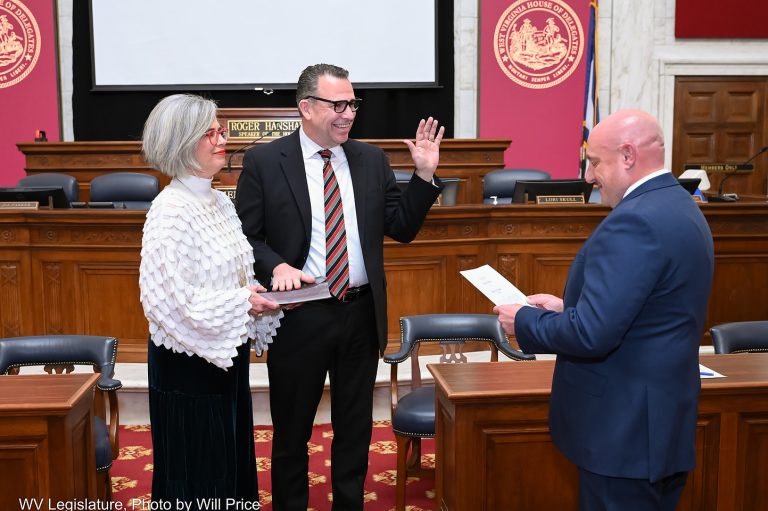
Former House of Delegates member Zack Maynard (R-Lincoln, 7) was sworn into the West Virginia Senate Wednesday afternoon during a brief ceremony in the Senate chamber.

A native of Harts, Maynard will represent the 7th Senatorial District, which includes parts of Kanawha, Lincoln, Boone and Logan counties.

Maynard replaces Mike Stuart, who left the Legislature last month after being confirmed by the U.S. Senate to serve as President Donald Trump’s general counsel for the U.S. Department of Health and Human Services.

Judge Stacy L. Nowicki-Eldridge, who serves the state’s Ninth Judicial Circuit (Boone and Lincoln Counties), administered the oath of office to Maynard.

Maynard was joined in the chamber by his wife Brittany and two young daughters as well as a host of family, friends, elected officials and dignitaries from around West Virginia.

Delegates Wayne Clarke (R-Jefferson, 99), Josh Holstein (R-Boone, 32), Jeff Eldridge (R- Lincoln, 30), Scot Heckert (R-Wood, 13), and J.B. Akers (R-Kanawha, 55) were on hand to show support.

Senate President Randy Smith (R-Preston, 14) as well as Senators Kevan Bartlett (Kanawha, 8), Rupie Phillips (R-Logan, 7), Tom Takubo (R-Kanawha, 17), Eric Tarr (R-Putnam, 4)  and Tom Willis (R-Berkeley, 15) were in the upper chamber to support their new colleague.

Agriculture Commissioner Kent Leonhardt was also in attendance.

During brief remarks following the ceremony, Maynard, a businessman by trade, expressed a desire to better the lives of his constituents in any way that he can. He mentioned jobs, infrastructure and education as his priorities to make West Virginia an attractive place for young people to live, work and raise a family.

Maynard formerly served three terms in the House of Delegates in Lincoln County from 2016 to 2022.

Interim Report: Joint Committee on Education Tour of Bluefield State

The Joint Education Committee toured Bluefield State University during travel interims today. First, the committee heard from professors and students in the education program. The presenters highlighted community partnerships with Mercer County Technical Education Center, McDowell County Technical Education Center, and with local schools for hiring and substituting positions while students are in school. The university participates in the Grow Your Own Program, which allows students to begin on the education track in high school. Students then come to Bluefield for a year or two, then return to their home county for a residency.

The presenters noted that they provide the courses necessary for current substitutes to receive the alternative certification for teaching. The alternative certification is a program provided by the West Virginia Department of Education to address the teacher shortage. The individuals in the program at Bluefield are already in the classroom teaching; their certification provides them with the guidance needed. The university also offers online programs for elementary education and multidisciplinary special education.

Next, the committee received a tour of the mining, engineering, and technology programs. In the mining program, there are 17 students. All types of mining are covered in the courses. Courses are developed with industry professionals, who also teach and present in the classroom. The instructors and course creators work with and listen to the partners in the field to ensure they are preparing their students for the future. The same partners are the ones hiring the graduates in the industry. Currently, the mining program has more scholarships available than students, but they are hoping to change that as the program continues to grow.

The committee toured a variety of engineering and technology labs including the mechanical lab, where 3D printing and robotics take place; the process control lab, which allows students to learn how to troubleshoot a variety of issues that may arise using technology they will see in the field; the electric control lab, which demonstrates what students will see in field and has controls for wiring, meter reading and PLC equipment; the civil engineering and technology lab, where students test soil and materials as well as learn about construction and development; and the machine shop. The committee also heard from students in the computer science and software engineering programs. Every student who spoke in these programs stated that they had had ample opportunities for internships. They stated that they were well prepared to step into the industry with what they learned at Bluefield State University. The motto repeated during the visit was “Small School, Big Opportunities.” The committee continued on for a tour of the nursing programs.

Interim Report: Joint Judiciary Committee & Joint Economic Development

The Joint Judiciary Committee and Joint Economic Development met this morning to hear a presentation on Commercial Property Assessed Capital Expenditures (CPACE) legislation. CPACE is a financing mechanism for energy efficiency-related upgrades to properties. The loan is repaid through property tax collection over 10 to 20 years. The loan obligation is a debt of the property, not the owner. The legislation for CPACE is proposed for commercial property or multifamily units. The improvements funded through assessment cannot be removed until its repaid. Eligible improvements include water efficiency, renewable energy, stormwater management, and environmental remediation. CPACE is gaining popularity as a low-cost, long-term financing for improvements that lower energy expenses. To establish CPACE, legislation would need to be passed to allow for these loans. Then, local governments would have to pass an ordinance for the programs. Then, property owners would apply to participate. Currently, all states around West Virginia use CPACE.

The committee also heard a presentation from the New River Gorge Regional Development Authority (NRGRDA) and its economic development initiatives. The mission for NRGRDA is to build a resilient regional economy that supports both large-scale investment and entrepreneurial growth. The authority covers Fayette, Nicholas, Raleigh, and Summers Counties. The authority is focused on site and infrastructure readiness, small business growth, industry attraction, and community redevelopment.

Readiness matters because modern industry needs reliable energy capacity, flat accessible land, high-speed connectivity, ample water resources, and predictable permitting. WV is in a position for readiness due to its abundant energy, strategic location, and strong regional EDAs. However, there are gaps in communication and coordination. Developers need utility clarity, utility providers need regulatory certainty, locals need incentive flexibility, and the state needs measurable impact.

Interim Report: Joint Education Tours Concord

The Joint Committee on Education toured Concorded University to see improvements to the university and hear from faculty, staff, and students. The tour began in the updated athletics facility, the Carter Center. Concord offers 18 sports and has over 500 student-athletes. In the updated facility, seven sports can be practiced simultaneously. Presenters mentioned the antigravity treadmill, stating that the school is the only Division 2 university with this treadmill, which is important in the rehabilitation of athletes’ injuries. The coaches expressed the importance of being competitive to recruit at a national level, but being able to build relationships to retain players.

Concord’s motto is: Come to learn, go to serve. The university has been known for education, business, and social work programs. However, the university is expanding into the health sciences with the new physician’s assistant program and the nursing program. The university’s enrollment this fall was just under 2,000 students, with around 1600 being from West Virginia. There are 307 graduate students at Concord.

The social work program offers bachelor’s and master’s degrees. From 2022 to 2025, the program had 661 bachelor’s students with 83 graduates. During the same time, the program had 923 master’s students with 323 graduates. Most of the social work graduates are from West Virginia. The education program received the annual assessment achievement award for 2023-2024. Half of the students are NOYCE grant recipients, which is a fellowship for undergraduates who have a STEM degree and wish to earn a master’s in education. Additionally, the university offers an online elementary program, which has allowed nontraditional students to earn a degree.

The science, math, and health program updates have provided a safe and modern place for students to learn. The mathematics and computer science programs are modernized and offer partnerships with Mercer County Technical School. The biology program has received renovated lab spaces with Anatomage tables, which allow students to study anatomy digitally. The physical and environmental science programs utilized $5 million in external grants for the Rare Elements Analysis Center, which houses the electron microprobe (EMP) – a high-magnification microscope that uses electrons, instead of light, to examine a sample. The EMP has been utilized to analyze samples for scientists worldwide.

In social sciences, the university has seen an uptick in students getting involved in student political organizations, applying for grants, and utilizing AI. In the health sciences, faculty and students have been involved in conferences and medical missions. The nursing program graduated its first cohort, with 100 percent exam passage and job placement. The nursing program is a four-year program. Students receive hands-on experience guided by professors through research and fieldwork. The nursing program offers a simulation lab and skills lab with mannequins, with the technology to respond to interactions with students. These allow students to practice nursing skills with life-like patients. It is an extension of the clinical setting. The first physician’s assistant program has 24 students. Next fall, the program will have two cohorts on campus.

Concord also offers an esports program, in which students from the following majors participate: cybersecurity, biology, education, and business. Esports provides experience in production, graphic design, photography, and videography. This year, the program won the 2025 Collegiate Esports Commissioners Cup for the Rocket League Championship. The school competes against larger schools and recruits uncovered talent in the esports arena. At Concord, esports is a vessel to guide students to being productive members of society by channeling their interests into careers. Gaming is just a part of esports; a variety of careers can be found in esports. Students participating have an average GPA of 3.11. If a student in the program drops below a 3.0 GPA, they are required to take study hours. If they drop below 2.5, they are benched. The program gives back by assisting high school and middle school programs, providing summer camps, and offering scholarships. The program also brings in money for the institution, as it brings in more than it spends.

The business program at Concord is the largest program on campus, offering both an undergraduate business degree and a master’s in business administration. The program provides a variety of opportunities for students to network through socials and an etiquette dinner. The business program gives back to the community through the Volunteer Income Tax Assistance (VITA) program. This program allows students to prepare taxes for low-income elderly taxpayers in the area under the supervision of their professors. Over 2,000 tax returns were completed this year, saving payers over $500,000 in tax prep fees. The business program is also focused on tourism and the growth of technology and business innovation.

Interim Report: Joint Committee on Finance

The Joint Committee on Finance met today to hear a presentation on the West Virginia State Fair Board Economic Impact.

According to the presenter, a study was conducted on the fairgrounds in the U.S., which found that fairgrounds have a total economic impact of $52 billion on local economies. More than 29 percent of the US population attends a fair each year. Every $1 of public money invested in a fairground yields $9 return. Fairs generated $1.29 billion in state sales tax. However, fairs are more than just money; they also have a cultural impact. West Virginia is known for having many fairs and festivals. The WV State Fair started in 1921 as the Greenbrier Valley Fair. This year it celebrated 100 years, including the 20 years as the Greenbrier Valley Fair. The State fair did not open during 1942, 1943, 1944, or 1945 due to WWII. Therefore, 2025 was the 100th year the fair was held.

The State Fairgrounds has 10 year-round staffers. During the 10-day fair, there are 175 employees, and the fair generates $356,000 in payroll. The 100th anniversary of the fair was attended by 165,000 people, of whom 42,000 bought concert tickets. The fair generated $4.6 billion in food sales and $1.4 million in carnival sales. This year, the fair had a $42.8 million impact on West Virginia, and generated $2.5 million in tax revenue and $90,000 in property taxes. The fair had two sold-out concerts and sold over $1 million in lottery tickets.

The fairgrounds are used for more than the West Virginia state fair and host several non-fair events. This year, the fair board created its own music festival, Wild Trails Music Festival, which was held in June. It had 7,200 attendees from 41 states and 5 provinces in Canada. It had a significant impact on local and regional tourism. The fairgrounds are also the site of several camper rallies with 600 hookups. The WV fairgrounds have hosted national and international rallies. Additionally, the campgrounds are available to tourists seasonally.

The fair board participates in community giving through scholarships, civic and school group support, and agriculture.

The WV Fair Board is planning for the next 100 years with reinvestment. Several projects are planned, including grandstand reservation and stage project: $4 million – will begin Sept 1, 2026; campground expansion: $5 million; Concert venue and facilities, Indoor livestock arena, and agriculture/livestock facility upgrades. The total cost for improvements is $35 million.


Gregory A. Watt Sworn-In as Delegate

This afternoon, Delegate Gregory A. Watt of Heckert Valley took the oath of office to become a member of the House of Delegates. Watt was appointed to fill the vacant seat of Tom Clark. Clay County Judge Mike Asbury administered the oath of office.

Watt, a defense contractor, accepted the appointment to make a difference in West Virginia.

Delegate Watt represents the 48th District, which includes Webster County and parts of Greenbrier and Nicholas counties.

Delegate Watt was joined by his wife, Sherry, for the swearing-in ceremony.


Interim Report: Committee on Corrections and Public Safety

Division of Corrections Commissioner David Kelly told lawmakers on Tuesday that while his agency has improved its ability to fill vacancies for entry-level correctional officers, a recent surge of retirements of experienced officers has proved challenging. Kelly was speaking to members during the final day of October interim meetings at the State Capitol.

Kelly informed the committee of 46 retirements in 2024 and 40 so far this year.

“We believe that the numbers will reach into the 50s this year,” Kelly said. “Just for a little bit of understanding, that could be nearly 100 retirees in 2024 and 2025, and that’s about 3,000 years of experience,” Kelly said. “We have a deep bench at DCR. We’re planning to move forward and place people in the proper positions. It’s not an easy task, but we will get it done.”

The agency is working to fill vacancies and retain staff, achieving a 77 percent retention rate in the current fiscal year, with some facilities retaining up to 85 percent for all three tiers of correctional officers, according to Kelly. He mentioned a pay raise approved by the Legislature for areas of critical vacancy has helped, but recruiting and retention challenges remain.

Kelly said one of the division’s biggest challenges remains recruitment and retention of correctional officers and non-uniformed correctional employees for facilities bordering other states.

“Not only are we working diligently towards filling correctional officer vacancies and non-uniform vacancies, we’re also striving to replace the upper tier of our division,” Kelly said.

Current inmate populations are 4,814 in jails, 4,888 in prisons, 378 in work release, and 297 in juvenile centers.

“We continue to assess our daily population within each facility, and we believe that we are managing our available space to the best of our the best of our ability,” Kelly said.

Kelly noted that four counties are at least 90 days delinquent in their regional jail bills: Webster, Clay, Lincoln and Mingo counties.

He also mentioned that regional jails are benefiting financially from processing detainees for the U.S. Immigrations and Customs Enforcement (ICE) in state correctional facilities. The facilities participating in the ICE detention program include South Central Regional Jail in Charleston, North Central Regional Jail in Moundsville and the Eastern Regional Jail in Martinsburg.

The federal government pays the state $90 per inmate per day, with ICE paying nearly $340,000 to DCR between June and July. Those funds are being used for general operational costs for the state’s regional jails.