Tuesday, June 2, 2026
Home Blog Page 6

House Education Advances Adjunct Teaching Permit Bill

House Education met this afternoon.

Markup & Passage

Senate Bill 155 creates an adjunct teaching permit, allowing individuals with this permit to fill vacant teaching positions, offer new classes, or supplement a program. To qualify for an adjunct teaching permit, individuals must have four years of experience in the content area they will teach or a college degree in that content area. The individual must submit a criminal history check to verify that they have not been convicted of or entered a plea to a felony. The adjunct permit is valid for 1 year and is renewable.

Senate Bill 694 removes the requirement that a county superintendent reside in the county or a contiguous county. The bill states that a county board may require, in the contract, that the superintendent reside in the county being served, and that the board may also prohibit working remotely.

Committee Hearing

House Bill 890 changes the minimum public school 180-day instructional requirement to 900 instructional hours. The bill would also change the minimum public-school employment term from 200 days to 1,600 hours. It would convert other public school calendar provisions from days and months to hours. The bill allows for 25 hours to be used without students present as noninstructional time for activities exclusive to educators.

House Debates Student Athlete Bill

The West Virginia House of Delegates advanced several bills, including the following:

House Bill 4425 would remove the law that allows students to transfer from one school to another without losing athletic eligibility.

Delegates expressed both support and opposition during the bill’s debate.

Supporters argued the bill addresses strained athletic programs and school instability caused by frequent student transfers under the law passed in 2023.

Delegates who rose in opposition shared concerns about potential safety issues for students who are unable to transfer from a harmful environment in their current school’s athletic program.

Delegate Betsy Kelly (R – Tyler, 9) said, “If this were about safety issues, they are still able to transfer. Obviously, these safety issues are still happening, regardless of this standard. The safety issues have nothing to do with this bill. This is about being able to play sports in your own community.”

Delegate Kathie Hess Crouse (R – Putnam, 19) said, “The repeal does not protect competitive balance; it punishes children. It removes a safety valve that families rely on when something goes wrong. It forces students to stay in unsafe situations.”

“The current law has created instability across schools. When an outside transfer takes a position, a local student often loses playing time and a roster space. Thus, feeling pressure to transfer elsewhere and the cycle continues,” Delegate Sarah Drennan (R – Putnam, 20) said. “While I feel for students who feel like they do not have some other place to go, there is, in fact, a petition process, which allows students to go before the board to request a transfer. This bill doesn’t eliminate that process.”

Delegate Adam Burkhammer (R – Lewis, 64) spoke in opposition to the bill due to the bill limiting students. He said he could not imagine limiting kids and limiting the freedom of parents and student athletes in West Virginia.

This bill passed with a vote of 78 to 19.

House Bill 5319 would establish a camping ban on certain public property. Under this bill, anyone who camps or stores personal property in public property owned by a municipality, state, or county would be subjected to a warning upon the first violation. If they continue to camp or store their property, on the second violation, they would be charged with a misdemeanor and fined for $200. The third violation would result in a $500 fine, a month in jail, or both fined and jailed.

In debate of this bill, delegates shared concerns about the impact this bill would have on the population of homeless people across the state.

Delegate Evan Worrell (R – Cabell, 23) said he was in opposition to this bill. He said homelessness is an issue across the state in rural and urban communities, and is against the criminalization of those who are unhoused.

Delegate Anitra Hamilton (D – Monongalia, 81) said she agreed with Delegate Worrell, the chair of the Health and Human Resources Committee. Hamilton said she works with several organizations in her community to raise funds and serve the homeless people in her area.

“Homelessness far exceeds the number of beds available. This bill undermines the work of organizations to care for the homeless,” Hamilton said.

Delegate JB Akers (R – Kanawha, 55) said he believes this bill does not require officers to charge all unhoused people with the penalties spelled out in the bill. Akers said this bill is to criminalize the bad actors and allow West Virginia police officers to make those decisions.

The bill’s sponsor, Delegate Geno Chiarelli (R – Monongalia, 078), said this bill was to target criminal vagrancy and the people who destroy communities around them.

“We try to paint every single person who are experiencing homelessness with the same brush. ‘They just need a little bit of help, they just need a hand up,'” Chiarelli said. “That’s just not true, it’s just not true.”

This bill passed with a vote of 62 to 32.

In addition to the passage of bills, there were 56 pieces of legislation on second reading. The calendar for the House can be found here.

Committee Meetings, Today, March 3

Committee Meetings, Tomorrow, March 4

The House is adjourned until 9:30 a.m. Tomorrow, March 4.

Alert Button For Teachers (Alyssa’s Law) Advanced in Senate Education

The Senate Education Committee met Tuesday afternoon and advanced three bills regarding emergency situations for teachers, senior citizens’ education, and financial aid for post-secondary education.

House Bill 4798 would authorize wearable panic alert systems in West Virginia schools under “Alyssa’s Law.”

The devices would allow school personnel to directly contact 9-1-1 and trigger campus-wide lockdown notifications during emergencies, contingent upon available funding.

The bill directs state education officials to set implementation rules. It allows county boards to distribute devices and requires annual training. The bill also mandates coordination with local law enforcement for security access. It creates a school safety fund for equipment costs and sunsets in 2029.

During testimony on House Bill 4798, Lori Alhadeff, mother of Alyssa, shared a personal plea for the legislature. She recounted the loss of her 14-year-old daughter in a school shooting and emphasized the life-saving potential of wearable panic alert devices, stating that if the bill passes and the devices are in every school, “Alyssa will be saving so many lives.”

The bill was reported to the full Senate with a recommendation of passage.

House Bill 5110 would lower the age for tuition and fee waivers at West Virginia colleges from 65 to 60.

This bill would allow seniors to take courses for credit or audit at reduced rates, depending on residency and classroom availability.

The bill requires schools to set rules for priority registration, additional fees like labs or parking, and tuition for credit courses at 50% of normal resident rates. The program applies to in-person, online, and other distance learning courses.

The bill was reported to the full Senate with a recommendation of passage.

House Bill 5212 would modernize West Virginia’s financial aid programs, streamline eligibility, and expand support for part-time and workforce-focused students. It also clarifies rules for loans, scholarships, and repayment requirements.

The bill would connect financial aid more closely to high-need job sectors, reduce administrative complexity, and create a more coordinated system for students and institutions across the state.

The bill was reported to the full Senate with a recommendation of passage, first being sent to the committee on Finance.

Senate Advances the Cohen Craddock Student Athlete Safety Act

The Senate met Tuesday morning and adopted Senate Resolution 55 regarding honeybees and Senate Resolution 56, which honors Sergeant First Class Bill Brown for his distinguished military service. The Senate also passed several bills on third reading.

Senate Bill 657 would establish the Cohen Craddock Student Athlete Safety Act.

This bill would require the West Virginia Board of Education to promulgate a legislative rule in conjunction with the West Virginia Board of Physical Therapy, governing concussion protocol, education on the prevention of concussions, and the development of the Concussion Education, Prevention, and Response Plan.

This bill is intended to address the various risks of injuries, including concussions, heat-related illnesses, and cardiac events that could take place with student athletes, and ensure the safety and well-being of students playing sports.

Senate Bill 502 would establish the Women’s Collegiate Sports Protection Act.

The bill would provide permanent funding and incentives to protect women’s college sports at public NCAA Division I colleges in West Virginia.

It would offer endowments, state matching funds for savings, and tax credits for private donations while ensuring compliance with Title IX.

Senate Bill 1012 would permit the development of additional juvenile substance use disorder treatment beds in Cabell County.

Under current law, new licensed substance abuse treatment beds generally cannot be added in counties that already have more than 250 beds. This bill creates an exception allowing a certificate of need to be issued in Cabell County for up to 60 additional inpatient treatment beds dedicated to individuals 17 years of age or younger.

These bills passed the full Senate and were sent to the House of Delegates for consideration.

Afternoon Meetings:

Education at 1 p.m. in Room 451M

Government Organization at 1 p.m. in Room 208W

Health and Human Resources at 2 p.m. in Room 451M

Finance at 3 p.m. in Room 451M

Judiciary at 3 p.m. in Room 208W

Morning Meetings:

Transportation and Infrastructure at 9 a.m. in Room 451M

Workforce at 9 a.m. in Room 208W

The Senate is adjourned until tomorrow at 10 a.m.

Machine Gun Access Bill Clears Senate Judiciary

The Senate Judiciary Committee met this afternoon and advanced several bills on firearms, polling locations, and child torture laws.

Senate Bill 986 would create a new criminal offense for child torture in West Virginia.

The bill defines child torture as a course of conduct that causes severe physical or emotional harm to a child under a caregiver’s supervision. Acts covered in the bill include inflicting extreme pain, depriving a child of necessities, subjecting a child to unsafe conditions or extreme temperatures, and other conduct that places a child at risk of serious injury.

Under the bill, anyone found guilty of child torture would face felony penalties, ranging from 1-5 years in prison if no bodily injury occurs, and 2-10 years if the child suffers bodily injury.

The bill was reported to the full Senate with a recommendation of passage.

Senate Bill 481 would require precincts to be reported independently and update state law by changing the term “precinct” to “polling location.”

The bill would set standards for election boards, including poll clerks and election commissioners, and clarify mapping and reporting requirements for counties and the Secretary of State to support federal and state redistricting.

Senate Bill 1071 would establish the Public Defense and Provisions Act and establish a new state Office of Public Defense within the West Virginia State Police.

The office would be authorized to acquire and transfer machine guns to qualified residents who pass a background check. The firearms would be similar to those used by law enforcement or the military.

The state and its employees would not be liable for the actions of individuals who legally obtain these machine guns.

The bill sets rules for record-keeping, transfer fees, and the operation of the office.

The bill was reported to the full Senate with a recommendation of passage.

Senate Bill 963 would require a full court hearing before someone can be barred from having guns under a protective order. The hearing must include the respondent, their lawyer, and clear evidence that they pose an immediate danger.

The bill allows the respondent an automatic appeal if their firearms are restricted. All other parts of the protective order, such as banning abuse, harassment, stalking, or threats, would stay in effect.

The gun restrictions may only be applied when the court finds convincing evidence of immediate danger to the petitioner and cannot be used for punitive purposes.

A witness testified in opposition to the bill, expressing concern for those in domestic violence situations, specifically the petitioner. She noted that a large share of women in the U.S. are killed by current or former partners, highlighting the risks involved when firearms are restricted under protective orders.

Following a discussion, the bill was reported to the full Senate with a recommendation of passage.

Senate Bill 686 would allow coal operators to mine land if 75 percent or more, agree. Owners who do not agree would still get paid their fair share, and operators are protected from legal trouble if the mining is done legally. The bill also safeguards miners and surface land rights.

If some owners can’t be found, the money owed to them goes into a special state fund managed by the Treasurer. The fund pays claims, and after seven years, surface owners can claim future rights, nut not past payments, so mining can continue smoothly while protecting missing owners.

The bill was reported to the full Senate with a recommendation of passage.

Senate Bill 182 would allow municipalities to expand their boundaries through a process called “minor boundary adjustment,” which is a streamlined method for annexation. Under this bill, a municipality can apply to the county commission for permission to annex territory, provided the annexation does not increase the total municipal boundary by more than 105 percent or the current area by more than 120 percent.

The legislation also introduces specific conditions for annexing streets or highways, allowing for annexation of a street or highway along with at least one property owner (freeholder), or a street or highway alone if it’s essential for emergency services and no freeholder is involved.

The application process requires detailed information, including consent from affected residents and businesses, a map of the territory, and a plan for providing public services. The county commission would review the application, considering factors like contiguity, impact on services, and the overall best interest of the county, before making a decision, with provisions for public hearings and appeals to the circuit court.

The bill was reported to the full Senate with a recommendation of passage.

House Education Advances Raylee’s Law

The House Education Committee advanced several bills this evening.

House Bill 5669 would establish Raylee’s law. This law would temporarily prohibit someone from homeschooling their child if there is a pending child abuse or neglect investigation against a parent or guardian. This bill was advanced through the process after the rule was suspended. This bill was reported to the Judiciary.

Senate Bill 155 would allow an individual with an adjunct teaching permit to be able to be hired to fill a vacant teacher position. This bill was advanced to markup and discussion.

Senate Bill 694 would remove the residency requirement for the county superintendent of a school and allow counties to use their discretion when making a contract with a new superintendent. This bill was advanced to markup and discussion.

Senate Bill 802 would create Leave Teachers Alone (LTA) days. This bill would allow teachers to have two noninstructional days, which would allow them to be able to be in their classrooms to work and not be disturbed by administrators.

Senate Tables Discharge Motion on Senate Bill 972 (Raylee’s Law)

The Senate met Monday morning for a lengthy floor session.

During the session, Senator Joey Garcia (D – Marion, 13) attempted a discharge motion to pull Senate Bill 972 from the Senate Health and Human Resources Committee and bring it directly before the full body for consideration. The motion was tabled.

After the motion was tabled, Senator Garcia requested that all bills on third reading be read in their entirety, meaning the full text of each bill must be read aloud before final passage.

Senate Bill 972, known as “Raylee’s Law,” would would pause a request for not just homeschoolers during a pending child abuse investigation; it would also impact parents in the same situation looking to move their child to a private school or microschool. Child Protective Services would have to complete the investigation within 10 days under the bill.

The legislation, which was named for an eight-year-old girl who died of horrific abuse and neglect in 2018 after her teachers notified CPS of potential abuse, prompting her parent to move her to homeschooling.

The Senate also advanced several bills, including Senate Bill 1077 and Senate Bill 459.

Senate Bill 1077 would require county school districts to offer vocational agriculture programs to students and limit the circumstances under which those programs can be eliminated.

Under the bill, a district could only terminate its agriculture program if it had the lowest enrollment among all vocational education programs, and it would have to report its reasoning to the Legislative Oversight Commission on Education Accountability.

Senate Bill 459 would update state custody law to promote meaningful contact between a child and his or her siblings, including half-siblings and step-siblings.

The bill adds step-siblings to the list of relationships courts should consider in serving a child’s best interest, when an established bond exists, and the step-sibling lives at least part-time with the biological parent.

Both bills passed the full Senate and were reported to the House of Delegates for consideration.

Afternoon Meetings:

Finance at 3 p.m. in Room 451M

Judiciary at 3:15 p.m. in Room 208W

The Senate is in recess until 4:30 p.m.

House Honors Former Delegate Kump

The West Virginia House of Delegates honored former Delegate and advanced several bills, including the following:

The House adopted House Resolution 20 to honor the life and service of former Delegate Larry D. Kump. Larry Kump served Berkeley County with distinction across three separate decades, representing the 52nd, 59th, and 94th Districts during 2010-2014, 2018-2020, and from 2022 until his passing in 2026.

House Bill 5381 would transfer the Office of Coalfield and Community Development as a program under the Office of Energy. In addition to this transfer, this bill would require the Office of Energy to develop an energy development policy plan, a comprehensive grid stabilization plan, and test the stability of West Virginia’s energy grid.

These plans would include all forms of energy and increase reliability for stable baseload generation, increase efficiency through innovation, and energy independence through increased production. Goals of the plans include, but are not limited to, prioritizing baseload generation, setting a goal to increase baseload generating capacity from 16 gigawatts to at least 50 gigawatts by 2050, and expanding the international market for West Virginia coal.

House Bill 5459 would make the taxes of certified HMO’s no longer be based on a tiered system and would impose a 2.5% tax on the organization’s gross premiums. This bill would bring the state into federal compliance, moving forward with Medicaid.

House Bill 5554 would allow state political parties to be able to accept donations of $50,000 annually for their headquarters. These funds would be able to be used for paying for furniture, utilities, equipment, or could be used for the costs of leasing an office building or constructing a political headquarters.

Committee Meetings, Today, March 2

Committee Meetings, Tuesday, March 3

The House is adjourned until 10 a.m. on Tuesday, March 3.

Adult Cabaret and Indecent Exposure Bills Pass Senate Judiciary

0

The Senate Judiciary Committee met on Friday morning and advanced three bills regarding governing cooperatives, indecent exposure in school locker rooms, and adult cabaret performances.

Senate Bill 723 would clarify state law governing cooperation between West Virginia law enforcement agencies and agencies in bordering states.

The bill updates definitions and outlines procedures for temporary assistance between state, local, and bordering-state law enforcement agencies.

One of the terms updated in the bill is “law-enforcement agency,” clarifying that the definition includes federal, state, and local agencies authorized to enforce criminal law, such as State Police, municipal police departments, sheriffs’ offices, and the Division of Forestry.

The bill was reported to the full Senate with a recommendation of passage.

Originating Bill 1 would expand the crime of indecent exposure.

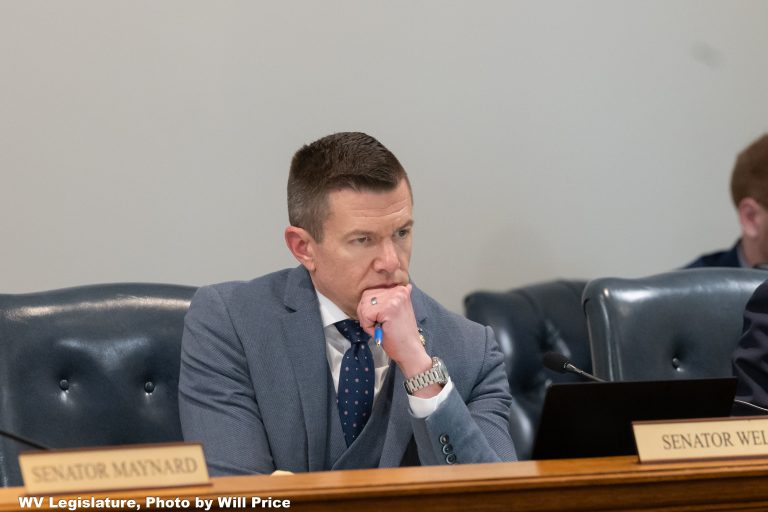
Senator Ryan W. Weld (R – Brooke, 01) raised concerns about the bill’s vagueness, noting that it does not clearly define “undresses” and giving the example that even removing a sweatshirt could potentially be considered a violation.

The bill is intended to clarify the offense of indecent exposure, including incidents such as a person undressing in a locker room designated for the opposite sex.

Weld proposed an amendment specifying that any acts of indecent exposure described in the bill would be prohibited in locker rooms designated for the opposite sex.

The amendment removes the word “undresses” from the bill and defines indecent exposure by reference to the acts listed in the subsection.

The amendment was rejected.

The bill was reported to the full Senate with a recommendation of passage.

Senate Bill 590 would make it a criminal offense to perform an adult cabaret where it could be seen by a minor.

The bill defines “adult cabaret performances” as a performance in a location other than an adult cabaret that features topless dancers, go-go dancers, exotic dancers, strippers, male or female impersonators who provide entertainment that appeals to the prurient interest, or similar entertainers, regardless of consideration.

A first violation would be a misdemeanor, while a second offense would be a felony punishable by up to five years in prison and a $25,000 fine.

The bill was reported to the full Senate with a recommendation of passage.

First Half of West Virginia First Energy Act Clears Senate

The Senate met Friday to pass 15 pieces of legislation, one of which was the first of two bills the body hopes will ultimately create the West Virginia First Energy Act.

House Bill 4026 relates to expanding the requirements for integrated resource plans utility companies must file with the Public Service Commission (PSC). This bill passed in the Senate today with amendment and will need to go back to the House of Delegates for concurrence.

The companion bill, Senate Bill 420, passed the Senate Energy committee earlier this week and now is under consideration in Senate Finance.

Both bills would create the West Virginia First Energy Act, a legislative framework designed to restore electric rate stability through prioritized in-state coal-fired generation and the preservation of the state’s natural gas industry.

The legislative package proposes a target utilization rate of 69 percent for coal-fired power plants, tied to tiered cost-recovery incentives. House Bill 4026 introduces requirements for utilities to analyze Advanced Transmission Technologies (ATTs) in their integrated resource plans.

Attainment of utilization goals is tied to cost-recovery incentives in a tiered structure, with cost recovery set at a specific level, increasing as the plant approaches the 69 percent  target. Utilities supplying electricity for industrial or residential use must maintain a 30-day supply of base fuel under the legislation.

A previous PSC order set an expectation that coal-fired power plants need to achieve at least a 69 percent  capacity factor in order for in-state electric companies to self-generate power and reduce reliance on purchased power.

Senator Brian Helton (R-Fayette, 09), a major supporter of the initiative, believes incentivizing coal-fired power plants to operate at a 69 percent capacity rate would lower electric rates and result in more coal miners being employed.

“We want them to be utilized according to the PSC standard of 69%. And if we’ll do that, and we’ll get these utilities back in line with that 69%, we’re going to see an economic uptick like we’ve never seen before,” Helton said.

The Senate is adjourned until Monday, March 2, at 11 a.m.

Morning Meetings for March 2:

Government Organization at 10 a.m. in 451M