

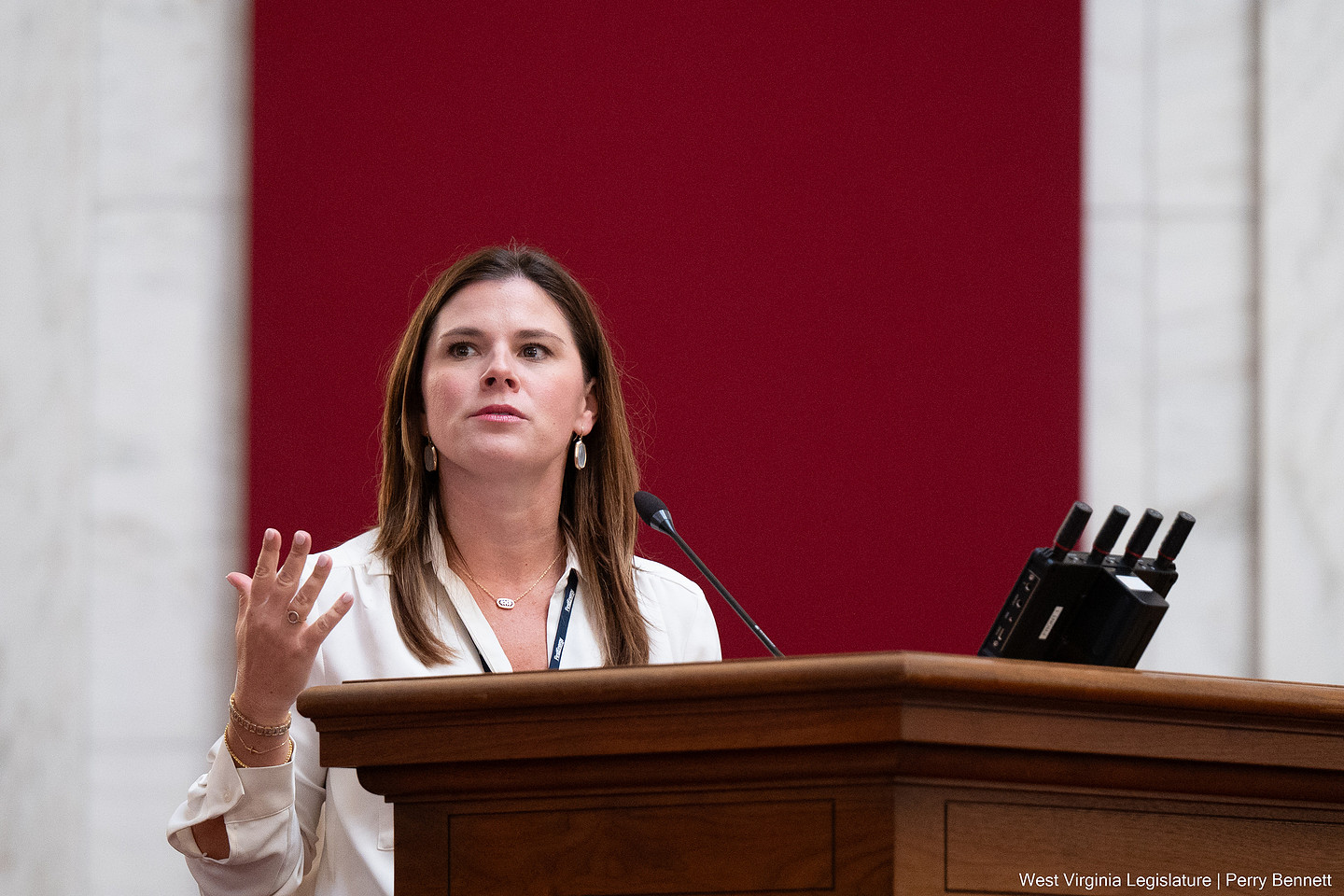
The Joint Committee on Energy and Public Works heard from officials with the Office of Energy, the Public Service Commission and the state’s two electric utility companies on Tuesday, the final day of legislative interim meetings at the State Capitol.
Much of the discussion centered around West Virginia’s ability to provide coal-fired power to the PJM Interconnection, the regional grid that serves 13 states and Washington, D.C.
PJM coordinates the movement of wholesale electricity, dispatching the power it needs for the regional grid on a minute-by-minute basis using the least expensive fuel sources first. While coal is considered base-load energy, it is not always the least expensive.
Nicholas Preservati, deputy secretary of the state Department of Commerce and director of the Office of Energy, said West Virginia is a key leader in the 13-state Governors’ Collaborative, which is intervening with the Federal Energy Regulatory Commission to reform PJM governance.
Preservati informed lawmakers that the system has benefited West Virginia and ratepayers—electricity rates from April of 2025 to 2026 actually decreased.
“For that year our rates actually went down from a year ago in residential,” Preservati said. “They’re going up less than inflation in a lot of instances when other states are going up 18 to 20 percent, so you’re seeing skyrocketing prices in these other states but not West Virginia.”
Preservati told lawmakers the state is working with federal partners, such as at the National Energy Technology Laboratory in Morgantown, to upgrade and extend the life of coal-fired energy in West Virginia.
“NETL is going to allow us to work with them to use their computing research, to work with the utilities to not only determine what upgrades need to be made, but to look at every process, start to finish, that affects the coal plant,” he said.
Abby Reale, senior advisor for government and external affairs for FirstEnergy, said they made repairs and improvements across their system, including the Fort Martin Power Station and the Harrison Power Station. FirstEnergy has leveraged federal grant programs like the Restoring Reliability Grant program to complete turbine overhauls, a dry bottom ash removal system, water treatment systems at Fort Martin, environmental upgrades, and control system upgrades.
“We have spent over $500 million over the last five years, so about $100 million a year,” Reale said. “That is to maintain the plants in a safe and reliable way.”
Reale informed members that FirstEnergy is evaluating what will be needed to extend the service life of their power plants, which is underway as part of phase I. Preliminary work is being done to quantify what needs to be changed, improved, or rebuilt in 2027.
Appalachian Power Director of Government Affairs Sammy Gray said looking at future demand, Appalachian Power is planning to maintain its generation capacity as long as possible. Gray said they plan to use a mix of coal and natural gas to meet increasing future needs.
“We understand there are rate pressures, and we’re committed to keeping our coal plants open and going as long as we can,” Gray said.
David Ellis, director of quality assurance at the Public Service Commission told lawmakers that his organization is in the process of implementing consumer economic dispatch rules required by a 2025 law dealing with data centers and microgrids. These rules mandate that utilities maintain plants to run at their lowest possible cost, targeting a 69 percent capacity factor when economical.
“The commission has said consumer economic dispatch means maintaining each individual power plant based on the engineering of that power plant, based on the limitations of the transmission, so that it runs at its lowest possible cost,” Ellis said
