
Sunday, April 5, 2026
Home Blog Page 131

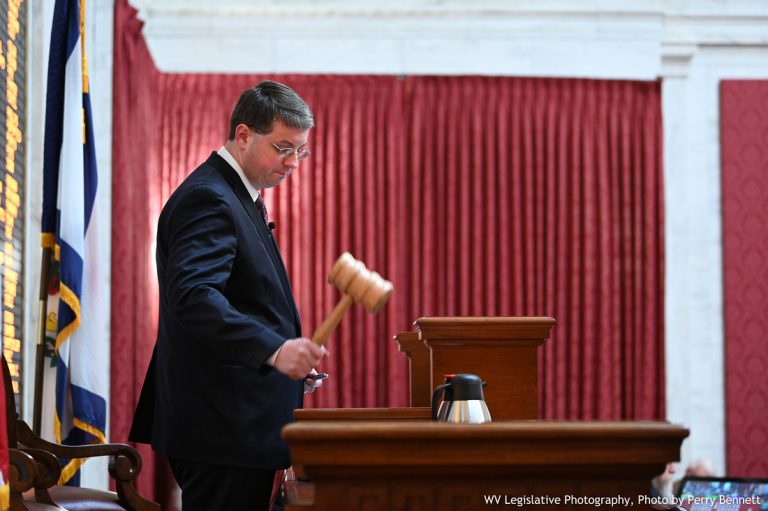
85th Senate Convenes, Elects Craig Blair President

The West Virginia Senate convened a one-day organizational session for 85th Senate today at Noon.

Sen. Donna Boley (R – Pleasants, 03) presided over the beginning of the organizational session as the Senate’s longest continually serving member.

Following the presentation of certified election results by Secretary of State Mac Warner, and the swearing in of newly elected senators by Chief Justice Evan H. Jenkins, members of the Senate nominated and elected Sen. Craig Blair (R – Berkeley, 15) by acclamation to serve as President of the Senate.

Following the election of the President, Lee Cassis was reelected Senate Clerk, Joseph Freedman was reelected Senate Sergeant-at-Arms and Jeffrey Branham was reelected Doorkeeper. All were unanimously approved.

The Senate also adopted several resolutions relating to the Senate Rules and other organizational matters. There were no rule changes from the 84th Senate.

The Senate is adjourned until members reconvene Feb. 10, 2021, at Noon for the start of the First Regular Session of the 85th Legislature.

House Health Hosts Informational Meeting on COVID-19 Response

The House Health Committee hosted an informational meeting Monday morning regarding the state’s COVID-19 response.

Committee members heard from State Coronavirus Czar Dr. Clay Marsh, State Health Officer Dr. Ayne Amjad, Maj. Gen. James Hoyer, and West Virginia Department of Health and Human Resources Secretary Bill Crouch.

Marsh gave an overview of the global pandemic. Close to 13 million people have been infected across the world and more than half a million people have died, according to Johns Hopkins University & Medicine’s COVID-19 dashboard. Marsh explained West Virginia and the U.S. overall have seen more younger  people becoming infected with COVID-19.

“As we look at West Virginia, COVID-19 is starting to spread more rapidly,” Marsh told the committee.

West Virginia has experienced the highest transmission rate in the country, Marsh said. Additionally, Marsh cited a study from the Kaiser Family Foundation, which found West Virginia to be the most vulnerable state in the country when it comes to the share of adults who have a higher risk of developing a more serious illness. Marsh said the state in collaboration with West Virginia University are determining reproduction rates for every county in the state. He said people could additionally view rates for each state at rt.live. He explained 75% of COVID-19 spread happens before a person becomes symptomatic.

“In general, we have done well but COVID’s spread is picking up in West Virginia,” Marsh said. “There has been more mobility among younger people going on vacation. There has also been outbreaks in churches, outbreaks related to bars, and outbreaks related to social gatherings in different places.”

This is one of the numbers Crouch said he was looking at including in the state’s COVID-19 dashboard. The DHHR Secretary said he is looking into making several changes to the dashboard such as including the reproduction rate, hospitalization numbers, and releasing the report once a day at 5 p.m. instead of the current 10 a.m. and 5 p.m. reports. Crouch also said he would work on providing numbers to the committee on death rates by gender, race, and region, along with the number of repeat tests.

Delegates asked Marsh other questions about PPE for vulnerable communities and providing education related to PPE. Marsh told the committee there is a task force with the DHHR that is working to facilitate more PPE supplies and working on educational materials, including a statewide PSA effort.

Delegate Mike Pushkin, D-Kanawha, asked about long term health effects and whether there were any known lasting effects in asymptomatic cases. Marsh said there is concern about how the virus affects blood vessels, citing autopsies conducted in New York City that found blood clotting in various blood vessels.

“There is a worry about that even in people who aren’t severe cases,” Marsh said.

In addition to the pandemic, West Virginia faces other public health issues. Amjad, who was appointed as state health officer last week, told the committee her biggest goals for the upcoming weeks and months are not just to focus on COVID-19 but also other public health issues, such as the opioid crisis and mental health.

“While we’ve had COVID-19 going on, the Appalachian area has had the opioid crisis as well,” Amjad said. “Depression and anxiety are going up too. These are issues we have to deal with too.”

Delegates asked Crouch about short term and long term goals for funding public health. Crouch said the DHHR has worked to forge better relationships with local health departments. He said the DHHR is working to increase the number of contact tracers, increase epidemiologist salaries, and double the number of physicians in the Bureau of Public Health. Additionally, Crouch said there is funding from a CDC grant and from the CARES Act that is dedicated to cities and counties that include local health departments.

Hoyer also addressed the committee, explaining lines of effort for the National Guard—population stabilization, logistics, data analytics, operationalizing health facilities, innovation, and surge capacity. Hoyer explained the National Guard has worked to provide food to kids and seniors, support food banks, support Workforce West Virginia during the surge in unemployment, has worked to establish a six-month supply of PPE, and has worked to provide support for contact tracing and trend analysis along with looking into bed use, ICU beds and ventilator use.

He also said the National Guard is working on developing PPE working in collaboration with WVU. He showed the committee a few items made at Prison Industries, including a reusable gown, and various face masks.

Delegates also asked about precautions recommended specifically for the Legislature. Delegate Jeffrey Pack, R-Raleigh, asked Crouch about precautions he would recommend the Legislature to take for members, staff, and others who work around the Legislature.

“Any congregate setting where there is a large number of people together is primed for an outbreak,” Crouch said. “I would suggest testing may be a good possibility but testing is only good on the day you do it. …Distancing and wearing masks is the best way to fight the virus. Anyone with symptoms should not come to the Legislature. … My suggestion is for everyone to wear a mask and social distance as much as possible.”

Pack said he intends to have another informational meeting, mentioning the possibility of the next one happening sometime in September.


Delegate Heather Tully Takes Oath of Office

West Virginia Supreme Court Chief Justice Tim Armstead administered the oath of office to new Delegate Heather Tully Thursday afternoon in the House chamber.

Tully is a Republican appointed by the governor to represent the 41st district, which covers parts of Greenbrier and Nicholas counties.

Tully, of Summersville, worked as a bedside ICU nurse for the first 13 years of her career and now works as an RN. She has a bachelor’s of science in nursing from the University of Charleston and a master’s of science in nursing from West Virginia University.

Tully takes over from former Delegate Jordan Hill, who resigned in May to pursue a job opportunity outside of his district.


House Passes Budget Bill, Adjourns Sine Die

The House convened at 10 a.m. to conclude the 2020 legislative session.

The House concurred with the Senate amendments to Senate Bill 150, the Budget Bill, and completed legislation on it. The Budget Bill allocates $108 million to fully eliminate the waitlist for the I/DD Waiver. This was a priority for this session by both bodies of the legislature and Governor Jim Justice. The budget allocates $16.8 million for the foster care system within the state under House Bill 4092. The budget also provides $3.3 million to fund a second location for the Mountaineer ChalleNGe Academy, which is a program that trains and mentors at-risk youths from the ages of 16-18 in a 22-week program.

The House concurred with the Senate amendment and provided an additional amendment to House Bill 4092. House Bill 4092 provides major structural change to the state’s struggling foster care system and seeks to address many issues. One of the most important parts of the bill is a per diem rate increase for foster and kinship families. This bill has been the House’s main priority during this legislative session and has faced major bipartisan support, so many members spoke to the bill before voting on the amendment.

Delegate Mike Pushkin, D- Kanawha, supported the bill during the floor session. “This is the most important piece of legislation we’ve worked on this session,” he said. “If we can’t stand up for these children, then what good is this legislature?”

Delegate Jordan Hill, R- Nicholas, is the lead sponsor of this bill and the Chairman of the Health and Human Resources Committee. “In my time in this House, there has been no greater honor than sponsoring this bill,” he said.

The House concurred with the amendments for House Bill 4543, which set a price cap on a thirty-day supply of insulin. The House originally had set the cap at $25, but the Senate amendment changed the cap to $100.

The House concurred with the Senate amendments and completed legislation for sixty-one House Bills. The House concurred with the Senate amendments and completed legislation for thirteen Senate Bills.

The House is adjourned Sine Die.

Senate Adjourns Sine Die

The Senate convened at 10:30 a.m. on Saturday for the final floor session of the 2020 regular session.

Legislation was completed for SB 150, the 2020 Senate budget bill.

The Senate completed legislation after concurring with additional House amendments for House bill 4092, which updates the current foster care system in the state. The bill increases reimbursement for child placement agencies and foster families, increases the number of children allowed in a foster care family and requires the DHHR to use a tiered reimbursement model to increase the rate for families caring for foster children with more specific needs.

House bill 4543 relates to insurance coverage for diabetics and the cost of insulin. It is estimated that there are over 240,000 West Virginians diagnosed with diabetes, all who rely on daily doses of insulin to survive. In recent years, the cost of insulin has escalated and can cost over $600 per month. This bill reduces the cost of insulin to cost $100 or less per month, regardless of the type of insulin used.

House bill 4737 waives the requirement for the completion of the FASFA in order to receive state-sponsored financial aid under certain conditions. The bill would mostly apply to students who don’t have access to the forms needed to complete the FASFA because they are under the care of someone other than their parents.

All of Governor Jim Justice’s executive nominations were confirmed on Saturday.

The Senate adopted Senate Resolution 71, which memorializes the life of Karl Cameron “Butch” Lilly, a former Assistant Clerk of the WV Senate who passed away in November 2019. A brief recess was held for the presentation of this resolution. Lilly’s loved ones visited the Senate chamber to be recognized.

Resolution 72 was also adopted, urging Congress to safeguard pharmaceutical supply chains.

Senate Resolution 73 was adopted as well, which memorializes the life and work of Dorothy Vaughn, a NASA mathematician and computer programmer.

The Senate also adopted Resolution 75, recognizing the dedication and public service of the Senator Roman W. Prezioso, Jr., D-Marion, the current Senate Minority Leader. Several members of the Senate rose in support of the resolution and thanked Prezioso for his contributions to the West Virginia Legislature. This is his last session before his retirement.

Senate Resolutions 76, 77 and 78 were adopted as well, recognizing the dedicated service of Senators Corey Palumbo, D-Kanawha, and Kenny Mann, R-Monroe and Paul Hardesty, D-Logan, respectively. Both senators have chosen not to run for re-election this year and were thanked for their contributions.

House Passes Judicial Pay Raise, Rejects Intermediate Court

On Friday during its floor session, the House passed a bill that would provide a pay raise for judges in the state.

Senate Bill 597 provides a five percent pay raise for Supreme Court Justices, circuit court judges and magistrates. The last time there was a judicial pay raise was in 2011. Originally, the amount of the raise in Senate Bill 597 was higher, but the House Finance Committee amended this amount to mirror the five percent pay raise that state employees received the previous year. This raise will be implemented July 1, 2020.

Some members argued against the pay raise because of the impeachment of all Supreme Court of Appeals Justices that happened in 2018. However, most members voted in favor of the bill.

Senate Bill 275, establishing an Intermediate Court of Appeals, failed during the floor session. This has been an important and widely discussed bill during the legislative session. The House heard many arguments both supporting and opposing this bill during its floor session.

House Minority Leader, Delegate Tim Miley, D-Harrison, spoke against the bill.

“When the day and time comes that we need this, we need to implement this. I don’t think the day and time for this is now or any time in the foreseeable future,” he said.

House Judiciary Chairman, John Shott, R-Mercer, spoke in favor of the bill because he said it would strengthen the state’s judicial system.

“An intermediate court of appeals would guarantee a full and meaningful appeal,” he said.
After much debate on the floor, Senate Bill 275 failed.

The House concurred with the Senate amendments for sixteen House Bills and one Senate Bill. The House refused to concur with the Senate amendment for House Bill 4524.

Thirty-six other Senate Bills were passed.

Five bills were advanced to third reading.

The House is adjourned until 10 a.m. Saturday.

Senate Passes Foster Care Bill

The Senate convened at 10:00 a.m. on Friday and amended and passed House bill 4092. This bill seeks to update and improve the current foster care system. The Senate Finance Committee discussed and amended the bill on Thursday, reducing the budget to $4.9 million and requiring the DHHR to use a tiered system for foster care reimbursement. This system would grant a higher rate to foster families caring for older children and/or children with more acute needs. The bill also creates a foster child bill of rights as well as a foster parent bill of rights.

Senator Craig Blair, R-Berkeley, explained a proposed amendment to restore the bill’s budget to $16.9 million. An updated revenue estimate of $20 million allowed for enough financial flexibility to cover this funding. This increases payment to the foster families to $26 per day to the lowest tier, with the highest tier receiving more funding than the version passed by the House. This amendment also increases the payment to child placement agencies, with the floor tier receiving $65. Additional funds will be dedicated to family reunification support, resources for providers and to increase resources for the foster and kinship family certification processes.

Senator Stephen Baldwin, D-Greenbrier, proposed an amendment to provide foster families with greater certainty of when they will be reimbursed. The amendment designates a specific week each month for the distribution of reimbursement rather than funding being varied from week to week.

Senator Corey Palumbo, D-Kanawha, proposed an amendment adding to the foster child’s bill of rights described in the bill. Palumbo moved to add the right to be free from unsolicited restraint and isolation, described in the version of the bill passed by the House. The amendment ties this right to another right in the bill related to abuse and exploitation.

The amendments to the amendment were adopted and the bill was unanimously passed in the Senate.

The Senate concurred with House amendments and completed legislation for 11 bills on Friday.

Senate bill 136 prohibits misleading lawsuit and advertising practices, such as an advertisement presenting itself as a public service announcement or a public health alert. The House amendment adds the term “medications” to the bill.

Senate bill 144 creates a misdemeanor penalty for making a false statement to a police officer investigating a misdemeanor crime.

Senate bill 289 creates the Green Alert Plan, which creates a program to recover missing at-risk veterans.

Senate bill 490 relates to criminal offenses to agricultural facilities.

Senate bill 578 recalculates the tax on generating, producing or selling solar energy-produced electricity.

Senate bill 614 changes the method of allocating money from Safe School Funds.

Senate bill 662 removes restriction that no more than 2 fiduciary commissioners operate in the same county.

Senate bill 668 enacts the Uniform Trust Decanting Act.

Senate bill 678 waives fines and fees for completing the Getting Over Addicted Lifestyles Successfully (GOALS) Program.

Senate bill 750 creates extended learning opportunities via elective credits granted through certain programs and activities outside the traditional classroom setting.

Senate bill 812 is a supplemental appropriation that transfers funds from the state Lottery Net Profits to Bureau of Senior Services.

House bill 4438 relates to the licensing of advance deposit wagering.

The Senate adopted Resolution 69, recognizing WV Kids Cancer Crusaders. Resolution 70 was also adopted, designating March 6, 2020 as McDowell County Day at the Legislature. Two brief recesses were held to present these resolutions.

The Senate is adjourned until 10:00 a.m. tomorrow.

The Senate Committee on Transportation and Infrastructure will meet at 8:30 a.m. in room 451M.

House Passes Medicaid Dental Bill

In Thursday’s floor session, the House passed a bill that would expand Medicaid to include dental coverage for adult recipients.

Senate Bill 648 expands the Medicaid program to include $1000 worth of dental care to adult recipients of Medicaid. The bill states that medical research demonstrates that dental health has a significant impact on overall health.

Lack of dental care is a risk factor for chronic illness and poor health. This bill seeks to address a problem that many West Virginians, including residents who live in rural areas or have a disability, are frequently unable to find or see a dentist or pay for dental care. The bill requires the Department of Health and Human Resources to implement this program.

During the floor session, members spoke in favor of this bill, saying dental coverage could provide people with confidence to pursue a different job or career. Additionally, members argued that by providing dental coverage now, this will save money in the long run. Supporters also mentioned that emergency rooms can see large numbers of patients with dental emergencies because people can’t get regular dental check-ups.

Thirty-seven other Senate Bills were passed.

The House suspended the constitutional rules during the session to dispense with the rule that bills are to be read on three separate days for four bills.

The House concurred with Senate amendments for 14 House Bills and three Senate Bills. The House receded from its amendments for Senate Bill 727 because the Senate refused to concur.

Thirty-seven bills were advanced to third reading. Senate Bill 752 and 856 were advanced to second reading.

House Concurrent Resolution 33 was adopted.

The House is adjourned until 9 a.m. Friday.

Senate Passes 18 House Bills

The Senate convened at 11:30 a.m. on Thursday and passed 18 House bills.

House bill 4524 seeks to remove outdated prohibition laws from the state. The bill allows for the sale of alcohol for offsite drinking across the entire state. There are currently 13 “dry” areas in West Virginia, which cannot sell alcohol. The bill allows political subdivisions to remain dry and provides that areas of the state may opt out of selling alcohol rather than opting to sell alcohol, because allowing the sale of alcohol will be the default.

House bill 4094 was passed, which adds to the duties of the Foster Care Ombudsman and the investigation responsibilities of the Foster Care Ombudsman Program. The bill creates access to foster care children and records to assist in investigations of complaints of the Foster Care Ombudsman’s duties. The bill establishes limitation of the Ombudsman’s liability and makes investigations confidential.

House bill 4001 creates the W4est Virginia Impact Fund and the Mountaineer Impact Office. The Fund would invest in projects around the state to promote economic development, job creation and infrastructure development in the state.

The Senate met again at 6:30 p.m. and concurred with House amendments to complete legislation for Senate bill 583, which seeks to establish a program to further development of renewable energy sources to improve economic resources in the state. The purpose of the program is to lessen the state’s dependent on limited energy resources and encourage innovation and job creation.

The Senate has called for a Conference Committee to discuss amendments to House bills 4049 and 4887.

The Senate adopted 3 Senate Resolutions on Thursday. Brief recesses were held for the presentation of these resolutions.

Senate Resolution 66 designates March as Red Cross Month. Workers and volunteers of the Red Cross visited the chamber for the presentation of the resolution.

Senate Resolution 67 designated March 5, 2020 as Treatment Court Day at the Legislature.
Senate Resolution 68 recognizes the Buckhannon-Upshur 4-H Air Rifle Team. The team visited the Senate chamber to be recognized.

The Senate is adjourned until 9:30 a.m. on Friday.

Senate Finance Discusses Foster Care Bill

The Senate Finance Committee met at 4:30 p.m. on Wednesday to discuss House bill 4092, which seeks to update foster care laws and provisions. The bill creates a bill of rights for foster children as well as a bill of rights for foster parents and kinship caretakers. The bill also requires the department to create a tiered reimbursement system.

The Senate Judiciary Committee amended the bill on March 3, changing the budget for the bill from $17 million to $4 million. The Senate Finance Committee created their own amendment, changing this budget to $4.9 million.

Jeremiah Staples, a representative of the Department of Health and Human Resources answered questions from the committee. He explained that the current version of the bill called for a tiered reimbursement system that grants a higher rate to foster families caring for older children and/or those with specific needs. The purpose of the system is to help prevent older children from being placed in institutionalized care in place of a family setting. Staples said that other surrounding states use this approach.

A social worker from the Children’s Society of WV answered questions from the committee.

Senator William Ihlenfeld, D-Ohio, asked the social worker if higher payment rates to families and agencies would attract more families into the foster care system. The social worker explained that multiple factors could improve the current foster care system, and better funding would be a component.

Senator Palumbo, D-Kanawha, proposed an amendment to the portion of the bill describing the foster child’s bill of rights. The version of the bill passed by the House included a total of 26 rights. In the amended version advanced by the Senate Judiciary Committee, 7 of these were removed. Palumbo proposed that the following be restored:

14. The child should be free from unwarranted physical restraint and isolation

17. The child should have social contacts with people outside the foster home, including teachers, mentors and friends.

22. The child should be free from unreasonable searches of personal belongings.

Some members of the committee favored the amendment, saying that these additions were necessary in preserving the rights and reasonable freedoms of the child. Others were opposed, saying that these rights were either covered by other rights listed, or infringed on the rights of the foster parent.

Palumbo’s amendment failed 8-9.

Senator Ihlenfeld proposed an amendment to raise the minimum daily rate granted to an agency to $75 per child, and raise the minimum monthly allowance given to foster families to $900 per month, per child, as described in the version of the bill that passed the House. “We are dealing with a foster crisis in West Virginia,” he said. “This amendment would help provide relief for these families.”

Senator Tom Takubo, R-Kanawha, spoke against the amendment, saying that the rates granted through the tier system places the state at a higher rate system than surrounding states. He instead advocated for more flexibility for the agencies and the DHHR. “I would like to see those who deal with these issues on a daily basis see an increase in flexibility, and not have to remove funds from upper tiers.”

Ihlenfeld’s amendment failed 7-10.

The committee advanced the amended version of the bill to the full Senate with recommendation for passage.