Sunday, April 5, 2026
Home Blog Page 132

House Passes Senate Budget Bill

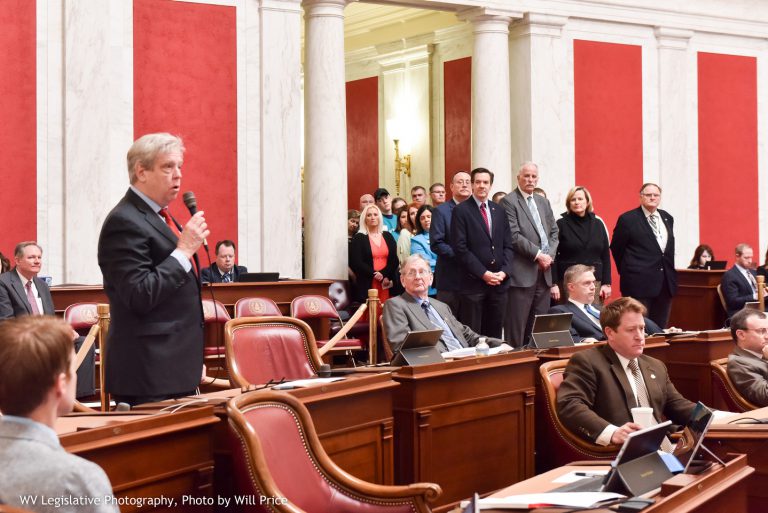
The House passed Senate Bill 150 during Wednesday’s floor session, which details the state’s budget for the 2020-2021 fiscal year.

Senate Bill 150, also called the Budget Bill, was passed after several attempted amendments during the floor session.

The total general revenue budget for this year is $4.579 billion.

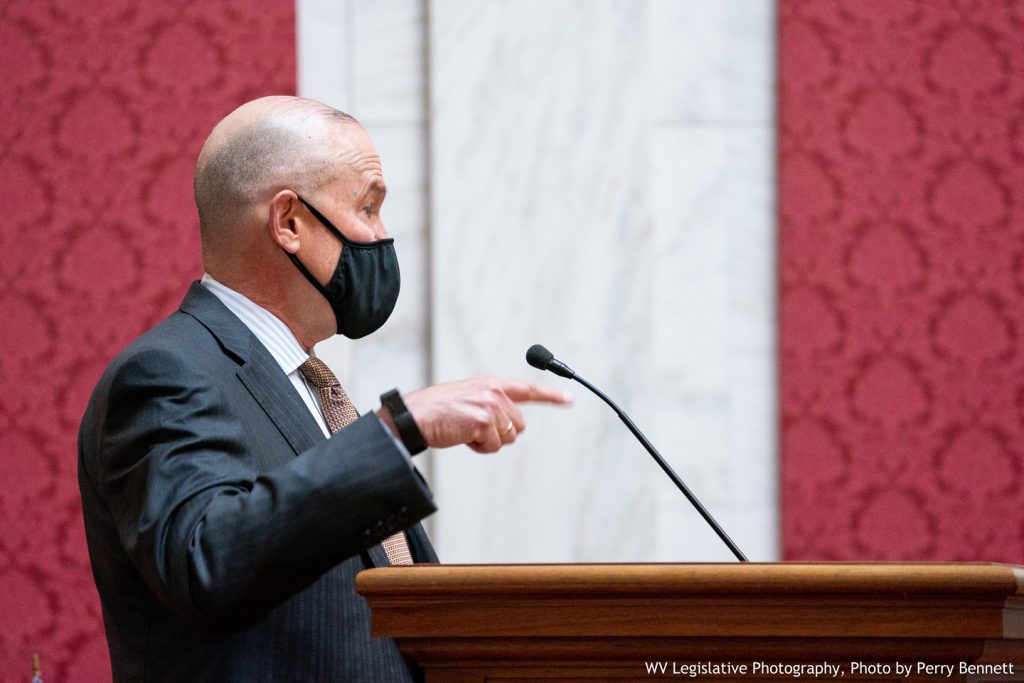
Although 16 amendments were proposed, two were adopted. The two adopted amendments came from the House Finance Chair, Delegate Eric Householder, R-Berkeley. The primary amendment, a strike and insert, detailed the House’s proposed budget. The second amendment changed a few line items on the primary amendment to provide funding in a total of $3.3 million for a second location of the Mountaineer ChalleNGe Academy.

The Mountaineer ChalleNGe Academy trains and mentors at-risk youths from the ages of 16-18 in a 22 week program. This program offers participants help to obtain a high school degree. This program has been very successful. Approximately 90% of participants obtain their degrees upon completion. The first location of the academy is located in Kingwood, located in Preston County. The new second location is set to be located in Montgomery, which is located in the Upper Kanawha Valley. There will now be funding for a northern and southern location for this program.

The House’s budget also provided $16.8 million for foster care, under House Bill 4092, which would increase the per diem rate for foster families. This bill is still under consideration in the Senate. During the floor session, this funding was described as the House’s top priority for the legislative session.

The governor’s original budget allocated $108 million to fully eliminate the waitlist for the I/DD Waiver. The House and Senate did not change this amount.

The House budget also provides an additional $17 million for Medicaid restoration.

The House suspended the constitutional rules during the session to dispense with the rule that bills are to be read on three separate days for eight bills.

The House refused to concur with the Senate amendment for House Bill 4039. The House concurred with the Senate amendments for 10 other House Bills.

Thirty-five bills were advanced to third reading. Thirty-seven bills were advanced to second reading.

Action for three bills, Senate Bills 275, 547 and 747, was postponed for one day.

The House is adjourned until 9 a.m. Thursday.

Senate Passes House Bill for Missing Child Recovery

The Senate convened at 10:00 a.m., passing 3 Senate bills and 22 House bills.

One bill, House bill 4415, seeks to improve the protection and recovery of missing and endangered children in West Virginia. The bill establishes a missing foster child locator unit program within the Department of Health and Human Resources. The unit would receive reports of missing foster children, assist law enforcement in locating these children and interviewing and completing trafficking screening for these children once they are recovered. The bill also establishes the Missing Child Information Act, which establishes requirements and duties for law-enforcement agencies to better the process of recovering missing children.

House bill 4551 defines criteria for continuing to receive an adoption subsidy if the adopted child is placed out of the home. The bill establishes an enhanced definition of the support requirement and provides means of reducing subsidy for families with children in long-term residential placements.

House bill 4519 creates a summer youth intern pilot program in the Department of Commerce for high school students. The bill creates a framework for schools and communities to engage their local stakeholders in programs teaching college and career skills and life skills for the changing modern workforce.

Three Senate supplemental appropriation bills were passed on Wednesday.

SB 854 expires $105,000 from the Purchasing Card Administration Fund to the Department of Arts, Culture and History.

SB 855 transfers $750,000 from the Purchasing Card Admission Fund to the West Virginia Commuter Rail Access Fund.

SB 856 transfers $222,563 from Synthetic Fuel-Producing County Fund to the Department of Commerce’s Marketing and Communications Operating Fund.

The Senate concurred with House amendments on four bills, completing their legislation.

Senate bill 125 prohibits victims of sexual assault from being subjected to certain physical examinations.

Senate bill 163 provides that marketplace facilitators are to collect the hotel occupancy tax. The bill states that a hotel operator may not represent to the public in any way that it will absorb any part of the tax or that the tax is not to be an element in the price to the customer.

Senate bill 545 authorizes the Insurance Commissioner to transfer special revenue funds from the Insurance Commission Fund to the Old Fund. The Old Fund was created to pay workers’ compensation claims with a date of injury on or before June 30, 2005.

Senate bill 651 simply clarifies the definition of “mortgage loan originator”.

Senate Concurrent Resolution 6 was also adopted, naming the Walter E. Swiger, Jr. memorial Bridge.

The Senate adopted Resolution 63, which designates March 4, 2020 as Recovery Community Day at the Capitol. Resolution 64 was also adopted, recognizing the efforts of the Kanawha State Forest Foundation. Two brief recesses were held for the presentation of these resolutions.

Resolution 65 was adopted as well, which designates the West Virginia State Folk Festival as the official site of the WV State Pepperoni Roll Championship.

House Concurrent Resolution 33 was adopted by the Senate, naming the USAF Lieutenant Colonel Frederick Donald Belknap Memorial Bridge.

The Senate is in recess until 7:00 p.m.

The Senate Committee on Transportation and Infrastructure will meet at 9:30 a.m. tomorrow in room 451M.

The Senate Committee on Government Organization will meet at 10:00 a.m. tomorrow in room 208W.

Senate Education Advances Bill for Student Financial Aid

The Senate Education Committee met at 3 p.m., advancing seven House bills.

House bill 4737 seeks to clarify student eligibility for state-sponsored financial aid and requires the vice chancellor for administration to report on it. This bill would primarily apply to students who are raised by a grandparent or other family member rather than their parents and do not have access to the forms required to complete a FASFA to receive financial aid. The bill would waive the requirement for the completion of the FASFA in order to receive financial aid from the state under specific conditions.

Matt Turner, the vice chancellor of administration for the Higher Education Policy Commission, answered questions from the committee. He explained the bill allows for consultation with secondary schools in order to arrange the waiver.

“Currently, institutions can waive certain requirements for FASFA, but we can’t waive FASFA and provide state-level without this,” he said.
The bill was advanced to the full Senate.

House bill 4069 creates the West Virginia Student Religious Liberties Act. This bill seeks to protect a student’s right to express their religion without discrimination. The bill seeks to protect the right to express religious affiliation through posters, artwork and the creation of prayer groups. The bill would require all outlets for religious expression and the creation of clubs or groups follow the same guidelines as secular school groups.

Senator Mike Romano, D-Harrison, asked counsel if the bill unintentionally makes students able to cite religion as a means to override rules and regulations of schools. Counsel answered that the language of the bill prevents this and requires school regulations be followed.

House bill 4497 creates the Alex Miller Law. The bill is named after Roane County High School senior Alex Miller, a football player who passed away after collapsing at a football game. The bill requires defibrillators and a qualified defibrillator operator to be present at all secondary school athletic events.

House bills 2775, 4165, 4804 and 4535 were also advanced to the full Senate with recommendation for passage.

Update:

The Senate convened an evening floor session to receive committee reports and read bills a first time.

The Senate has adjourned until tomorrow at 10 a.m.

House Finance Advances Intermediate Court of Appeals

The House Finance Committee considered Senate Bill 275, a bill that would establish an Intermediate Court of Appeals, in committee on Monday.

Senate Bill 275 creates an Intermediate Court of Appeals, which is a court meant to add an extra step for appeals between the county circuit courts and the Supreme Court of Appeals. The Intermediate Court of Appeals would handle a variety of civil cases and would not handle any criminal cases. This would eliminate the Office of Judges and would place their duties under Board of Review hearing examiners.

The Intermediate Court would have two districts, one in the northern part of the state and one in the southern. A tentative map was drawn up to show the jurisdiction of each district. This map was drawn based on population, but it also attempts to keep circuit courts intact to make the appeals process easier. Each district would have three elected judges.
One of the five fiscal notes presented to the committee estimated the initial cost of the court to be $7.6 million, and $6.4 million annually after the first year. The actual cost of the court was unclear to the committee because of the range presented in the fiscal notes. An updated fiscal note was requested before Senate Bill 275 reaches third reading in the House.

Those supporting this bill argue that this court is needed to take the burden off the state Supreme Court. Although the number of appeals has declined in recent years, Senator Charles Trump IV, R-Morgan, told the committee he believed this is not an accurate representation of the full business done in the Supreme Court.

“By measure of decisions rendered, our Supreme Court is much busier now than it was in 2009,” Trump told delegates in an earlier House Judiciary Committee meeting.

Vice chairman of the House Finance Committee, Delegate Vernon Criss, R- Wood, supported this bill on the basis that it would strengthen the state’s judicial system.
“We should spend money to have proper organization of our court systems,” he said. “We need to give serious consideration to an Intermediate Court of Appeals. This is a good way to accomplish justice.”

Those opposing this bill said they believed the court is an unnecessary expense that would be better used for other parts of the state budget.

The House budget for 2020 was advanced out of committee last week. Delegate Jason Barrett, D- Berkeley, said, “I did not see $8 million allocated in our budget for a court of appeals. What I did see in the budget was $16.9 million for foster care, $19 million to eliminate the I/DD Waiver, and $16 million to fund Medicaid.”

Additionally, some delegates argued that creating this layer to the court system would actually delay cases instead of speeding them up, due to the nature of civil cases.

Delegate Isaac Sponaugle, D- Pendleton, opposed this bill for that reason.

“We have this shiny object that is trying to bring investments into the state, but it’s going to cost a lot of money and it’s going to delay our justice system,” he said. “It’s not going to provide better justice for our citizens.”

An amendment offered by the House Judiciary Committee, and later adopted by the Finance Committee, provided a permanent location for the northern and southern courts in Clarksburg and Beckley, respectively.

Delegate Jim Butler, R-Mason, offered several amendments in Finance to change the location of the southern court. He proposed to locate the court in Spencer, Hurricane and Point Pleasant. All these amendments were rejected.

The Senate has proposed and passed similar legislation the past three years, but it has never been reported to the full House.

House Finance advanced the bill to the full House. Senate Bill 275 was read a first time Tuesday and is now on second reading.

Senate Passes House Bill for Childhood Trauma Screening and Care

The Senate convened at 11:00 a.m. today and passed 24 House bills.

House bill 4773 establishes statewide standards for a work group to investigate screening protocol for adverse childhood trauma. The bill states that the Bureau of Public Health is to provide staff for this work group. The purpose of this bill is to address a growing body of research linking childhood trauma to lifelong health consequences.

The bill states that the prevention of childhood trauma and mitigating the impact of such trauma are to be implemented into the state’s opioid response plan. Using a comprehensive systems approach, the protocols would provide for different care services such as referral to counseling programs, education about toxic stress, and identification and treatment of adverse childhood experiences and linked health conditions.

Senator Ron Stollings, D-Boone, explained the bill to the Senate and urged passage. “This bill has a far-reaching impact for the future of our children,” he said. The bill was passed with bipartisan support.

House bill 4790 extends the Career and Technical Education curriculum into middle school grades using comprehensive career exploration for success in occupations and entrepreneurship in the changing workforce. The bill requires middle school electives in Career Technical Education to be offered starting with the 2022-2023 school year.

House bill 4478 creates a lifetime ban for commercial drivers involved in human trafficking. The bill states that any driver using a commercial motor vehicle in a commission of a felony involving an act of human trafficking is prohibited from having a Commercial Driver’s License for life.

The Senate concurred with House amendments and completed legislation for Senate bill 201, which clarifies terminology and conditions for criminal stalking and harassment charges.

The Senate amended House amendments to Senate bill 849, which generally addresses military service as a factor in certain insurance rates. The bill prohibits an insurance company from increasing premiums when reinstating an insurance contract. The Senate requested the House to concur before legislation can be completed.

The Senate adopted Resolution 61, which recognizes Leadership Jefferson for their contributions and service to Jefferson County, West Virginia. The Senate also adopted Resolution 62, recognizing October as National Dwarfism Awareness month. Two brief recesses were held for the presentation of these resolutions.

The Senate is in recess until 6:30 p.m.

House Passes Renewable Energy Bill

The House convened at 9 a.m. for an early floor session and passed Senate Bill 583, which creates a program for renewable energy resources.

Senate Bill 583 permits electric companies to expand their capacity by providing energy from solar power. This bill aims to attract business into the state with the diversification of energy production.

There are several large businesses in the country that require a percentage of their energy to be produced by solar, including Amazon, Google and Netflix. These corporations have stated that they will not bring their business into West Virginia without the possibility of solar power production.

This solar power program will increase customer’s power bills by 18 cents per month, but this number has the potential to decrease if more customers sign up for solar energy. The largest consumer of energy in the state is the industrial sector.

Senate Bill 583 passed the Senate unanimously but was met with some resistance in the House. Those opposed to this bill were concerned about how solar power will affect the future of the coal industry in the state. However, others in support of the bill stated how this program will benefit the state by attracting large businesses. Additionally, those in support of this bill stated the potential of this program to actually increase usage of all forms of energy in the state, with the attraction of new energy customers. It is estimated that solar power is viable for 25% of energy production, and the remaining 75% is covered by coal and natural gas sources.

Delegate Rodney Miller, D- Boone, spoke in favor of the bill and mentioned how solar energy could benefit his county in southern West Virginia, which has been hit particularly hard by the decline of the coal industry.

“If this is something that we can do to move West Virginia forward, then we need to do this,” he said.

Despite the controversy, Senate Bill 583 was passed in the House.

Fourteen other Senate Bills were passed.

Ten bills were advanced to third reading. The budget bill, Senate Bill 150, was advanced to third reading with amendments pending and the general right to amend. Twenty-seven bills were advanced to second reading.

The House is in recess until 7 p.m.

After the recess, the House received committee reports and message from the Senate.

The House is adjourned until 10 a.m. Wednesday.

House Passes Municipality Weapons Bill

During Monday’s floor session, the House passed Senate Bill 96, which prohibits municipalities from restricting the right to carry weapons.

Senate Bill 96 states that municipalities must follow state law in accordance with deadly weapon or pepper spray laws. This means that municipalities may not restrict a person’s right to carry, possess, purchase, own or sell deadly weapons that are lawfully possessed. This also encompasses the right to carry weapons at a fair or festival. Municipalities may only restrict the carrying of weapons in municipality-owned facility.

The House also passed Senate Bill 201, which modifies and clarifies the offense of stalking and harassment. The bill defines these terms and offenses and sets criminal penalties for each. A person who is found guilty of harassment or credible threats is guilty of a misdemeanor and can be fined up to $1,000 or imprisoned for up to six months. A subsequent conviction for the same offense is a felony offense and is punishable for a prison sentence of three-five years, or a fine of $3,000-$10,000.

The House passed four other Senate Bills.

Eight bills were advanced to third reading. Nine bills were advanced to second reading.
Action for one bill, Senate 651, was postponed one day.

The House is in recess until 6 p.m.

Following the recess, the House received committee reports and messages from the Senate. The House is adjourned until 9 a.m. Tuesday.

Senate Passes 17 Bills

The Senate met at 11:00 a.m. today and passed 2 Senate bills and 15 House bills.

Senate bills 852 and 853 are supplemental appropriations that transfer funds from the state Treasury to the Department of Education School Building Fund and School Building authority.

House bill 3127 allows homeschooled students to participate in extracurricular activities and athletic programs in public schools. The bill provides that the homeschooled student is to comply
with the requirements of the Secondary Schools Activities Commission, demonstrate sufficient academic performance for two years and does not receive compensation for their participation.

House bill 4412 provides that federal programs that pay for fees and tuitions for Army National Guard and Air National Guard members shall be the first payor of the tuitions, instead of the last. The bill states that the Adjunct General may pay directly to the member an amount equal to the tuition and fees that would have otherwise been payed to the school, for members participating in the Promise Scholarship Program.

House bill 4365 allows institutions of higher learning to grant college credit hours to students who have learned English as a second language. The bill states that if a student reaches an acceptable score on an English test, this can satisfy the student’s foreign language requirement.

House bill 4969 provides a new tax credit against personal or corporate net income for the donation or sale of a qualifying vehicle to a charity organization for low-income workers.

House bills 4090, 4146, 4438, 4450, 4461, 4466, 4522, 4760, 4882 and 4929 were also passed in the Senate on Monday.

The Senate adopted Resolution 60, memorializing the West Virginia native Katherine Johnson, NASA mathematician and recipient of the Presidential Medal of Freedom.

UPDATE: The Senate met briefly at 6:30 p.m. to receive additional committee reports.

The Senate is adjourned until tomorrow at 11 a.m.

Transportation and Infrastructure will meet tomorrow at 9:30 a.m. in 451M


House Passes Military Insurance Bill

The House convened at 12 p.m. Saturday to consider several bills, including Senate Bill 849, which relates to insurance coverage for military personnel.

Senate Bill 849 considers how military service acts as a factor in certain insurance coverage rates. This bill protects military service members from being subjected to denied, cancelled, or increased premium insurance coverage based on the fact that this person was on active duty. For purposes of determining a premium, an insurer must consider that a uniform service member whose coverage lapsed or was discontinued during active duty service is to be considered as having maintained continuous coverage. This prevents an increased premium.

The House also passed Senate Bill 225. This bill encourages municipalities to participate in an “Adopt A Street” program. This is similar to the state-wide “Adopt A Highway” program. In West Virginia there are currently 25,000 volunteers who regularly pick up litter on 4,000 miles of highway. They have been responsible for removing more than 40 million pounds of litter since the program began. This bill seeks to expand the success for the “Adopt a Highway” program into municipalities.

The House passed nine other Senate Bills.

Seven bills were advanced to third reading. Thirty-six bills were advanced to second reading.

Action for Senate Bill 583 was postponed for one day.

One resolution was introduced.

The House is adjourned until 11 a.m. Monday.

Senate Passes Budget Bill

The Senate convened at 9:00 a.m. on Saturday to discuss Senate bill 150, which describes the Senate’s budget for the 2020 fiscal year.

As of today, the total general revenue budget of the West Virginia Senate is $4.571 billion.

Currently, $6.3 million of this budget has been dedicated to the Intermediate Court of Appeals established by Senate bill 275. This bill is currently awaiting consideration from the House of Delegates.

The Senate does not currently include the additional $17 million proposed by the House dedicated to improving foster care. These funds would raise peridium for families providing foster care.
The Senate adopted three amendments to the budget bill on Saturday.

Senator Craig Blair, R-Berkeley, proposed the amendment to fully fund the Disability waivers from the Department of Health and Human Resources. This provides homecare instead of institutionalized care for people with intellectual and developmental disabilities to maximize their independence. This now occupies a total of $108.5 million of the Senate’s budget.

Senator Stephen Baldwin, D-Greenbrier, proposed an amendment to better fund rape crisis centers. He proposed an additional $125,000 be dedicated to these centers.

Senator Ron Stollings, D-Boone, proposed that $2 million be dedicated to the Public Health Emergency Response Fund in response to the global outbreak of the Corona Virus. He said that there was an increasing need to better educate the public and prepare hospitals to minimize exposure and spread of the disease.

Senator Tom Takubo, R-Kanawha, stated his support for the bill, saying that this could save at-risk West Virginians, and if the outbreak passes, the money would not have to be spent.

The budget bill passed as amended and was ordered to the House.

The Senate passed four House bills on Saturday as well.

HB 2149 permits the Farm-to-Food Bank Tax Credit to equal 100% of the value of the donated products if the value is $2,500 or less.

HB 4437 adds eligible unbanked payees of state funds to the WV Pay Card Program. This would increase efficiencies and decrease the expenses of paper check issuances.

HB 4513 increases the costs for game and protected species replacement. The bill also increases replacement costs for antlered deer and creates provisions for hunting and fishing license revocations.

HB 4582 declares certain claims against state agencies be considered moral obligations of the state. The bill directs the Auditor to issue warrants for the payments of these claims.

The Senate is adjourned until 11:00 a.m. on Monday.

The Senate Committee on Government Organization will meet at 1:00 p.m. in room 208W.

The Senate Education Committee will meet at 1:00 p.m. in room 451M.

The Senate Judiciary Committee will meet at 3:00 p.m. in room 208W.

The Senate Finance Committee will meet at 3:00 p.m. in room 451M.