Sunday, April 5, 2026
Home Blog Page 134

House Passes Parenting Fairness Act

The House passed House Bill 4648 during Wednesday’s floor session, otherwise known as the Parenting Fairness Act of 2020. Wednesday was the last day for House Bills to be passed out of the House for this legislative session.

House Bill 4648, the Parenting Fairness Act of 2020, establishes that a 50-50 custody split between two parents in the case of divorce is in the best interest of their child(ren) and is to be set as the standard for courts in the state. This is to be used in cases when parents cannot come up with their own parenting plan that they both agree on. Additionally, this custody split will only be implemented in cases where abuse, neglect or drug use are not present with one of the parents. Ultimately, it will be up to the judge to decide custody agreements after hearing all the facts of each case. House Bill 4648 only sets the standard for co-parenting in the court system, after research has shown that this is in the best interest of the child(ren).

House Bill 4958 eliminates the ability for a driver’s license to be revoked under the circumstances of unpaid court fines and costs. The purpose of this bill is to allow those with long outstanding fines to legally drive and pay their fines on a payment plan. This legislation aims to keep people working while they have outstanding fines.

Research has shown that suspension of driver’s licenses or the threat of suspension does not force people to pay fines. Instead, these people are either forced to drive to work with a suspended license in order to make money to pay off their fines, or otherwise lose their job and lose their ability to repay their debts. As said by several delegates during the floor session, West Virginia does not offer much in the ways of public transportation, so this creates another layer of distress for people in this situation. This bill passed with strong bipartisan support.

House Bill 4524 permits the sale of alcohol for offsite consumption across the entire state. West Virginia currently has 13 dry areas, which are areas of the state that cannot sell alcohol. Under this new legislation, any political subdivision will be allowed to opt to stay dry. This will allow areas of the state to opt out of selling rather than having to opt in, because the majority of the state does allow for the sale of alcohol.

Other notable bills passed during the floor session include House Bills 4494 and 4892.
House Bill 4494 creates a Tobacco Use Prevention and Cessation Task Force and provides money to the Office of Tobacco Prevention to combat tobacco use in West Virginia by using funds from the Tobacco Master Settlement Fund.

House Bill 4892 reduces personal income tax rates by using money that is directed from certain revenue sources into a new Personal Income Tax Reduction Fund.

Twenty-nine other bills were passed. One bill, House Bill 4639, was rejected. House Bill 4639 proposed to change mandatory state inspections for motor vehicles to once every two years instead of once every year.

Three bills were advanced to third reading. Seventeen bills were advanced to second reading.

Four resolutions were introduced.

The House is adjourned until 11 a.m. Thursday.

Senate Passes Bill for Medicaid Dental Coverage

The Senate met at 10:00 a.m. on Wednesday and passed a total of 52 Senate bills. Today is Crossover Day at the Legislature and all bills are required to be advanced from their houses of origin to receive further action this session.

The Senate passed SB 648, which provides dental coverage for adult Medicaid recipients. Several members of the Senate rose in support of the bill.

Senator Ron Stollings, D-Boone, stated that while he believes the program should be expanded, this would be a good start. “This bill will have a far-reaching impact,” he said.

Senator Tom Takubo, R-Kanawha, also stood for the bill, saying that preventative treatment would likely reduce the amount of coverage needed for emergency care. “Emergency procedures are more expensive than maintenance care,” he said.

SB 653 was passed as well, which increases the number of magistrates in Putnam, Monongalia, Berkeley and Jefferson Counties. The bill states that effective January 1, 2021, Berkeley County will have 6 magistrates, Jefferson County will have 4, Monongalia County will have 5 and Putnam County will have 4.

SB 752 was placed on third reading with right to amend. This bill updates and improves the WV Medical Cannabis Act by increasing the locations of dispensaries and the acceptable forms of medical cannabis. The bill also clarifies that the Tax Division and the Bureau of Public Health are to monitor the price of medical cannabis.

Senator Charles S. Trump IV, R-Morgan, proposed an amendment to grant the Commissioner of the Department of Health and Human Resources the authority to approve or disapprove of forms of medical cannabis based on recommendations from a medical advisory board. The amendment was adopted by the Senate and the bill was passed.

SB 850 was passed as well. This bill clarifies that racial discrimination includes discrimination based on certain hair styles and textures. This includes but is not limited to hairstyles such as twists, braids or locks.

The Senate also passed SB 38, which, as amended, allows county boards of education to offer high school students an elective social studies course on sacred texts or comparable world religions. The bill allows a student to use a translation of their choice. The purpose of this course would be to educate students on literary forms and symbolism which influence culture, art, philosophy, law, etc.

SB 661 changes the minimum minutes of intersectional time required per day to an average of 5 hours per day throughout the instructional term. The bill prohibits the instructional term from commencing before September 1 and allows county boards of education to publish notice of public hearings for discussing school calendars on the board’s website.

The Senate adopted Resolution 56, congratulating Jason Gibs of Wayne High School for being the PLTW Biomedical Science Teacher of the Year. A brief recess was held for the presentation of this resolution and to recognize Gibbs and his family.

The Senate also adopted Resolution 52, designating February 26, 2020 as Celebrating Children and Families Day with the West Virginia Child Care Association. A brief recess was held to present this resolution and recognize members of the WVCCA.

The Senate is in recess until 11:00 a.m. tomorrow.

The Senate Judiciary Committee will meet at 9:30 a.m. tomorrow in room 208W.

The Senate Finance Committee will meet tomorrow at 9:30 a.m. in room 451M.

Senate Rejects Resolution for Constitutional Amendment

The Senate met at 11:00 a.m. today and discussed Senate Joint Resolution 9. This is a Constitutional Amendment that allows the Legislature to eliminate or lower ad valorem personal property taxes. The resolution doesn’t allow the Legislature to raise personal property taxes above the limits already in place.

The bill removes the constitutional requirement for the uniformity of taxation and allows the legislature to set different rates of taxation, valuation and/or assessment in the state. The resolution required the votes of at least 2/3 of the Senate to advance to the House.

This resolution has been highly anticipated in the Senate since January 8, when Governor Jim Justice listed the elimination of the business inventory tax as a priority in his State of the State address. The Resolution allows for the implementation of SB 837, which creates a six-year phase out of personal property taxes on manufacturing inventory and machinery.

The Senate was very divided and engaged in lively debate concerning this issue. Many expressed support for the resolution, stating that it would allow the citizens of West Virginia to vote whether they desired this change, and would allow them to voice whether they support the tax cut to businesses. Others opposed, stating that the resolution and the bill were not without consequences and citizens would have to pay for the tax cut to businesses.

Senator Charles S. Trump IV, R-Morgan, rose in favor of the resolution. He stated that because of the business tax, small businesses are suffering, and the resolution would give the Legislature the ability to provide relief to these businesses. He stated that even members of the Senate who opposed SB 837 should vote in favor of the resolution because it places the decision in the hands of West Virginian voters.

Senator Ryan Weld, R-Brooke, agreed, stating that this is a decision for the people of the state about how to spend their money.

Senator Mike Romano, D-Harrison, spoke against the bill. “The resolution, first and foremost, usurps local control of counties and places it in the hands of the Legislature,” he said. He stated that he is concerned about the decisions made if the resolution should pass. He also said that it was unlikely the people of West Virginia to make an informed decision when voting on the resolution because it is deceptive. “We are showing citizens a tax cut, when behind our back is a tax increase,” he said.

Senator Paul Hardesty, D-Logan, agreed that, even though the resolution may have the best intentions, county autonomy would be severely impaired.

Senator Craig Blair, R-Berkeley, rose in response to claims that the resolution is deceptive. He stated that he supported the resolution and would ensure that the language is transparent and readily available to the public before Election Day.

Senator Patricia Puertas Rucker, R-Jefferson, stated to those concerned that the bill does not guarantee a tax break or increase, but gives the decision to the people. She said that she had seen a lot of concerns about the resolution infringing on funding to public education and wanted to assure that the resolution does not interfere with the constitutional mandate to continue funding education.

Senator Trump closed the debate by saying that this resolution was intended to move WV forward and create measures to improve business investment in the state.

The Resolution was rejected with 18 in favor and 16 opposed.

The Senate passed a total of 29 Senate bills on Tuesday.

SB 511 regulates pawnbrokers to better prevent the selling of stolen property and assist in the recovery of stolen property by the police. The bill states that pawnbrokers cannot purchase from a minor or a person who appears to be under the influence of alcohol or a controlled substance.

SB 284 creates the West Virginia Health Care Continuity Act, which ensures that healthcare coverage plans meet certain standards while remaining affordable and are not denied to persons with preexisting conditions.

SB 668 enacts the Uniform Trust Decanting Act, which allows a trustee to distribute assets of one trust into another trust.

Ten bills on second reading were passed after the Senate suspended Constitutional rule that a bill be read on three separate days to receive a vote.

SB 106 makes daylight savings time the official time year-round in the state. If the bill becomes law, it will only be made effective after federal congressional action to allow it.

SB 472 provides an alternative sentencing program for work release for individuals convicted of a misdemeanor or felony. The bill allows such persons to work with the Division of Highways or the Division of Natural Resources on tasks such as cleaning up state parks or highways.

SB 569 expires funds from various accounts and moves them to The Medical Services Program Fund of the Department of Health and Human Resources.

SB 570 expires funds from the State Excess Lottery Revenue Fund and moves them to the Medical Services Program Fund of the DHHR.

SB 633 creates the Medicaid Families First Reserve Fund Account. This fund would be administered by the Secretary of the DHHR.

SB 729 relates to awards and disability distributed under the Deputy Sheriff Retirement Act.

SB 749 requires the Fatality and Mortality Review Team to share data with the Center of Disease Control in order to identify themes and risk factors as well as other determinants of health.

SB 798 requires dairy foods processed in the state ne added to the list of items to be purchased by state-funded organizations.

SB 805 is a supplemental appropriation of funds from the state Treasury to the West Virginia Commuter Rail Access fund.

SB 812 is a supplemental appropriation to transfer funds from Lottery Net Profits to the Bureau of Labor Services.

The Senate amended House amendments for SB 39, which is a rules bundle for the Department of Health and Human Resources. The Senate concurred and completed legislation for the bill.

The Senate also concurred with House amendments for SB 657, which allows for the designation of tourism development districts in the State.

The Senate adopted Resolution 50, designating February 25, 2020 as Fairmont State day. A brief recess was held for the presentation of the resolution and a visit from Fairmont State students.

Resolution 51 was also adopted, celebrating the 90th anniversary of the Shinnston Fire Department. A brief recess was held for the presentation of this resolution and to thank the staff of the Fire Department.

The Senate is adjourned until tomorrow at 10 a.m.

House Passes Bible Course Bill

The House convened on Tuesday to pass twenty-seven bills, including House Bill 4780, offering elective courses on the Bible.

House Bill 4780 permits school boards to offer social studies elective courses to high school students on the Bible. This bill complies with federal regulations in which schools are not permitted to teach theology, or promote, endorse or favor any one religion over another. Students in this class must use a school-provided Bible and are not allowed to use their own for class purposes. The bill specifically states that schools will be permitted to teach about the influence of the Hebrew Scriptures or New and Old Testament on law, history, government, literature, art, music, customs, morals, values and culture.

The House also passed House Bill 4009, the Downstream Natural Gas Manufacturing Investment Tax Credit Act of 2020, and House Bill 4421, the Natural Gas Liquids Economic Development Act. Both of these bills aim to advance economic development in the Oil and Gas industry.

House Bill 2008 bill was rejected. Forty-six bills were advanced to third reading.

Seven resolutions were introduced.

Wednesday is the last day during this legislative session for the House to pass House Bills.

The House is adjourned until 9 a.m. Wednesday.

Senate Passes Bill to Eliminate Business Inventory Tax

The Senate met at 11:00 a.m. on Monday and discussed SB 837. This bill creates a 6-year phase out of personal property taxes on manufacturing machinery, equipment, automobiles and inventory. The bill creates a Special Revenue Account which provides that the Legislature restore funding to counties and municipalities in compensation for the tax cut.

The bill calls for an increase in sales tax to 6.5 cents per dollar to provide for the tax cut. The bill calls for a tax increase on cigarettes to $2.00 per 20 cigarettes. Other tobacco products, E-cigarettes and vaping products would see a tax increase to 50% of the wholesale price. All money collected from these taxes would be deposited into the Special Revenue Account.

The bill would become effective if Senate Joint Resolution 9, a constitutional amendment granting the legislature the right to eliminate or lower Ad Valorem Tax on personal property, is voted for by West Virginian citizens.

The Senate was very divided when discussing the bill, some believing that this would improve West Virginia’s competitive economic environment while others feared that West Virginians would suffer from the sales tax while large corporations benefitted.

Senator Mike Romano, D-Harrison, expressed the concern that the large corporations benefiting from the tax break will take that money back to the headquarters of the business, rather than feed the money from the tax cut back into West Virginia’s economy.

Senator Chandler Swope, R-Mercer, rose in support of the bill, saying that cutting the taxes is a good investment to help foster business in the State. One of his arguments in favor of the bill is that eliminating the tax can help to raise wages in the state.

Senator Paul Hardesty, D-Logan, opposed the bill, saying that the tax breaks already implemented, as well as similar steps already taken, are not meeting current expectations.

Senator Eric Tarr, R-Putnam, stated his approval of the bill. “Growth is undeniable with this plan,” he said.

Senator Charles S. Trump IV, R-Morgan, rose in strong support of the bill, referring to SB 837 as an “extraordinary piece of legislation”. Trump stated that the tax break would provide for more West Virginian businesses to thrive and afford to hire West Virginian citizens. “This tax is a job-killer,” he said, “and we have suffered under the illusion that there’s nothing we can do about it.”

Senator Craig Blair, R-Berkeley, closed the debate by urging a Yes-vote. In response to those who opposed the bill, he stated that the bill would only be implemented with the consent of the majority of West Virginian citizens. He said that this tax cut would improve the business environment, create jobs, encourage competition, and foster investments in the state.

When the Senate voted on the bill, it passed 17-16 and advanced to the House.

The Senate also passed 20 other Senate bills on Monday.

SB 528 creates the Uniform Worker Classification Act. The purpose of the bill is to create a test to distinguish independent contractors from employees. This bill was also debated by the Senate. Senator Trump presented the bill, stating that this would help to decrease confusion for businesses.

This was also debated in the Senate, as the bill would lower the bar for what classifies an independent contractor, which do not receive unemployment compensation.

Senator Mike Romano, D-Harrison, stated that this bill doesn’t put West Virginians first and was meant to benefit lawyers and large corporations. Others stated that the bill may increase litigation rather than decrease it.

The bill passed 17-16 and advanced to the House.

SB 578 was also passed, which recalculates the tax on producing, selling and generating solar electricity. The bill aligns the price with other energy taxes. Many members of the Senate regarded this as a step forward in the state’s investment in renewable energy sources and believe that the bill would help the state to be less reliant on the coal industry.

The Senate also passed SB 689, which creates the Requiring Accountable Pharmaceutical Transparency, Oversight, and Reporting Act. This bill requires drug manufacturers and health benefit plan issuers in the state to provide cost information, changes in cost information and prescription drug statistics to the State Auditor. The State Auditor is required to publish this information on a searchable transparency website for public use.

The Senate passed Senate bills 579, 586, 651, 691, 705, 707, 723, 727, 728, 734, 751, 755, 770, 782, 787 and 838 on Monday.

The Senate also adopted Senate Concurrent Resolution 46, which requests the DEP and DHHR to propose a source-water supply study plan.

The Senate has adjourned until tomorrow at 11 a.m.

House Judiciary Advances Solar Energy Bill

0

The House Judiciary Committee advanced Senate Bill 583, which creates a program to further the development of renewable resources in the state.

Senate Bill 583 aims to allow electric utility companies to expand their reach to provide energy from solar power. The purpose of this bill is to increase economic activity and diversify types of electricity within the state.

John Scalzo, a representative from Appalachian Power, testified in committee that the addition of solar services would increase their customers’ electric bills by only 18 cents per month to fund the initial creation of the project. The more customers that sign up for renewable energy, the less this cost will be.

Customers for solar energy include both residential and industrial customers. Larger industrial customers have the potential to cover the costs alone depending on their needs.

Some delegates had concerns about the efficiency of solar power on cloudy days and during nighttime. Although West Virginia is not a particularly sunny state, solar power can still be produced when the sun is covered by clouds. However, solar power is not produced during nighttime. At this point, energy companies will use coal to continue powering facilities or residential areas.

Mike Graney, the Executive Director of the West Virginia Development Office, testified in committee that some Fortune 500 companies require a certain percentage of their energy use be reusable. Because West Virginia currently does not offer renewable energy sources, these companies are not bringing their business into the state. Some of these companies include Amazon, Netflix and Google.

All of West Virginia’s surrounding states, Virginia, Kentucky, Ohio, Pennsylvania and Maryland produce renewable energy.

The production of solar energy also aims to utilize land that is not currently in use, such as abandoned coal mines or farmland.

Speaking in favor of this bill in committee, Delegate Sammi Brown, D- Jefferson said, “We don’t need to abandon one form of energy—we need to diversify. In turn, this will diversify our economy.”

Senate Bill 583 is reported to the full House with the recommendation that its do pass.

House Passes Involuntary Hospitalization Bill

In Monday’s floor session, the House passed House Bill 4009, which relates to the procedure for involuntary hospitalization.

House Bill 4009 permits a doctor to order the involuntary hospitalization of a mentally ill or addicted patient that is in clear danger to themselves or other people.

In the case of a psychiatric emergency, a doctor may hold a patient for up to 72 hours. This procedure has been established in the case where a mental hygiene commissioner, county magistrate or circuit judge is unavailable for an immediate hearing. Upon admission and up to 24 hours after admission to the hospital for the involuntary hold, the doctor must file a petition for a mental hygiene hearing. During the hold, the patient may receive medical treatment if necessary. The patient that is involuntary hospitalized must be released within 72 hours.

Judiciary Chair Delegate John Shott, R-Mercer, spoke in favor of the bill during the floor session.

“It’s not too often that we have the opportunity to pass bills that can save lives. I think this bill is one of those,” he said.

The House also passed House Bill 3127, which allows home-schooled students to participate in secondary school extracurricular activities. The Senate has passed similar legislation in recent weeks. Senate Bill 131 is called the “Tim Tebow Act,” which is named after former homeschooled NFL and current MLB player Tim Tebow.

House Bill 3127 goes further with the qualifications that must be reached before an individual is permitted to participate in extracurriculars. Students must demonstrate satisfactory evidence of academic progress for one year and be enrolled in one virtual instruction course per semester before being eligible.

This bill has been communicated to the Senate for consideration.

The House passed six other bills.

Senate Bill 657 was passed with an amendment. It will go back to the Senate for concurrence with the amendment.

Thirty bills were advanced to third reading. Forty-three bills were advanced to second reading.

The House is adjourned until 11 a.m. Tuesday.

Senate Government Organization Advances 5 Bills

0

The Senate Committee on Government Organization met at 4:00 p.m. Friday and advanced 5 bills

SB 690 promotes the development of overland recreation in the state. The bill establishes a fund for the acquisition, construction, maintenance, and rehabilitation of roads for overland recreation and establishes a grant program with administration provisions to oversee applications for such grants. The bill also allows street-legal special purpose vehicles to be operated on highways and grants the Recreational Trails Advisory Board authority to use money from the Overland Recreation Fund for the sole purpose of building an overland trail system in West Virginia.

SB 521 provides for economic incentives and job creation. The bill creates the Tax and Economic Incentives Review Committee, establishes who is permitted to serve on the committee and describes the committee’s powers and responsibilities. The bill requires the review of all tax and economic incentives every five years.

SB 66 requires that state police follow the towing policies of the counties in which they operate.

SB 119 establishes an online voter’s guide on the Secretary of State’s Website. The guide would be created by the State Election Commission using information given on certificates of announcement. Candidates for statewide office would be eligible for submitting a statement as well as other information required for the certificate of announcement.

SB 687 authorizes an increase in compensation to elected county officials. Every county commissioner who desires the salary increase must file their request to the office of the clerk of the county commission before the effective date.

House Finance Advances Bill to Provide Defibrillators at School Athletic Events

0

The House Finance Committee advanced a bill that would require defibrillators at any secondary school athletic event and practices.

House Bill 4497, as amended, would make this a requirement for the West Virginia Secondary Schools Activity Commission for the duration of the high school or middle school event or practice. The bill also requires the commission to have a posted emergency action plan.

The committee also advanced an originating bill that creates a new tax credit for 501(c)3 charitable organizations registered in the state. The organization could claim the credit, which is an aggregate amount of $300,000 per year, for cars donated or sold to it for donating vehicles to low-income workers. Workers who qualify under the bill would be at or below 200% of the federal poverty level. The credit is on a first-come first-serve basis.

Another bill advanced by the committee would establish a severance tax rebate for metallurgical coal mines.  Under the bill, a coal operator could qualify for the rebate if it has experienced a total increase of all mines operated. The operator would have to show an overall increase of production from all mines or it would not be able to claim the rebate.

Large seam metallurgical coal would be included in this calculation under House Bill 4439 but not small steam coal mines because of the severance tax was lowered in a bill that passed last year below the maximum required for the rebate of 5%. The committee substitute added further clarification to limit the rebate to 80% of the aggregate total of severance taxes of the rebate year compared to the base year, which was initially established.


House Passes West Virginia Impact Fund Bill

The House passed House Bill 4001, which creates the West Virginia Impact Fund.

House Bill 4001 seeks to further economic development, infrastructure development and job creation in West Virginia by the creation of the West Virginia Impact Fund, its Investment Committee and the Mountaineer Impact Office.

The Mountaineer Impact Office and Investment Committee will bring forth projects that private investors wish to fund. These entities will also look across the world for businesses that wish to pursue capital investments in the state. This includes domestic and foreign investment opportunities. The investments will go into the West Virginia Impact Fund.

Some businesses can be hesitant to make investments in our country because there is a possibility that the investment can be taken away at the federal level up to two years after the investment was made. The benefit to businesses is that they will be refunded their investment if the federal government gets in the way. West Virginia will be able to reap the benefits of their businesses, which will bring jobs and tax dollars into the state.

The Investment Committee will consist of the Governor, Secretary of Commerce, and five individuals appointed by the Governor, with the advice and consent of the Senate, that specialize in finance or economic development. The bill gives legislative control to the Impact Fund with the oversight of the state Senate.

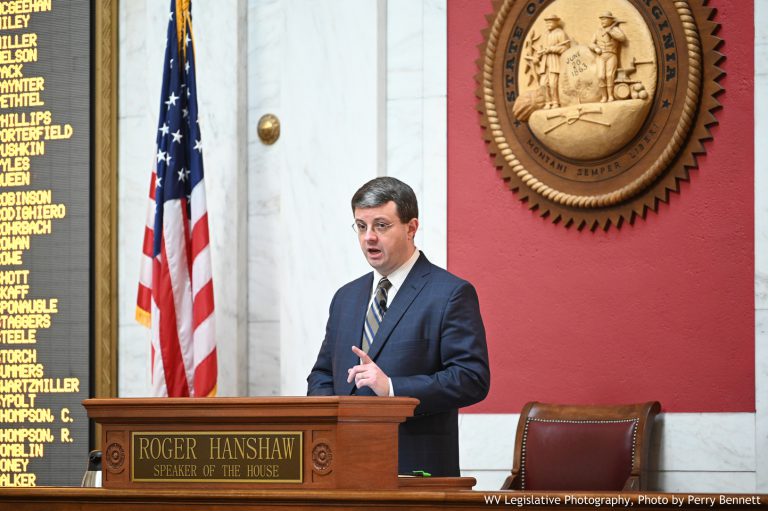
House Speaker Roger Hanshaw, R-Clay, is the lead sponsor of this bill.

When describing the benefits of the bill to the House, Hanshaw said, “We seek to benefit the state of West Virginia by increasing employment opportunities and secondary taxes.”

Other states have created similar funds to encourage economic development with the use of tax money. This legislation does not have a fiscal note. Instead of bringing in money in with taxes, House Bill 4001 encourages private companies to invest.

“This bill shows that the state of West Virginia says to the world: ‘We legitimately want you here and we are open for business,’” Hanshaw said.

The House passed twelve other bills.

Ten bills were advanced to third reading. Thirty-one bills were advanced to second reading.

Senate Bills 573 and 623 passed, therefore completing action on the bills. House Bill 4820, relating to inventory of firearms owned by state agencies, was rejected.

Three resolutions were introduced.

The House is in recess until 6 p.m. Friday.

Following the recess, the House received Senate messages and Committee reports.

The House is adjourned until 11 a.m., Monday, February 24th.