The Committee on Health and Human Resources met this afternoon.
Markup & Passage
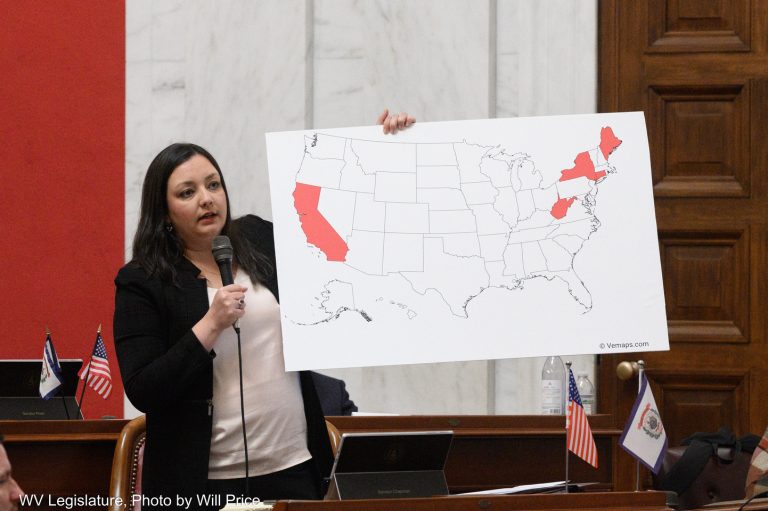
House Bill 2007 eliminates the Healthcare Authority and repeals the certificate of need (CON) progress in West Virginia. The repeal of the CON program would be effective January 1, 2026. The bill continues the moratorium on certain services, such as nursing homes, intermediate care facilities, methadone beds, substance abuse treatment beds, and hospice.
A motion was made to table the bill; it was rejected.
A motion was made to advance to the floor; 12 voted in favor and 13 voted in opposition. The motion was rejected.
For the committee hearing discussion, please see this blog.
A motion was made to reconsider action on House Bill 2007. A motion was made to table the reconsider motion. It was rejected. A motion to adjourn was offered and failed. Then, the motion to reconsider the action was rejected.
Committee Hearing
Senate Bill 460 creates exemptions to mandatory vaccination requirements based on religion and moral reasonings. The bill revises the existing medical exemption process and eliminates the position of the State Immunization Officer. The bill allows for civil action for violations of the section. The bill relates to the mandated vaccines, not COVID-19 or flu vaccination.
Opponents of Vaccine Exemptions
 A former State Health Officer presented at the bill hearing. He stated that about 75 percent of medical exemptions are approved. A child must have 22 vaccines before pre-K. By high school, the child has an additional 8. This is a total of 30 vaccines before adulthood. An unknown number of unvaccinated children live in the state because if a child does not go to public school, they do not need an exemption.
A pediatric doctor from South Charleston spoke to the bill. She spoke of death certificates before 1955 that she found while doing research, which listed measles, polio, diphtheria, and other disease as causes of death. These diseases were thought to be eradicated. Now, there are outbreaks of measles in Texas. A few years ago, there was a case of polio in New York. Last year, there was a case of measles in West Virginia. She stated that a lax vaccine policy will allow severe diseases to return. Schools are high-risk settings, which is why vaccines are mandated for school-age students.
A pediatric immunization specialist from Huntington spoke to the bill., stating decades of research shows immunizations help save lives. He said immunizations help reduce the overburdening an already stretched healthcare system. He noted four resources for monitoring adverse reactions. He stated vaccines give people freedom. Keeping the public safe protects our own families.
A Lincoln County school nurse spoke about how this bill will affect children and how school nurses operate. When kids enter pre-k, nurses let parents know they need to take their child to see a doctor before entering school. During these visits, students are usually vaccinated. Many of these students may not have seen a doctor for years. She stated the time wasn’t taken to make appointments. She worries that if the option is provided, then some parents may take the route that requires the least amount of time, which would be saying they do not want to vaccinate. She is also concerned about her autoimmune compromised students. School immunizations can protect students who cannot take them. She spoke about school attendance. Exemptions to vaccines could lead to higher absences because of illness, exposure, and immunocompromised students and faculty.
A registered nurse presented against the bill. She said the impact of a preventable disease would be devastating. The Supreme Court has upheld strong vaccine policies, and that religious freedom does not give anyone the right to put others at risk.
Another doctor presented against the bill. He stated that New York and California had relaxed their mandated vaccines and had outbreaks. Then, the states reversed their decisions. The doctor noted that West Virginia has great vaccine rates; with most children receiving most vaccines by 2 years old. He was asked about the use of aborted tissue being used in vaccines and stated most vaccines do not use that. The only vaccines in use today that were originally developed using tissues are chickenpox, rubella, and hepatitis A. He also stated that acetaminophen was developed similarly.
Proponents of Vaccine Exemptions
A physician spoke about informed consent and how choice is a principle of informed consent. He said the bill is about respecting patients’ right to choose the healthcare they want. He mentioned some decide not to vaccinate for personal reasons, including vaccine injury.
A pharmacist spoke about her experience of vaccine injury after a HEP B vaccine. She also stated there is distrust with regulatory agencies. She said West Virginia does not monitor Vaccine Adverse Reaction Experiences.
 A Registered nurse and mom whose child had an adverse reaction spoke in favor of removing the mandate on vaccines. She expressed concerns about the ingredients in vaccines. She noted that adults have religious freedom to choose vaccines, such as COVID.
Another speaker presented on vaccines being a business. She spoke of the early years of vaccines and errors made, which led to contracting the virus it was trying to prevent. She read the ingredients and warnings on the vaccine inserts. Since 2000, there have been 4,499 cases of measles with zero deaths. She spoke about the outbreak in Texas with 90 cases and no deaths. She said fear sells products and vaccines are a business.
An education consultant and homeschooling mom presented about securing freedoms for West Virginians. She spoke of attempting to obtain a medical exemption for her autoimmune-compromised children. She vaccinated her children, even though she was planning on homeschooling. Her daughter experienced an adverse response to the vaccine. She continued to vaccine. Her son experienced a severe adverse reaction to the MMR vaccine. After this, she got a medical exemption. Then, her children wanted to participate in sports and an issue arose that she wasn’t vaccinated. She attempted to provide her exemption, but it wasn’t from the State, so they had to start another process. The State Immunization Officer denied the medical exemption, with very little explanation. In her research, she noted that exemptions are not clarified as permanent or temporary.
A mom presented about her son’s adverse vaccine reaction. After a vaccine, he had eczema and a severe rash. He was diagnosed with PANS (Pediatric Acute-Onset Neuropsychiatric Syndrome); the causation of PANS is unknown. She received a federal exemption but still had to get a state exemption. She spoke about being ostracized by other families and school personnel because she did not want to further vaccinations.
Another mother with a child who had an adverse reaction spoke about her baby screaming all night after MMR. Her daughter is being treated for an autoimmune disorder. She said that the vials were contaminated, which led to the disorder. She does not believe health agencies are being honest with the public.
The bill has been moved to the markup and passage phase.