

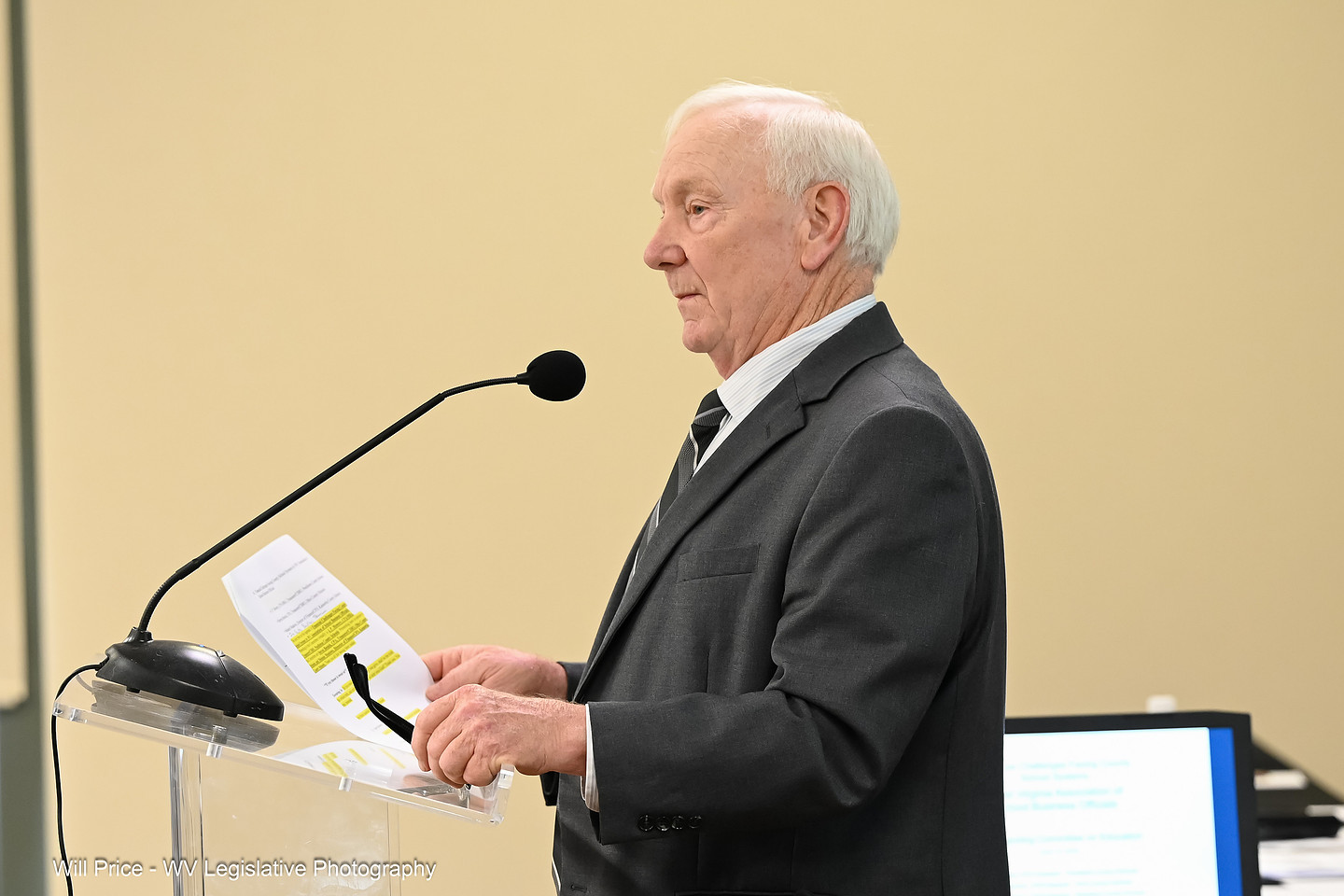
The Joint Education Committee met this morning to discuss financial challenges facing county school systems. Four treasures from county school boards presented the school aid formula. The school aid formula consists of the total allowances for professional educators, service personnel, fixed charges, transportation, professional student support personnel, current expenses, professional and service substitutes, faculty senate, improvements for instructional programs, technology, AP programs, and teacher and leader induction. Once the total allowance for these is calculated, a foundation is established, and then a local share is subtracted. The local share is each district’s regular levy tax collection. Adjustments are made for taxes not collected and payments in lieu of taxes. These are added to or subtracted from the base minus the local share.
The calculations include certified enrollment data as of October 1, a certified list of personnel as of October 1, transportation data from the previous year, WVEIS Financial Data, end-of-year average daily attendance, and end-of-year certified facility square footage data. The school aid formula is based on FTE enrollment, adjusted for certified adults, districts with fewer than 1,400 students, jointly established schools, and public charter schools.
The 55 boards of education are classified into four categories based on student population density. The classifications are sparse – less than 5 students per square mile, low – 5 to 9 students per square mile, medium – 10 to 19 students per square mile, and high – 20 or more students per square mile.
The allowance for professional educators is based on the following ratios per 1,000 students: sparse – 72.75; low – 72.60; medium – 72.45; and high – 72.30. The allowance for service personnel per 1,000 students is spares – 55.50, low – 54.92, medium – 54.35, and high – 53.79. The allowance for fixed charges, such as social security, unemployment, workers’ compensation, and retirement, is a percentage of the allowances for professional educators, service personnel, and student support personnel.
The allowance for student transportation includes current operations, maintenance, and contracted services, based on actual expenditures for the two years prior. Each district has an allowance for student support personnel based on a ratio of 5 positions per 1,000 students. There is a formula for the allowances for other current expenses. The allowance for substitutes is 2.5 percent for professional teachers, service personnel, and student support personnel. The faculty senate allowance is $400 per professional instructional support personnel and student support personnel employed.
Allowances for instructional programs are based on the prior year’s appropriation plus 10 percent growth in the local share, with a $150,000 base per district. For 21st-century technology, the allowance is based on the amount appropriated last year, plus 20% growth in the local share, with a base of $30,000 per county board. For advanced placement allowance, the formula is 1 percent of the state average per-pupil rate multiplied by the number of students enrolled in dual enrollment, AP, and international baccalaureate courses. The Teacher and Leader Induction allowance is last year’s appropriation plus 20 percent in local growth.
General areas of concern include the cost of student discipline, the lower socioeconomic population, special education needs, a benefit needed for teachers hired after July 1, 2015, inadequate service staff funding, personnel ratios are at 1990s levels, not current levels, funding is tied to enrollment, even though expenses do not decrease at the same rate as enrollment. Other concerns include the 1984 supplemental, which could be eliminated and rolled into the state’s basic table; the high cost of living in certain areas; the lack of an inflation factor in the formula; and the formula’s failure to include all professional employees. The BOE treasurers said the formula is not unreasonable; it’s just underfunded in some areas.
Small county concerns include population spread across large geographical areas, with student density as low as 1 student per square mile, unfunded positions, and technology and connectivity disparities. The 1990s ratios need updates, and exceptions are needed for lower within-reason ratios. The 1,400-student floor has helped smaller counties, but it is based on one county’s specific situation.
Mid-size county concerns include declining tax revenue, declining enrollment, and rising expenses. Ohio County Schools’ tax revenue is lower than in 2022. Additional special education funding is needed. The child nutrition expenses are growing. Enrollment in Ohio County has dropped by nearly 500 students since 2022. Decreased enrollment leads to decreases in funding and positions. Although Ohio County and other counties have found ways to fund above-FTE allocations. The BOE treasurer mentioned that some of the highest-performing schools do find ways to exceed the FTE allowance.
Large county concerns include high transportation and driver shortages, longer commute times, difficulty recruiting and retaining staff due to neighboring counties (or states) offering more competitive pay, additional and unfunded administrative needs, technology/connectivity disparities, declining enrollment over a large geographical area, making consolidation difficult, increasing special education expenditures, and facility needs. Declining enrollment has led to position cuts in Kanawha County, which has had an economic impact, as the BOE was one of the largest employers. Berkeley County has staffing ratio concerns, high special education expenditures, including out-of-state placements, and transportation issues. The county also recommends eliminating the 1984 supplemental.
